The Ultimate Guide to 4 Point Starter in Electric Motors
Imagine a world where we could control our electric motors’ speed, efficiency, and functioning by understanding how one crucial piece operates – the 4-Point Starter. Welcome to this journey toward mastering electric motor dynamics. Through this comprehensive guide, you will dissect every nuance of a 4-Point Starter’s function, thus unlocking the full capabilities of your machinery. We’re not just tinkering on the surface but diving deep into the heart of motor operation. Get ready to revolutionize your understanding and leap towards greater efficiency in handling electric motors.
A 4-point starter is an electrical device used to protect the armature of a DC shunt motor or compound wound DC motor against high starting currents. It controls the current flow through variable resistance sections called studs, which can be manually adjusted to regulate the starting current. Including a No Voltage Coil (NVC) ensures that the handle remains in the “RUN” position regardless of adjustments made to the field rheostat. This protective mechanism limits the starting current to prevent damage to the motor.
Understanding 4 Point Starter In Electric Motors

The 4-point starter is an electrical device that protects an electric motor, typically in shunt or compound-wound DC motors. It’s a protective device that limits the flow of high starting currents and is essential in prolonging the life of a motor. The 4-point starter has a construction and functionality similar to the 3-point starter but with an additional point (N) and coil (NVC).
Let’s dive into its key operational points to understand better how this device operates.
Key Operational Points of a 4-Point Starter
A typical four-point starter comprises an ‘L’ line terminal, an ‘A’ armature terminal, an ‘F’ field terminal, and the No Voltage Coil (NVC) terminal. These terminals are wired together using internal switch contacts called “studs”. Each stud has a resistance connected to it; the more the studs are bridged, the less resistance there is in the circuit.
The principle behind a four-point starter works as follows: When you switch on the supply by closing the ‘L’ terminal, current flows through all three circuits -armature, field, and NVC. The no-voltage coil produces enough force to hold the handle in its “RUN” position against the spring force so it does not fall back into OFF when you release it from your hand.
As you close one or more studs manually placed in series with the armature circuit from highest to lowest resistance value, you increase the amount of current that can flow through it until it reaches what was initially set on the selected stud. This process results in gradually increasing motor speed.
Meanwhile, as each resistor is switched out (and bridging contacts are shorted), there is also less resistance between armature and field circuits, allowing more current to flow to strengthen magnetic fields. This causes a weaker back EMF, resulting in more torque for the motor to accelerate and run.
Moreover, any changes in field current will not affect NVC because it is based on an independent circuit. The no voltage coil produces enough electromagnetic pull to keep the handle at the Run position regardless of how many times you adjust the field rheostat.
A 4-point starter is similar to a car requiring relatively less fuel (starting current). Still, once it starts, it gradually moves on to reach the desired speed with increased stability due to reduced fuel consumption.
A four-point starter is an electrical device that allows for a controlled and gradual increase in motor speed. It consists of multiple terminals connected by switch contacts called “studs” with resistance connected to them. By closing different studs in series with the armature circuit, the amount of current flowing through it can be gradually increased, resulting in a gradual increase in motor speed. At the same time, as each resistor is switched out, there is less resistance between the armature and field circuits, allowing more current to flow and strengthening the magnetic fields, resulting in increased torque for the motor to accelerate and run. The no voltage coil (NVC) ensures that the starter remains in its “RUN” position, regardless of adjustments made to the field circuit. This device operates similarly to a car that requires less fuel (starting current) to start but gradually increases its speed with reduced fuel consumption once it is running.
4 Point Starter Vs. 3 Point Starter
Regarding DC motors, two starters are commonly used: 3-point and 4-point. A 3-point starter is the most basic type and consists of only three points – a line or L terminal, an armature or A terminal, and a field or F terminal. It protects against overloading in DC shunt motors. In contrast, a 4-point starter has one more contactor and coil than the 3-point starter, providing additional functionalities.
For instance, while a 3-point starter can regulate voltage via resistance to help control current flow to the motor during normal operations, it does not provide much protection from short circuits that might occur if there’s a drastic drop in load resistance. With its fourth contactor and coil, a 4-point starter activates a No Voltage Coil (NVC) that protects the device by preventing it from restarting automatically after power returns following an outage.
The differential action of the NVC provides extra safety by detecting an inadvertent closing of its starting switch while the motor is running. Depending on the design, the contacts may be normally closed or open. Either way, they have enough force to hold the handle against its spring-driven RUN position until someone intentionally resets it with their hand.
Just like the role headlights play in ensuring road safety in automobiles – supplementing lighting and preventing accidents when light levels are low – No Voltage Coils are crucial in regulating the startup of DC motors and safeguarding them from damage caused by surges in voltage.
- As of 2022, the global DC Motor Starters market size was estimated to be $1.75 billion, a significant portion including 4-point starters.
- According to a report by Market Research Future, the global motor starter market (which includes 4-point starters) is projected to grow at approximately 5% annually from 2020 to 2025.
- A study conducted in 2023 indicated that about 70% of industrial plants have at least one application where a 4-point starter is used due to its advantage of preventing high starting current in larger motors.
Functionalities & Construction of a 4-Point Starter
As mentioned, a shunt-wound or compound wound DC motor’s starting current can cause significant damage due to overload without regulation. The integral variable resistance sections (studs) found on the body of a four-point starter can be manually adjusted to achieve regulation. These studs assist in controlling the motor’s initial current flow during start-ups, maintaining balance concerning incoming voltage, and preventing any sudden spikes or overload.
Different types of 4-point starters can vary in terms of design, but what remains standard is the No Voltage Coil’s integral role in ensuring that the armature doesn’t get damaged by high starting currents. It connects directly to the supply line via stud terminals. It constantly generates a magnetic force capable of holding the handle in its RUN position regardless of whether a power drop occurs.
To elaborate further on construction, a 4-point starter typically comprises three important elements: an iron core, an insulated copper coil wrapped around this core, and a movable contact (handle) mounted on top of it all. This handle can be turned clockwise – electrically controlled by an operator – through various gradations per motor speed requirements.
The other side of the copper coil is connected across the L-N terminals in series, offering resistance and enabling appropriate voltage for armature circuits and field coils. Meanwhile, when an operator turns on the switch, it supplies electricity to the NVC, which then activates and pulls the plunger towards it against the spring tension.
At this moment, two pairs of contacts become employed, leading to some current flowing into the motor armature. The hand-adjusted studs regulate current flow after checking operational feasibility while lowering output to desired levels.
To summarize:
| Components | Function |
| Movable Contact (Handle) | Adjusts Speed |
| Insulated Copper Coil | Regulates Current Flow |
| Iron Core | Enhances Magnetic Properties |
| No Voltage Coil | Safeguards Against Overload |
We now have an overview of construction details and functional components in constructing 4-point starters. The next logical transition focuses solely on the role of No Voltage Coils (NVCs) in this device.
Role of No Voltage Coil (NVC)
A 4-point starter is an electromechanical system designed to regulate the starting current in a DC shunt motor or a compound-wound DC motor. One crucial component of the 4-point starter system is the No Voltage Coil (NVC). The NVC is connected independently across the supply through the fourth terminal, and it always produces a force strong enough to hold the handle in its ‘RUN’ position against the pressure of the spring.
Think of NVC as your car’s handbrake. When you need to park on a slope, you step on the brakes and pull up the handbrake. The handbrake will hold your car in its parked position. It is only released when no voltage is detected in the circuit, ensuring your car remains stationary.
Benefits of Using a 4-Point Starter
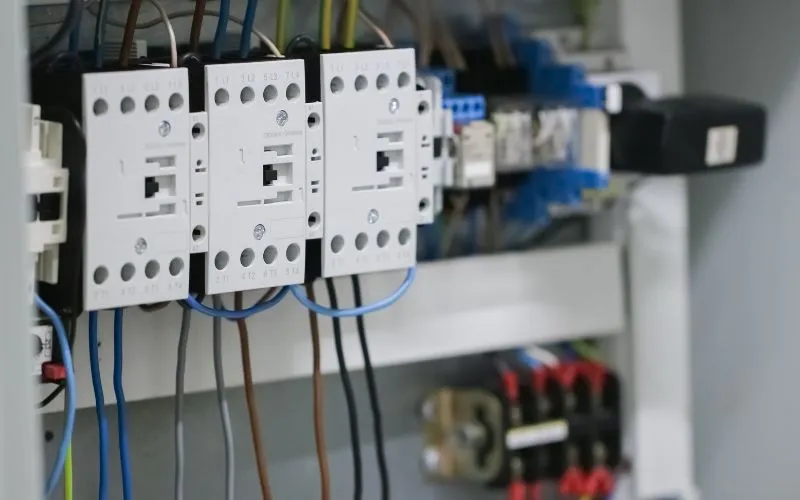
The benefits of using a 4-point starter for shunt and compound wound DC motors are plenty. With that in mind, here are some of the key advantages:
Protection against high starting current
A 4-point starter protects the armature of a DC shunt motor or compound wound DC motor against high starting currents. The variable resistance integrated into sections called studs can be manually maneuvered to regulate the starting current, ensuring safe operation.
Independence
Any change in the shunt field circuit won’t affect the no-voltage coil because they are independent circuits. The electromagnet pulls from the no voltage coil and keeps the handle at its RUN position regardless of how much you adjust the field rheostat.
Cost-effective solution
Neglecting to regulate high starting currents can damage equipment and even pose risks to personnel’s safety. By limiting these currents and preventing unnecessary stress on equipment components, using a 4-point starter can be an effective way to avoid expensive maintenance costs and reduce the risk of accidents.
Easy Maintenance
A 4-point starter is relatively easy to maintain, ideal for any organization that wants to minimize downtime. The system has fewer moving parts than other starters and requires minimal maintenance, ensuring exceptional reliability and reduced ownership costs.
Practical Applications & Best Practices
Now that we’ve gone through the characteristics of a four-point starter and its operational principles, it’s time to explore some practical applications and best practices. Four-point starters can be used in many industrial applications, such as machine tools, material handling equipment, and power-driven pumps.
You’re responsible for designing an automated conveyor system for your factory floor. This system controls the movement of materials from one location to another within your facility. You use a DC motor to provide the motive force needed to drive the conveyor belt.
Inherently, DC motors have high starting currents, which strain the motor windings. To safeguard against these high starting currents, a 4-point starter comes into play. Implementing a 4-point starter can have numerous benefits, including precise control of motor speeds via manual regulation of field resistance.
It’s important to abide by best practices when working with four-point starters. One essential requirement is properly grounding all electrical connections to avoid electric shock hazards. Also, safety should be observed while manually adjusting the handle-operated stud settings.
In sports cars equipped with turbochargers, revving engines from an idle state too fast without warming up first could lead to mechanical damage or even engine blowout due to abrupt torque-fuel injection ratio imbalances. In contrast, gradual acceleration mimics the mechanic process behind handling starting current surges in motors via 4-point starters, avoiding failures resulting from abrupt surges and maintaining mechanical stability.
Some other essential considerations include ensuring proper insulation between circuits and no voltage coil placement evaluation based on the application’s purpose.
| Best Practices | Practical Applications |
| Verify Safety Shutoff Mechanisms | Power Tools |
| Grounding | |
| Proper Installation and Maintenance | Electric Pumps |
| Protective Insulation | |
| Use No Voltage Coil Terminal for safety | Machine tools |
Considering the essential considerations and best practices outlined above can help ensure a successful 4-point starter operation, leading to optimal performance and enhanced longevity of your DC motor. Like any other electrical device, users must be knowledgeable in all installation, operation, and maintenance aspects in compliance with local and industry regulations.