Difference Between Single-Phase and Three-Phase Transformers
When you’re exploring the world of transformers, you’ll encounter the distinct differences between single-phase and three-phase models. Each serves a unique role in electrical systems, but what distinguishes them? It’s not just about the number of phases—there’s more beneath the surface. From design and construction to their applications and efficiency, understanding these differences can greatly impact your choice in residential or industrial settings. Curious about which transformer fits your needs?
Key Takeaways
- Single-phase transformers are simpler, featuring one primary and one secondary winding, and are suitable for lower power applications, such as residential use.
- Three-phase transformers have three winding sets, making them ideal for industrial settings, as they provide higher power capacity and efficient energy distribution.
- Three-phase transformers deliver higher voltages (around 415V) with balanced power, resulting in reduced current per phase compared to single-phase transformers.
- Single-phase transformers are initially cheaper, but three-phase transformers are more efficient and cost-effective over time due to their lower energy losses.
- Three-phase transformers require less maintenance, offer better durability, and handle larger loads efficiently compared to single-phase transformers.
Overview of Transformer Types

Transformers are essential components in electrical systems, and understanding their types helps in selecting the right one for your specific needs.
Single-phase transformers feature one primary and one secondary winding. They’re ideal for lower power applications, such as those in residential settings, and typically operate at 120V or 240V. This makes them perfect for everyday household power distribution.
In contrast, three-phase transformers contain three sets of windings, making them suitable for industrial or commercial use with higher power demands. These transformers manage voltages like 415V, supporting larger machinery and offering efficient power distribution.
Although more complex and costly initially, three-phase transformers offer enhanced efficiency and reliability, effectively handling both three-phase and single-phase loads with configurations such as Delta-Delta or Star-Delta.
Design and Construction Differences
When examining the design and construction of transformers, you’ll notice distinct differences between single-phase and three-phase models. Single-phase transformers are simpler, featuring a single pair of windings around a core, making them more compact and easier to handle.
In contrast, three-phase transformers have three sets of windings arranged in configurations like Delta or Wye, spaced 120 degrees apart. This design allows for balanced power distribution across three phases.
Here are some key points:
- Core Design: Single-phase uses core-type or shell-type; three-phase uses a three-section core.
- Winding Arrangement: Single-phase has one primary and secondary; three-phase includes three windings.
- Power Capacity: Single-phase handles lower loads, while three-phase accommodates higher power demands.
Voltage and Current Characteristics

When you compare single-phase and three-phase transformers, you’ll notice distinct differences in voltage transformation levels and current flow patterns.
Single-phase transformers operate with a single alternating voltage, typically providing 120V or 240V, while three-phase transformers deliver higher voltages, often around 415V, through three circuits.
This setup allows three-phase transformers to deliver power more efficiently and handle larger loads, making them better suited for industrial and commercial use.
Voltage Transformation Levels
A key distinction between single-phase and three-phase transformers lies in their voltage transformation levels, which significantly impact their applications and efficiency.
Single-phase transformers typically handle lower voltage levels, such as 120V and 240V. These are ideal for residential setups, where high-voltage demands aren’t necessary.
On the other hand, three-phase transformers operate at higher voltages, such as 415V, making them suitable for industrial settings. They supply three-phase power efficiently, supporting heavy machinery seamlessly.
Here’s why voltage transformation levels matter:
- Single-phase transformers are limited to lower voltage, requiring higher current for the same power.
- Three-phase transformers provide balanced power delivery across three conductors, reducing current per phase.
- Versatility in three-phase systems allows simultaneous support for both single-phase and three-phase loads.
Current Flow Patterns
Understanding voltage transformation levels sets the stage for examining current flow patterns in transformers.
In single-phase transformers, the current flows through one primary and one secondary winding, creating a single AC waveform. You’ll generally see this in residential settings, where voltages are typically 120V or 240V. The current flow pattern here is characterized by a single peak per cycle, limiting power capacity to under 10 kVA.
On the other hand, three-phase transformers feature three sets of windings, spaced 120 degrees apart from each other. This design yields three simultaneous AC waveforms, resulting in a balanced and steady power supply.
You’ll notice three peaks per cycle, enhancing power delivery. These transformers handle over 100 kVA, making them ideal for industrial use, with improved load distribution and system reliability.
Power Delivery Efficiency
Although both single-phase and three-phase transformers serve the purpose of voltage transformation, their power delivery efficiency markedly differs.
Single-phase transformers rely on two conductors, which can cause voltage and current fluctuations, resulting in less efficient power delivery. In contrast, three-phase transformers use three conductors, providing a balanced load and higher power capacity.
Here are some key points to evaluate:
- Power Capacity: Three-phase transformers can deliver about 170% more power than single-phase transformers at the same current level, making them ideal for industrial applications.
- Efficiency: Three-phase systems typically exceed 90% efficiency, whereas single-phase systems experience higher losses.
- Power Factor: The power factor in three-phase systems is generally better, resulting in reduced energy losses and enhanced efficiency.
Applications and Usage
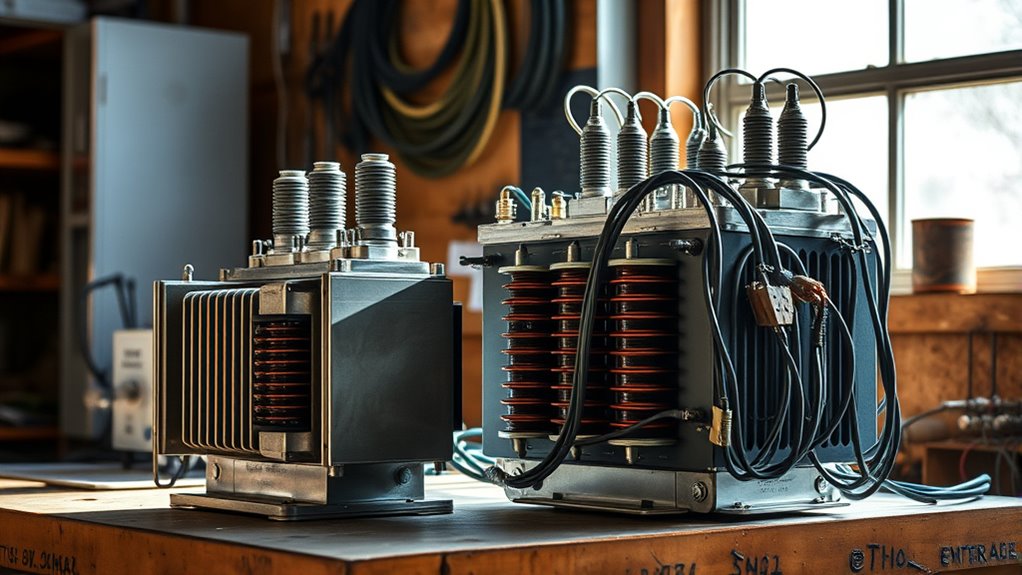
When choosing between single-phase and three-phase transformers, it’s crucial to evaluate their specific applications and usage contexts.
Single-phase transformers are ideal for residential applications, powering household appliances and lighting systems, and typically handling loads up to 10 kVA. They’re often mounted on utility poles to distribute electricity in neighborhoods.
On the other hand, three-phase transformers shine in industrial and commercial settings, efficiently supplying power to large machinery and equipment with demands exceeding 100 kVA. They’re commonly installed in substations, supporting operations such as HVAC systems and elevators due to their higher power-handling capacity.
Unlike single-phase transformers, three-phase models can support both single-phase and three-phase loads, offering versatility for various applications.
Choose based on your specific power needs.
Efficiency and Reliability
When considering efficiency and reliability, you’ll find that three-phase transformers offer significant advantages over single-phase options.
They provide greater power transmission stability, ensuring a consistent and balanced energy flow, which is essential for industrial applications.
Additionally, the long-term cost benefits of three-phase transformers make them a more economical choice due to their reduced energy losses and lower operational costs.
Power Transmission Stability
Power transmission stability greatly benefits from the use of three-phase transformers, which deliver superior efficiency and reliability compared to their single-phase counterparts.
By providing a more balanced load distribution, three-phase transformers enhance power transmission stability, reducing the risk of overloads and failures.
Here’s why they’re a game-changer:
- Higher Power Handling: They can manage approximately 170% more power than single-phase transformers, making them ideal for high-demand industrial settings.
- Reduced Losses: With a typically higher power factor, these systems experience fewer transmission losses, ensuring stable operation even under varying loads.
- Enhanced Reliability: Their design minimizes vulnerability to voltage fluctuations and faults, preventing full system shutdowns and maintaining a consistent power supply.
Incorporating these advantages leads to a more reliable and efficient power system.
Long-Term Cost Benefits
Building on the stability benefits of three-phase transformers, their long-term cost advantages, particularly in terms of efficiency and reliability, are also significant.
You’ll find that their operational efficiencies often exceed 95%, resulting in minimized energy losses. This efficiency leads to lower long-term energy costs, as three-phase systems deliver continuous power, unlike the pulsating delivery of single-phase systems.
Additionally, they handle larger loads without oversized conductors, resulting in savings on installation and material costs over time. The ability to run multiple three-phase transformers in parallel enhances load management and reduces operational costs, boosting reliability.
While the initial investment is higher, their durability guarantees lower maintenance costs. Ultimately, these factors provide a better return on investment compared to single-phase transformers, making them a wise choice for long-term savings.
Cost and Economic Considerations
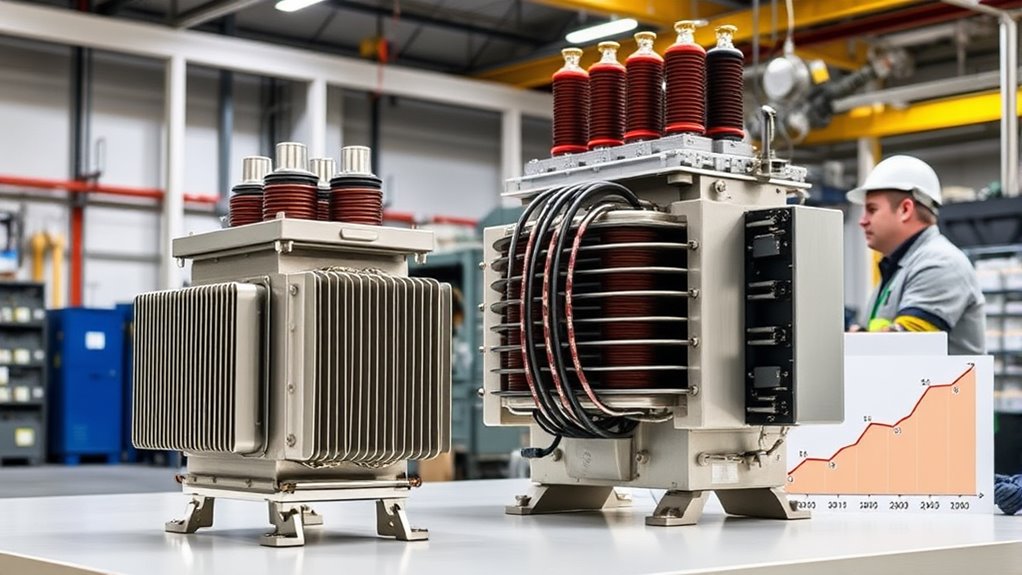
Although single-phase transformers are generally more affordable to purchase and install, they’re best suited for residential and small commercial settings.
For larger industrial applications, three-phase transformers offer several advantages despite their higher initial cost. They provide superior efficiency and power distribution, resulting in lower operating expenses over time.
Here’s why you might consider them:
- Cost Efficiency: Although more expensive upfront, three-phase transformers reduce energy losses and improve load balancing, resulting in long-term cost savings.
- Power Handling: They manage larger loads with fewer conductors, making them ideal for high-power distribution scenarios.
- Infrastructure Savings: Fewer units are required compared to single-phase, resulting in minimized installation and maintenance costs.
Conclusion
When choosing between single-phase and three-phase transformers, consider your specific power needs. Single-phase transformers are perfect for residential use, offering simplicity and lower upfront costs. However, if you’re dealing with higher power demands, three-phase transformers are your best bet. They provide greater efficiency, reliability, and better load management, which can lead to reduced operating costs over time. Ultimately, your decision should strike a balance between immediate budget constraints and long-term operational benefits. Choose wisely to optimize your energy solutions.
FAQs
1. What Is the Difference Between Single and Three-Phase Transformers?
You’ll find that single-phase transformers are simpler, smaller, and used for lower power needs, like in homes. Three-phase transformers handle higher power, offer more reliability, and are used in industrial settings. They continue operating even if one phase fails.
2. What Are the Advantages of 3 3-Phase Transformer Over a Single-Phase Transformer?
You’ll find three-phase transformers to be more efficient and space-saving, as they handle more power with smoother delivery. They lower operational costs, reduce voltage fluctuations, and simplify the installation process. Plus, they offer greater reliability and flexibility for high-demand applications.
3. Can a Single-Phase Transformer Be Used on a Three-Phase Source?
Yes, you can use a single-phase transformer on a three-phase source, but it only utilizes one phase, resulting in an imbalance. Be cautious of overloading and limited output voltage. For balanced loading, consider a three-phase transformer.
4. What Is the Main Difference Between Single-Phase and Three-Phase?
You’ll notice the primary distinction lies in the design and application. Single-phase transformers handle smaller loads, suitable for residential use, while three-phase transformers manage larger loads, ensuring efficiency and reliability in industrial and commercial settings.