Transformer Earthing: Types, Importance, and Safety Guidelines
When it comes to transformer earthing, you’re dealing with an essential safety measure that can’t be overlooked. By grounding the transformer, you protect against electrical hazards, ensuring both the safety of equipment and personal well-being. Understanding the various types of earthing systems and the regulations that govern them is crucial. But why is it so important, and what role does bonding play in this process? There’s more to explore in the world of transformer earthing.
Key Takeaways
- Transformer earthing ensures electrical safety by providing a safe path for fault currents to return to the earth.
- Solidly grounded systems offer low-impedance paths for fault currents, enhancing system reliability and safety.
- NEC compliance requires proper bonding and sizing of grounding electrodes for safety and performance.
- Grounding transformers, often with zigzag windings, manage fault currents and facilitate system monitoring.
- Regular maintenance and testing ensure grounding systems remain compliant and effectively handle fault currents.
Definition and Purpose of Transformer Earthing

Although often overlooked, transformer earthing is fundamental for electrical safety and system stability. By grounding the transformer neutral, you create a path for fault currents, guaranteeing they return safely to the earth. This method is critical for maintaining the stability of your electrical system and minimizing risks associated with overvoltages.
An earthing transformer protects against potential electrical hazards by reducing the likelihood of electrical shock to personnel and equipment damage.
It’s not just about safety; proper grounding enhances the reliability of electrical networks by guaranteeing fault currents have low-resistance pathways. Compliance with the National Electrical Code (NEC) ensures that all grounding electrodes are bonded and adequately sized, which is essential for safety.
This fundamental practice safeguards your system, preventing costly interruptions and damage.
Types of Transformer Earthing Systems
When evaluating transformer earthing systems, you’ll encounter two primary types: solidly grounded and ungrounded systems, each with distinct benefits for fault management.
Solidly grounded systems directly connect the neutral to the ground, enhancing fault current control and system reliability.
On the other hand, ungrounded systems don’t have a direct ground connection, offering flexibility but requiring careful management to prevent overvoltages.
Solidly Grounded Systems
In solidly grounded systems, the neutral point of a transformer is directly connected to the ground, guaranteeing that phase conductors remain at ground potential under normal conditions. This setup is essential for managing power efficiently.
By providing a low-impedance path for fault currents, solidly grounded systems allow ground fault currents to flow promptly, triggering protective devices quickly. This swift response is crucial for protecting equipment and minimizing damage.
You’ll find this grounding method particularly beneficial in industrial and commercial settings, where safety is of paramount importance. Importance: It helps stabilize system voltage during faults and minimizes transient overvoltages, enhancing reliability.
The National Electrical Code (NEC) even requires solidly grounded systems in certain installations to guarantee effective fault detection and reduce shock hazards.
Ungrounded Systems Approach
While solidly grounded systems focus on directly connecting the transformer’s neutral point to the earth, ungrounded systems take a different path by operating transformers without a direct link to the ground. This approach is common in three-phase networks, reducing the risk of equipment damage during temporary faults.
However, it can lead to transient overvoltages and instability during earth faults. To manage these issues, grounding transformers are employed to provide a neutral point for grounding. They allow for the detection and management of fault currents.
Additionally, implementing neutral grounding resistors (NERs) in ungrounded systems limits fault currents, boosting safety and protecting sensitive equipment. This method balances operational reliability with safety considerations in your electrical network.
Grounding Requirements and Regulations
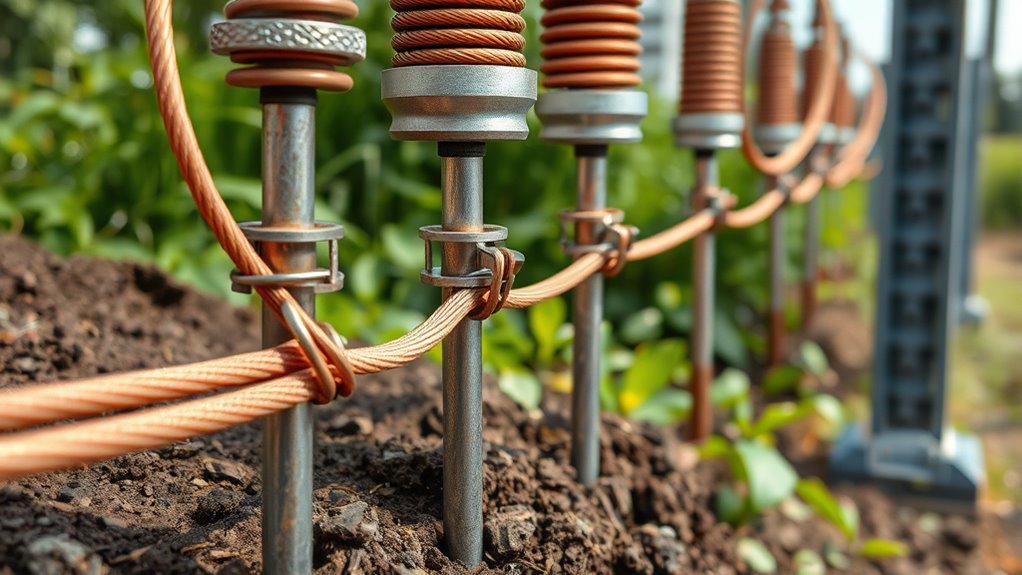
When working with transformers, understanding the National Electrical Code (NEC) grounding standards is essential for ensuring safety and compliance.
You’ll need to focus on bonding all metallic parts to prevent electric shock, as outlined by the NEC.
Regular checks and maintenance can help you maintain a safe and reliable grounding system.
NEC Grounding Standards
Navigating the complexities of electrical systems requires a solid understanding of the National Electrical Code (NEC) Grounding Standards, which serve as the foundation for ensuring safety and reliability.
When working with a grounding transformer, it’s vital to address ground faults effectively. The NEC outlines that an auxiliary transformer used in conjunction with primary systems must be grounded to guarantee safety and prevent the occurrence of electrical hazards.
Bonding jumpers play a crucial role in creating a low-resistance path for fault currents, thereby reducing the risk of electric shock.
The NEC emphasizes the importance of a grounding electrode system, requiring all grounding electrodes of a structure to be bonded together.
Additionally, grounding electrode conductors must be sized correctly to handle potential fault currents, guaranteeing they perform safely and efficiently.
Regular inspections maintain effectiveness.
Bonding and Safety
Understanding the intricacies of bonding and safety is essential for guaranteeing the electrical systems you’re working with are both reliable and secure.
The National Electrical Code (NEC) governs grounding practices, requiring that grounding electrode systems bond all grounding electrodes at each structure. This guarantees safe electrical installations by effectively managing fault currents.
Properly sizing the grounding electrode conductor is vital to avoid overheating and potential hazards. Article 250.30 of the NEC highlights the necessity of a reliable connection between the neutral point and the grounding electrode system for separately derived systems.
Verify all metallic parts of electrical equipment are bonded to prevent electric shock hazards. Regular maintenance of these systems boosts safety and guarantees compliance with NEC regulations.
Role of Bonding in Transformer Earthing
In the domain of transformer earthing, bonding plays a crucial role in ensuring electrical safety and system reliability. Proper bonding ensures secure connections between the transformer’s neutral, ground, and conductors, thereby minimizing potential differences and reducing the risk of electric shock. It provides low-resistance paths for fault current, which is vital for the effective operation of protective devices. This maintains system reliability by allowing these devices to function correctly during electrical faults.
Additionally, bonding equalizes voltages across metal components, thereby reducing electromagnetic interference and enhancing the performance of protective relaying equipment. According to the National Electrical Code (NEC), bonding all metal parts is mandatory to prevent electric shock hazards.
Effective techniques, like using system bonding jumpers, not only comply with NEC regulations but also enhance overall system performance.
Functions and Applications of Grounding Transformers
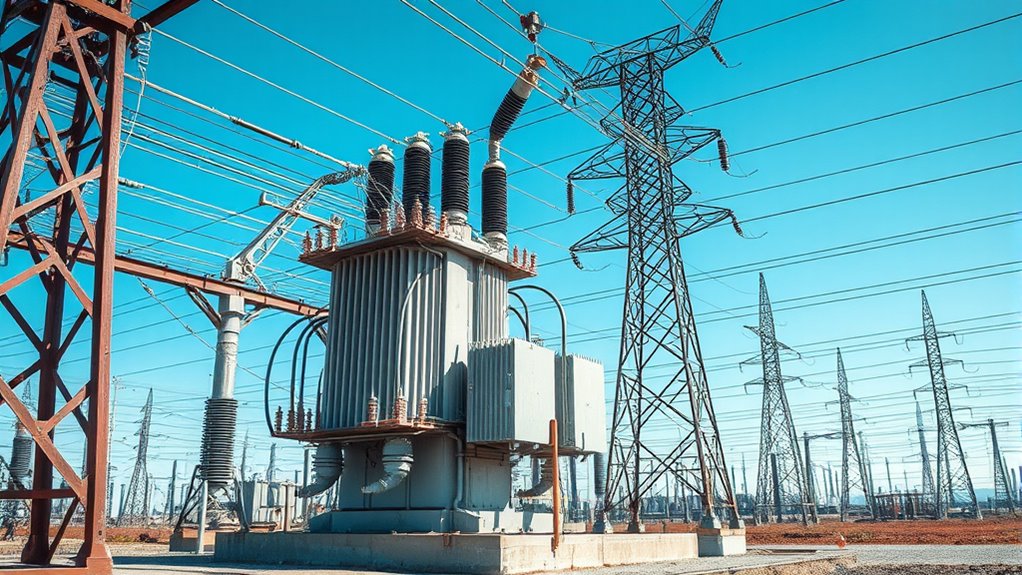
Although often overlooked, grounding transformers play an essential role in enhancing system stability and safety in power systems. They provide a low-impedance path to ground, vital during line-to-ground faults. In high-voltage sub-transmission systems and generators, grounding transformers facilitate the smooth connection of phase-to-neutral loads.
Typically designed with a zigzag winding configuration, they establish a neutral point, improving safety and reliability in ungrounded wye or delta systems. These transformers help absorb fault currents, dissipating them as heat through neutral grounding resistors, which protect equipment from thermal damage.
They also enable continuous system monitoring through relay protection with current transformers, maintaining operational integrity. By grounding transformers, downtime is reduced, ensuring consistent performance.
Behavior of Fault Currents in Earthing Transformers
When dealing with fault currents in earthing transformers, it’s crucial to recognize how these currents behave during an earth fault. In zigzag-connected transformers, an artificial neutral point stabilizes the system by canceling ampere turns. This design effectively manages fault currents, especially during a single-line-to-ground fault.
Here’s how it works:
- Equal Division: Fault currents divide equally among the three phases.
- Opposite Directions: Currents in winding halves that flow in opposite directions cancel out the magnetic flux.
- Voltage Reduction: The voltage across the winding drops to approximately 1/√3 of the rated per-phase voltage.
- Safe Operation: Transformers handle maximum fault current for a set duration, ensuring effective grounding.
This configuration prevents a choking effect, maintaining system stability under fault conditions.
Importance of Regular Maintenance for Earthing Systems
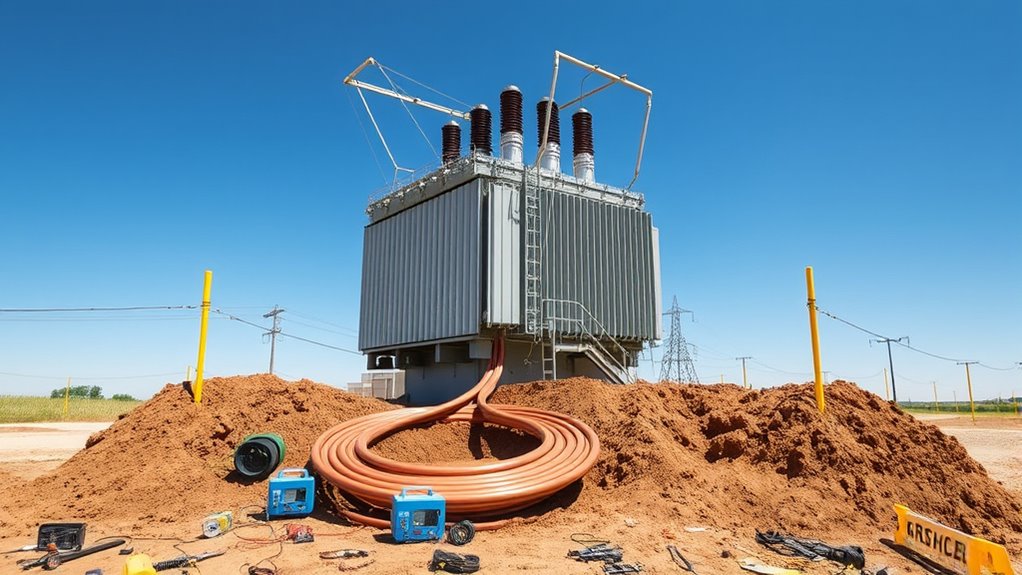
Although earthing systems are often out of sight, regular maintenance is essential for ensuring electrical safety and reliability. Regular maintenance ensures that grounding conductors and connections remain secure and corrosion-free, which is crucial for handling fault currents. Inspections should be conducted annually to verify the integrity of grounding electrodes and confirm compliance with regulations, such as the National Electrical Code (NEC). Testing for resistance values below 5 ohms is critical to maintain low impedance paths.
| Task | Objective |
|---|---|
| Inspect connections | Confirm integrity and compliance |
| Test resistance | Verify low impedance paths |
| Document activities | Assist in audits and troubleshooting |
| Rectify issues | Prevent electrical hazards |
Conclusion
In transformer earthing, you guarantee electrical safety by providing a reliable path for fault currents to return to the ground. To ensure effective grounding and bonding, it is essential to understand various earthing systems and adhere to relevant regulations, such as the National Electrical Code (NEC). Regular maintenance is crucial for keeping the system functioning properly, thereby reducing the risk of shock and equipment damage. By focusing on these aspects, you enhance the reliability and stability of your electrical network, minimizing electromagnetic interference.
FAQs
1. Which Earthing Is Used in Transformers?
You choose the earthing type based on system voltage, reliability, and safety needs. Solidly grounded offers fault current pathways, resistance-grounded limits fault current, and ungrounded manages capacitive currents. Each type guarantees peak transformer performance and safety.
2. Do Transformers Need to Be Earthed?
You’re wondering if transformers need earthing. They do. Earthing provides a safe path for fault currents, protecting both equipment and personnel. It guarantees system stability and prevents electrical shocks, making it essential for safety and reliability.
3. What Does an Earthing Transformer Do?
You rely on earthing transformers to provide a grounding path, stabilizing systems during faults. They limit overvoltages, enhance relay reliability, and support diverse equipment connections by establishing a neutral. Their design guarantees safety and system stability.
4. How Should Transformers Be Grounded?
You should ground transformers by ensuring a low-impedance path for fault currents, typically through a zigzag winding grounding transformer. Comply with NEC guidelines, use Neutral Earthing Resistors, and maintain systems regularly to enhance safety and system reliability.