Working Principle of Photovoltaic Cells | How Solar Cells Work
You’ve probably heard about solar panels, but do you know how they work? At the heart of these panels are photovoltaic cells, which convert sunlight into electricity through a fascinating process called the photovoltaic effect. It involves semiconductor materials, mainly silicon, and the creation of charge carriers. But how exactly does this conversion happen, and what makes it so efficient? There’s a mesmerizing science behind it that you won’t want to miss.
Definition of Photovoltaic Cells
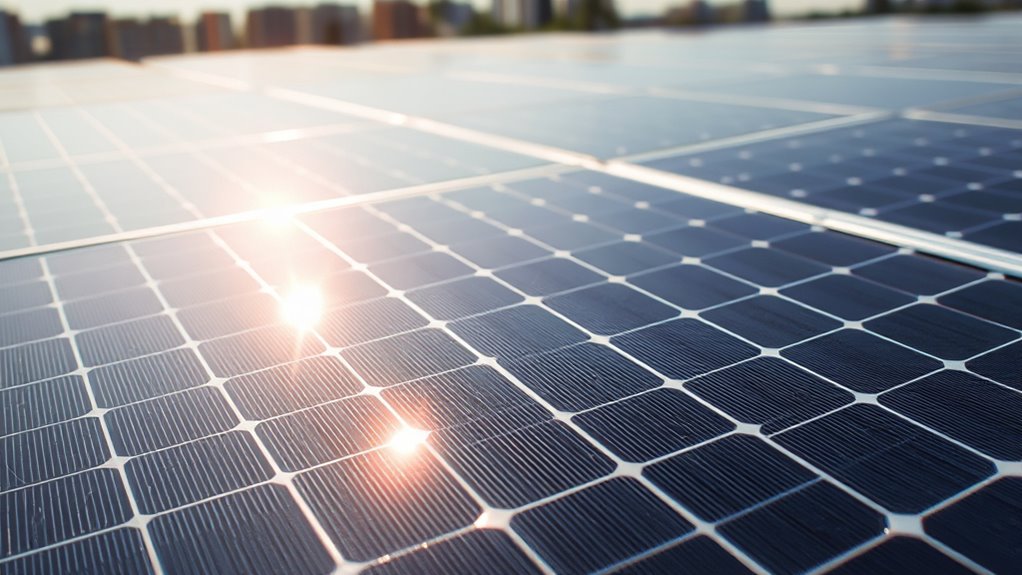
Photovoltaic cells, often known as solar cells, are electronic devices that transform sunlight into electricity through the photovoltaic effect. You harness solar energy by using these cells, which rely on semiconductor materials to convert light into electrical energy. The core of each photovoltaic cell features a P-N junction—this is where the magic happens. When sunlight hits the cell, photons energize electrons in the semiconductor material, causing them to move. This movement creates a flow of charge carriers across the P-N junction, generating current. Fundamentally, the photovoltaic effect allows you to turn light into electricity efficiently. Utilizing these cells can produce direct current (DC), which can power anything from residential homes to portable electronics.
Structure and Construction of Photovoltaic Cells
Understanding how photovoltaic cells convert sunlight into electricity naturally leads us to explore their structure and construction. Photovoltaic cells primarily use semiconductor materials, with silicon being the most common due to its stability and efficiency. The core of these cells is the PN junction, formed by doping silicon to create P-type (with holes) and N-type (with excess electrons) layers, facilitating charge separation. An anti-reflection coating is applied to maximize solar energy absorption by minimizing light reflection. The top contact, a transparent conductive layer, allows light to penetrate while permitting current flow. Meanwhile, the back contact gathers electrons to complete the electrical circuit. A back surface field layer is included to enhance charge collection and efficiency by reducing recombination losses.
Working Principle of Photovoltaic Cells

When you look at how photovoltaic cells work, it all starts with the light absorption, where photons energize electrons in the semiconductor. This energizing effect causes charge carrier separation, with electrons and holes moving in opposite directions due to the internal electric field at the P-N junction. As a result, the movement of these charge carriers generates a direct current that can be harnessed for electrical power.
Light Absorption Process
As light photons hit the surface of a photovoltaic cell, they set off an essential process that energizes electrons within the cell’s semiconductor material. This light energy is absorbed by the semiconductor layer, typically silicon, which is significant for the photovoltaic effect. When the solar energy exceeds the semiconductor’s band gap, it liberates electrons, forming electron-hole pairs. These energized electrons and holes move toward the n-type and p-type layers, across the P-N junction. This movement underpins the energy conversion efficiency of the cell. The light absorption process is a key factor in determining the cell’s overall efficiency, generally ranging from 15% to 25%, as it dictates how effectively solar energy is harnessed and converted into electricity.
Charge Carrier Separation
Charge carrier separation in photovoltaic cells is a fundamental step in converting sunlight into electricity. Photons that strike the semiconductor energize electrons, creating electron-hole pairs at the P-N junction. The built-in electric field directs electrons to the n-type layer and holes to the p-type layer, allowing efficient charge carrier separation. This process is essential for the photovoltaic efficiency of solar cells, as it influences the electric current generated. The difference in doping levels creates this internal electric field, enhancing mobility and boosting overall efficiency.
Here’s a simple depiction:
| Component | Role in Separation | Impact on Efficiency |
|---|---|---|
| P-N Junction | Directs electrons and holes | Critical for efficiency |
| Electric Field | Enhances mobility | Increases output power |
| Semiconductor | Creates electron-hole pairs | Fundamental for current flow |
This separation is important for generating ideal power from solar cells.
Current Generation Mechanism
Harnessing the power of sunlight, photovoltaic cells generate electricity through a fascinating process known as the photovoltaic effect. Incoming photons energize electrons in semiconductor materials, creating electron-hole pairs. At the core, the P-N junction forms an internal electric field, driving electrons towards the N-type layer and holes towards the P-type layer. This movement establishes a current flow, where electrons migrate through the external circuit, while holes move in the opposite direction, resulting in a direct current (DC) output.
- The efficiency of solar energy conversion is closely tied to the intensity of sunlight.
- The P-N junction is essential for directing electron-hole pair movement.
- Real-world conditions influence the efficiency of photovoltaic cells, typically operating between 15% and 25%.
Maximize solar exposure for peak electricity production.
Types of Photovoltaic Cells
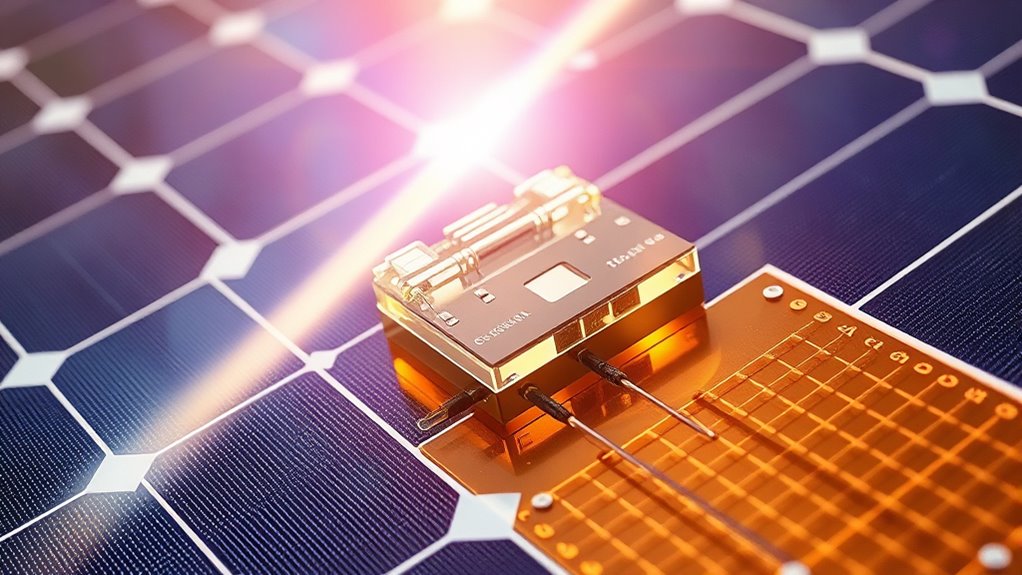
When exploring the types of photovoltaic cells, you’ll encounter several variations, each with distinct features and efficiencies. Monocrystalline silicon solar cells are highly efficient, ranging from 17% to 23%, but they’re pricier due to their single crystal structure. Polycrystalline silicon cells, made from multiple crystals, offer a more cost-effective solution with 14% and 18 efficiencies. Thin-film solar cells, made from materials like cadmium telluride, are known for their flexibility and lighter weight, though they typically have efficiencies between 10% and 14%. Multijunction solar cells stack layers to capture more sunlight, achieving efficiencies beyond 50%. Emerging photovoltaic technologies such as perovskite solar cells promise efficiencies up to 23.7%, with the potential for lower-cost production.
Characteristics and Efficiency of Photovoltaic Cells
When you explore the characteristics and efficiency of photovoltaic cells, focus on key performance metrics like efficiency, Open-Circuit Voltage, and Short-Circuit Current. Understanding these metrics helps you gauge how well a photovoltaic cell converts sunlight into electrical energy. By optimizing factors like the Fill Factor and temperature coefficient, you can enhance energy conversion and maximize the cell’s performance.
Performance Metrics Overview
Photovoltaic cells, essential components of solar energy systems, are evaluated based on several key performance metrics that determine their effectiveness and efficiency. The efficiency of these cells, typically ranging from 15% to 25%, is vital. It’s dependent on the sunlight intensity, semiconductor materials, and temperature conditions. The open-circuit voltage (Voc) and short-circuit current (Isc) provide insights into the cell’s potential power output. A higher fill factor indicates a more efficient cell.
- Open-Circuit Voltage (Voc): Maximum voltage without a load.
- Short-Circuit Current (Isc): Maximum current with shorted terminals.
- Fill Factor (FF): Ratio reflecting cell quality and efficiency.
The temperature coefficient also plays a role, as it shows how temperature variations impact efficiency, making it a significant performance metric to consider.
Enhancing Energy Conversion
Understanding the performance metrics of photovoltaic cells gives you a solid foundation for enhancing their energy conversion capabilities. Photovoltaic (PV) cells typically achieve an efficiency of 15% to 25%, converting solar energy into electrical power. By optimizing factors like open-circuit voltage and short-circuit current, the current to flow can be maximized. The fill factor (FF) is essential, indicating how effectively a PV cell converts solar radiation into usable power. Temperature coefficients also play a role, as higher temperatures can decrease efficiency.
| Characteristic | Description |
|---|---|
| Efficiency | 15% to 25%, converting solar to electrical energy |
| Open-Circuit Voltage | Maximum voltage without load |
| Short-Circuit Current | Maximum current with terminals shorted |
| Fill Factor (FF) | Ratio of max power output to Voc and Isc product |
Balancing these factors guarantees efficient solar energy conversion.
Applications of Photovoltaic Cells

Even as the demand for sustainable energy solutions grows, photovoltaic cells play a pivotal role in various applications. When you use solar panels on your rooftop, you’re harnessing energy from the Sun to generate electricity, reducing your reliance on grid power and cutting down on bills. In solar power plants, photovoltaic cells deliver high efficiency and contribute notably to large-scale renewable energy production, with some facilities powering thousands of homes.
These PV technologies extend beyond just large installations:
- Solar water pumping systems: Provide sustainable irrigation and drinking water in remote areas.
- Portable electronics: Power devices like solar chargers for smartphones and laptops.
- Automotive innovations: Enable solar-powered cars and bicycles, promoting cleaner transportation.
Embrace these technologies to lead a more sustainable lifestyle.
Advantages and Disadvantages of Photovoltaic Cells
While photovoltaic cells offer significant advantages, they also come with certain limitations. One major advantage is their ability to generate clean energy, reducing greenhouse gas emissions and air pollution. You’ll find that, over time, they have low maintenance costs, making them economically viable despite high initial installation expenses. They’re versatile and capable of operating in varied geographic locations with adequate sunlight, serving residential and commercial needs.
However, there are notable disadvantages. The lack of infrastructure can limit scalability, hindering widespread adoption. Photovoltaic cells aren’t ideal for high electricity demands and face challenges with energy transmission over long distances. These limitations can restrict their effectiveness in certain applications, particularly in areas needing substantial energy output or where sunlight is inconsistent.
Conclusion
You’ve now seen how photovoltaic cells work, converting sunlight into electricity through the photovoltaic effect using semiconductor materials like silicon. These cells are integral to harnessing solar energy with a typical 15% to 25% efficiency. You understand their structure, the role of the P-N junction, and the different types available. While there are pros and cons to consider, the applications of photovoltaic cells continue to grow, playing a vital role in sustainable energy solutions.
FAQs
1. What Is the Working Principle of Photovoltaics?
Photovoltaic cells convert sunlight into electricity through the photovoltaic effect. Light photons hit semiconductor materials, generating electron-hole pairs. An internal electric field directs electrons, creating a flow of direct current for power.
2. How Does a Photovoltaic Cell Work Step by Step?
You start by absorbing sunlight, energizing electrons. Electrons move to the n-type layer, and holes go to the p-type layer. This creates a current, which is collected by metal contacts. Efficiency varies with silicon quality, temperature, and sunlight intensity.
3. What Is the Difference Between a Solar Cell and a Photovoltaic Cell?
You might think solar and photovoltaic cells are the same, but they are not. Solar cells convert sunlight to energy broadly, while photovoltaic cells specifically turn sunlight into electricity using the photovoltaic effect. It’s an essential distinction.
4. How does a photovoltaic cell work?
Photovoltaic cells convert sunlight into electricity. When sunlight hits the cell, it energizes electrons, creating a flow of electric current. This process depends on the intensity of the sunlight and the semiconductor material’s properties.