What Is Slew Rate of Op-Amp: Definition and Importance
When you think about the performance of an operational amplifier (op-amp), the term ‘slew rate’ might not be the first thing that comes to mind, but it’s vital. The slew rate defines how quickly the op-amp‘s output can change in response to a varying input signal, typically measured in volts per microsecond (V/µs). This characteristic is essential for high-frequency applications where rapid voltage changes are necessary to maintain signal integrity. So, what’s the significance of slew rate in your designs, and how does it impact the overall performance of your circuits?
Key Takeaways
- The slew rate is the maximum rate of change of an op-amp’s output voltage, measured in volts per microsecond (V/µs).
- It determines an op-amp’s ability to handle rapid voltage changes without distortion.
- Higher slew rates allow for better performance in high-frequency applications.
- The slew rate is measured by the output voltage change from 10% to 90% of a step input signal.
- Finite slew rates in real op-amps can impact signal quality and frequency response.
Understanding Slew Rate

Imagine you’re listening to your favorite song on a high-quality audio system. The clarity and fidelity of the music can be attributed to various technical elements, one of which is the Op-Amp Slew Rate. The slew rate is the maximum rate of change of an op-amp’s output voltage per unit time. It’s an important factor in determining how quickly an op-amp can respond to changes in the input signal.
A higher slew rate indicates that the op-amp can handle higher frequencies without distortion when considering Rate vs. Frequency. This quality is crucial for applications requiring precise and rapid signal reproduction, such as high-fidelity audio systems or fast data communication devices. The slew rate is typically measured by observing the output voltage change from 10% to 90% of a step input signal’s amplitude.
Several factors cause slew, primarily related to the internal capacitance and current-limiting characteristics of the op-amp. If an op-amp has a low slew rate, it may struggle to keep up with fast input changes, leading to signal distortion and loss of fidelity.
Therefore, understanding and optimizing the slew rate is key to ensuring high performance and accurate signal processing.
Ideal vs. Real Op-Amps
When understanding op-amps, distinguishing between ideal and real op-amps is essential. Ideal op-amps are theoretical models with infinite open-loop gain, zero output impedance, and perfect performance. However, real op-amps, which you’ll encounter in practical applications, exhibit various nonidealities.
Here’s why this distinction matters:
- Slew Rate: In real op-amps, the slew rate measures how quickly the output voltage can change. Unlike ideal op-amps, real ones have a finite slew rate, impacting high-frequency performance.
- Input and Output Impedance: Ideal op-amps assume zero output impedance and infinite input impedance, but real op-amps have finite values, affecting circuit behavior.
- Current Flow: Real op-amps allow current to flow in and out of input terminals, unlike the ideal model where no current flows.
Understanding these differences helps you analyze and design op-amp circuits more effectively. Real op-amps have limitations like finite open-loop gain and non-zero output impedance, which you must factor into your designs. By recognizing how these nonidealities affect performance, particularly the slew rate, you’ll be better equipped to choose the right op-amp for your needs.
Definition of Slew Rate

When discussing the slew rate, you’re looking at the maximum speed at which an op-amp‘s output voltage can change, measured in volts per microsecond (V/µs).
This rate of change is important because it determines how quickly the op-amp can shift in response to input signals.
A higher rate of change means the op-amp can handle rapid voltage shifts without distorting the signal.
Rate of Change
Understanding the concept of slew rate is [VITAL] for anyone working with operational amplifiers (op-amps). Slew rate refers to the maximum rate of change of an op-amp’s output voltage per unit time, typically measured in volts per microsecond (V/µs). This parameter indicates how quickly the op-amp can respond to changes in the input signal, which is [ESSENTIAL] for maintaining signal integrity in high-speed applications.
- Precision: [GUARANTEES] accurate signal reproduction without distortion.
- Performance: Determines the op-amp’s ability to handle high-frequency signals.
- Application Suitability: Guides in selecting the right op-amp for your specific needs.
A higher slew rate allows the op-amp to respond more rapidly to input changes, [THUS] [ENSURING] that the output voltage can keep up with fast variations in the input signal.
However, if the required rate of change exceeds the op-amp’s slew rate, the output signal will be distorted, leading to inaccuracies and performance issues.
[THUS], understanding the slew rate is [VITAL] when designing circuits that demand high-speed performance, as it directly impacts the op-amp’s frequency response and overall functionality.
Consider the slew rate specifications to [ENSURE] your op-amp can handle your application’s frequency requirements.
Voltage Transition Speed**
At its core, the voltage alteration speed, known as the slew rate, defines how fast an op-amp’s output voltage can change in response to an input signal. In simple terms, the slew rate is the maximum rate at which the output voltage of an op-amp can alter per unit of time. This is measured in volts per microsecond (V/us) and is critical for determining the op-amp’s ability to respond to fast input voltage adjustments.
When dealing with high-speed applications, you need an op-amp with a high slew rate to guarantee that the output voltage changes smoothly and rapidly. If the alteration rate isn’t high enough, the output voltage won’t keep up with the rapid changes in the input signal, leading to distortion.
This can notably impact the performance and fidelity of your circuit, especially in audio and high-frequency applications.
Different op-amps have varying slew rate specifications, so choosing one that matches your needs is vital. Higher slew rates are crucial for applications requiring rapid and undistorted output voltage adjustments.
Causes of Slew Rate
The slew rate in op-amps arises from several intrinsic factors that affect how quickly the output can respond to changes at the input. One primary cause is the delay in response from the high-gain differential input. When you apply a signal to the op-amp, the internal circuitry needs time to process this change, especially if the frequency response is high. This delay becomes evident, particularly in negative feedback configurations where the op-amp struggles to keep up with large differential voltages.
Several other key factors also contribute to the causes of slew rate:
- Compensation Capacitance: The internal compensation capacitance of an op-amp directly impacts how fast the output can change. Larger capacitances slow down the slew rate.
- Current Flow: The rate at which current flows through the input terminals influences the slew rate. Limited current flow means a slower response time.
- Internal Construction: The design and materials used in the op-amp’s internal construction, including open-loop gain limitations, play a significant role. Poor design can result in slower slew rates.
Understanding these factors helps you grasp why an op-amp mightn’t always respond immediately to input changes, which is important for designing precise and efficient circuits.
Impact on Signal Quality
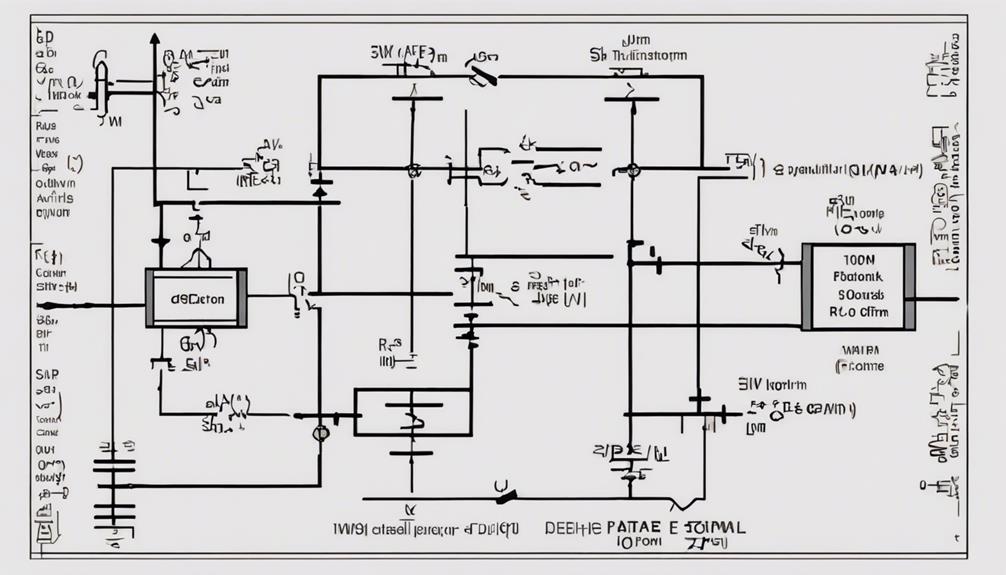
You must understand that an op-amp’s op-amp’s slew rate directly impacts signal quality, especially at high frequencies. If the slew rate limit is exceeded, the output waveform gets distorted, which compromises signal fidelity. Accurately managing the slew rate is essential for maintaining the integrity of high-frequency signals in your applications.
Distortion at High Frequencies
One essential issue to watch out for in high-frequency applications is signal distortion caused by exceeding an op-amp’s slew rate. When working with high frequencies, the op-amp’s output mightn’t keep up with the rapid changes in the input signal, leading to waveform distortion. This happens because the op-amp can’t slew fast enough to follow the high-frequency input, negatively impacting the signal quality.
Consider these key points to understand the implications:
- Distortion: When the slew rate is surpassed, the output signal becomes distorted, deviating from the intended waveform.
- High Frequencies: At higher frequencies, the risk of exceeding the slew rate increases, making choosing an op-amp with an adequate slew rate vital.
- Signal Quality: Maintaining signal quality in high-frequency applications requires careful management of the op-amp’s slew rate to prevent distortion.
Understanding and managing the slew rate is fundamental to guaranteeing the fidelity of your output signal. You might encounter significant signal integrity issues if the slew rate limitations aren’t addressed. By selecting the appropriate op-amp and considering its slew rate, you can mitigate distortion and maintain high signal quality in your high-frequency designs.
Signal Fidelity Considerations
To ensure high signal fidelity in your designs, it’s important to consider the impact of the op-amp’s slew rate on signal quality. The slew rate determines how quickly an op-amp can respond to changes in input voltage. If the slew rate is inadequate, the op-amp can’t accurately track these changes, leading to signal distortion and inaccuracies in the output waveform.
Slew rate limitations particularly impact high-frequency applications. In these scenarios, a high slew rate is essential to maintaining signal fidelity. Without it, the op-amp might struggle to keep up with rapid input signal variations, resulting in compromised signal integrity.
Understanding the slew rate is crucial for selecting the right op-amp, especially in applications with high signal fidelity, which impacts the response time of an op-amp. A slow response can smear the output signal, degrading its quality. By ensuring the op-amp has an adequate slew rate, you can achieve cleaner, more accurate signal reproduction.
This is pivotal for any design requiring precise signal fidelity, especially in high-frequency domains where every detail counts.
Slew Rate Measurement
Understanding the nuances of rate of change measurement is crucial for evaluating an op-amp’s performance. To accurately assess this, you typically observe the output change from 10% to 90% of a step input signal’s magnitude. This measurement is often done using a 1 V step signal, and essential tools like an oscilloscope and function generator are indispensable.
Here’s what you’ll need to focus on for a precise measurement:
- Tools Required: Oscilloscope, function generator, and the specific op-amp circuit.
- Procedure: Apply a 1 V step signal and monitor the op-amp’s output voltage waveform.
- Key Metrics: Measure the time the output changes from 10% to 90% of the input signal’s magnitude.
The rate of change measurement directly impacts the op-amp’s high-frequency response. The faster the rate of change, the better the op-amp can handle rapid changes without distortion. Knowing the rate vs. frequency response helps you understand the op-amp’s capacity to drive complex signals efficiently.
Accurate measurement ensures that the op-amp meets the necessary specifications for your application, especially when dealing with high-speed or high-frequency signals. By mastering this, you guarantee your circuits perform optimally under varying conditions.
Slew Rate Formula
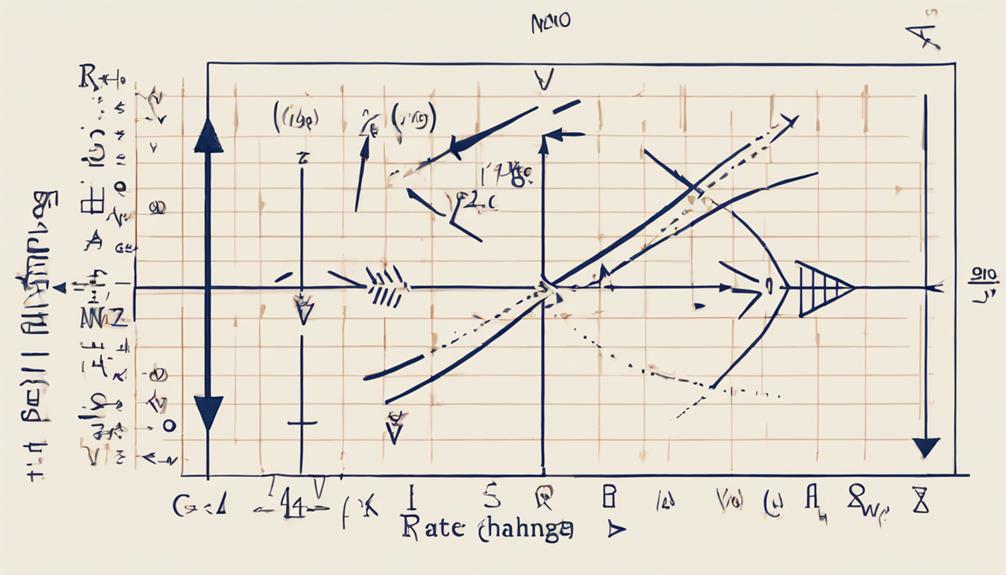
The slew speed equation, ( S = 2pi f V_m ), is vital for understanding an op-amp’s performance, especially in high-frequency applications. By using this Speed Equation, you can determine the maximum pace at which the output voltage of an amplifier changes per unit time. This is particularly significant for high-power amplifiers, as it guarantees that the output voltage can change rapidly to follow the input signal’s variations.
When you utilize the slew speed equation, simply input your signal’s signal’s frequency (f) and peak voltage (V_m). This calculation quantitatively measures the op-amp’s ability to respond to input changes swiftly. Selecting the right op-amp for applications that demand specific frequency response characteristics is crucial.
For instance, a higher slew speed in audio and communication systems ensures that the amplifier can handle fast signal shifts without distortion. Understanding and applying the slew speed equation helps you guarantee that your circuits perform optimally, especially when operating at high frequencies.
Slew Rate vs. Bandwidth
When comparing slew rate and bandwidth, you’ll see how they jointly influence an op-amp’s performance, particularly regarding settling time and distortion. If the slew rate isn’t sufficient, high frequencies can lead to severe signal distortion, impacting the amplifier’s high-frequency response.
For instance, the OPA333AIDBVT op-amp has a gain bandwidth of 250 kHz, but its performance at these frequencies depends heavily on its slew rate.
Distortion Due to Slewing
In operational amplifiers, the interplay between slew speed and frequency range can make or break your circuit’s performance. When the slew speed is inadequate for your signal’s requirements, you face a significant risk of distortion. This is particularly evident with high-frequency signals, where the op-amp can’t keep up with the rapid changes in voltage, leading to waveform distortion.
- Distortion: Exceeding the slew speed results in an output that fails to replicate the input accurately, introducing unwanted artifacts.
- High-Frequency Signals: Fast signals demand a high slew speed; otherwise, the op-amp can’t respond quickly enough, causing signal degradation.
- Bandwidth: Although the frequency range specifies the maximum frequency the op-amp can handle, it works with the slew speed to maintain signal integrity.
Understanding this relationship is important to design circuits that minimize distortion. The slew speed governs how quickly the output can change, directly impacting how well the op-amp can handle high-frequency signals.
The op-amp will struggle if the slew speed is too low for the given frequency range, resulting in poor performance and distorted outputs. Therefore, ensuring your op-amp has an adequate slew speed for its frequency range is essential for maintaining signal fidelity.
Frequency Response Impact**
To maintain signal accuracy and avoid distortion, you must understand the interplay between an op-amp’s slew rate and bandwidth. These two factors work together to determine the op-amp circuit’s overall frequency response and settling time. The bandwidth represents the highest frequency at the op-amp, which can accurately respond to changes, while the slew rate is the maximum rate at which the output voltage can change. Understanding their relationship is essential for designing high-performance op-amp circuits.
Here’s a table to summarize key aspects:
| Factor | Description | Impact on Performance |
|---|---|---|
| Slew Rate | Max rate of output voltage change | Limits signal change |
| Bandwidth | Highest frequency for accurate response | Defines frequency response |
| Settling Time | Time to stabilize after a change | Affected by both slew rate and bandwidth |
| High Slew Rate | Faster voltage change | Better for high-frequency signals |
| High Bandwidth | Accurate high-frequency response | Essential for signal fidelity |
Remember that a higher slew rate guarantees the op-amp can handle rapid changes without distortion when designing circuits. In contrast, a higher bandwidth allows the op-amp to respond accurately to high-frequency signals. Both factors define the settling time, ensuring your circuit performs as expected under various conditions.
Practical Applications
Op-amp slew rate is a vital parameter that directly impacts a wide range of practical applications. Whether you’re working with musical instruments, communication systems, or high-frequency signal processing, understanding and optimizing the slew rate of your op-amp is crucial.
- Musical Instruments: Synthesizers’ slew rate is crucial for achieving the portamento effect. A higher slew rate ensures smooth shifts between notes.
- Communication Systems: Signal fidelity and rapid response to changing inputs are paramount. An op-amp with an appropriate slew rate ensures clear and accurate signal transmission.
- High-Frequency Applications: For accurate signal reproduction, especially in high-frequency environments, selecting an op-amp based on its slew rate is vital.
In practical applications, the internal circuit design, capacitive load, and temperature variations can all influence an op-amp’s slew rate performance. Balancing the slew rate with other factors like gain settings and power supply voltage is crucial for optimal performance.
If you overlook these considerations, you risk signal distortion or lag, which can severely impact your system’s effectiveness. By understanding these nuances, you can make informed choices that enhance the performance and reliability of your electronic designs.
Design Considerations
Designing a circuit with an op-amp requires careful attention to its slew rate. You need to ensure that the op-amp can respond swiftly to changes in input voltage, which is essential for minimizing signal distortion. Incorporating the slew rate is vital to preserving the integrity of your signals, particularly in high-frequency applications where prompt response times are necessary.
One crucial design consideration is frequency compensation. This method stabilizes the op-amp but can also impact its slew rate. When designing your device, you’ll have to strike a balance between stability and the necessity for a high slew rate.
Moreover, the limitations of the output driver play a significant role. These restrictions can limit the maximum rate at which the output can alter, influencing the overall performance of your circuit.
Comprehending the slew rate specifications of different op-amps can assist you in choosing the appropriate component for your specific requirements. A high slew rate op-amp is often essential to guarantee that your circuit functions efficiently and accurately, particularly when handling high-speed signals. You can achieve peak performance and reliability in your electronic circuits by carefully addressing these design considerations.
Conclusion
To sum up, comprehending the slew rate of an op-amp is crucial for ensuring your circuits handle high-frequency signals without distortion. Real-world op-amps differ from ideal ones, and their slew rate directly impacts signal quality. By considering the slew rate in your designs, you can achieve improved performance in audio systems, data devices, and other high-speed applications. Always balance the slew rate with bandwidth to optimize your circuit’s performance and maintain signal integrity.
FAQs
What is the slew rate of an op-amp?
The slew rate of an operational amplifier (op-amp) is the maximum rate of change of its output voltage per unit of time. It is usually measured in volts per microsecond (V/µs). The slew rate indicates how quickly the op-amp’s output can respond to rapid changes in the input signal.
Key Features:
- Maximum rate of change of output voltage.
- Measured in volts per microsecond (V/µs).
- Indicates the speed of the op-amp’s response.
Why is slew rate important in op-amps?
The slew rate is crucial because it determines the speed and accuracy of an op-amp when amplifying fast-changing signals. An op-amp with a low slew rate may not accurately reproduce high-frequency signals or sharp transients, leading to distortion or signal loss.
Importance:
- Ensures accurate signal amplification.
- Prevents distortion in fast-changing signals.
- Affects the performance of high-speed circuits.
How is the slew rate calculated in an op-amp?
The slew rate of an op-amp can be calculated using the formula:
Slew Rate = ΔV / Δt
Where:
- ΔV is the change in output voltage.
- Δt is the change in time.
For example, if an op-amp’s output voltage changes by 10V in 2 microseconds, the slew rate would be:
Slew Rate = 10V / 2µs = 5 V/µs
Calculation Example:
- Change in voltage (ΔV): 10V.
- Change in time (Δt): 2µs.
- Slew Rate = 5 V/µs.
What factors affect the slew rate of an op-amp?
Several factors can influence the slew rate of an op-amp, including:
- Internal Circuit Design: The slew rate depends on the design of the op-amp, particularly its internal components and layout.
- Supply Voltage: The available supply voltage can impact how quickly the op-amp can change its output, affecting the slew rate.
- Load Capacitance: Higher load capacitance can slow the op-amp’s response time, reducing its slew rate.
- Temperature: Temperature variations can also affect the slew rate by altering the behavior of the op-amp’s internal components.
Factors Influencing Slew Rate:
- Internal design and components.
- Supply voltage levels.
- Load capacitance on the output.
- Temperature changes.
What is the ideal slew rate for an op-amp in audio applications?
For audio applications, an op-amp with a slew rate of at least 1 V/µs is typically sufficient to handle audio signals without noticeable distortion. However, for high-fidelity audio or applications involving high-frequency signals, a slew rate of 5 V/µs or higher is recommended to ensure accurate signal reproduction.
Ideal Slew Rate for Audio:
- Minimum of 1 V/µs for standard audio.
- 5 V/µs or higher for high-fidelity audio.