What Is an Actuator in Robotics? A Beginner’s Guide
In robotics, an actuator is like the brawn behind a robot’s movements, converting energy into motion. Whether electric, hydraulic, or pneumatic, each type serves unique needs, driving everything from simple tasks to complex operations. You’re about to uncover how these components power up automation and revolutionize industries, enhancing precision and efficiency. But what makes them tick, and why are they indispensable in robotics?
Key Takeaways
- Actuators are devices in robotics that convert energy into mechanical motion, enabling robots to perform tasks.
- Actuators function as the robot’s “muscles,” facilitating movements like gripping, lifting, and rotating. Electric, hydraulic, and pneumatic actuators are available, each with unique strengths for different applications.
- Performance metrics include force, speed, and precision, which are essential for effective robotic operations.
- Innovations involve smart materials and AI integration, enhancing actuator efficiency and adaptability.
Understanding the Role of Actuators in Robotics
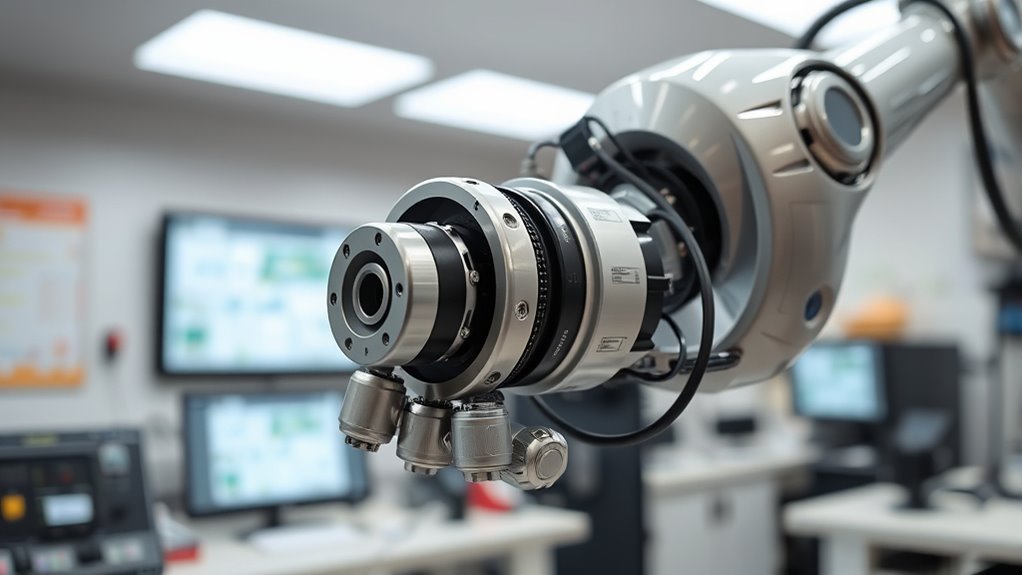
When delving into robotics, you’ll quickly realize how essential actuators are to a robot’s functionality. Acting as the “muscles” of robots, actuators convert energy into mechanical motion, enabling everything from simple gripper operations to complex arm movements.
In robotics, linear actuators provide straight-line motion, while rotary actuators offer rotational movement. Both are vital for diverse tasks. These components are integral to control systems, ensuring precise and efficient task execution.
Actuators’ performance metrics, such as force, speed, and precision, directly influence a robot’s effectiveness. As robotics advances, emerging technologies like soft and smart actuators enhance adaptability and responsiveness, allowing robots to thrive in dynamic environments. This further underscores their pivotal role in modern robotic systems.
Different Types of Actuators and Their Applications
When exploring actuator types in robotics, electric actuators stand out for their precision and speed, which are perfect for tasks demanding accurate positioning.
On the other hand, hydraulic actuators shine in heavy-duty scenarios, offering the power needed for construction or industrial automation.
Each actuator type brings unique strengths, tailoring solutions to specific robotic applications.
Electric Actuators Overview
Electric actuators play an essential role in robotics by converting electrical energy into precise mechanical motion.
Electric actuators use electrical energy to achieve high precision, making them ideal for applications in robotics, such as positioning robotic arms. They’re easily integrated with electronic control systems, allowing you to implement sophisticated automation strategies.
This makes them perfect for controlling the movement of grippers and other components requiring accuracy. One thing to watch out for is heat generation during operation, which can affect efficiency if not managed correctly.
However, electric ones are generally quieter and cleaner than hydraulic or pneumatic actuators, making them suitable for environments where noise and contamination are concerns.
Embrace electric actuators for a smoother, more precise robotic experience.
Hydraulic Actuators Applications
While electric actuators offer precision and integration benefits, hydraulic actuators excel in applications demanding immense power and force. They’re your go-to for heavy-duty applications like construction equipment, where lifting and manipulating large loads is vital.
By leveraging pressurized fluids, these actuators provide the muscle needed for such tasks, operating on Pascal’s law to generate significant force efficiently.
Hydraulic actuators are indispensable in industrial automation. They guarantee precise movements, especially in tasks involving material handling and robotic arms.
Although hydraulic systems can be complex and require regular maintenance, their reliability in environments demanding heavy lifting and high-speed operations is unmatched.
Beyond industrial settings, hydraulic actuators are used in aerospace, guaranteeing robust and reliable flight control systems for critical functionalities.
Energy Sources for Robotic Actuators
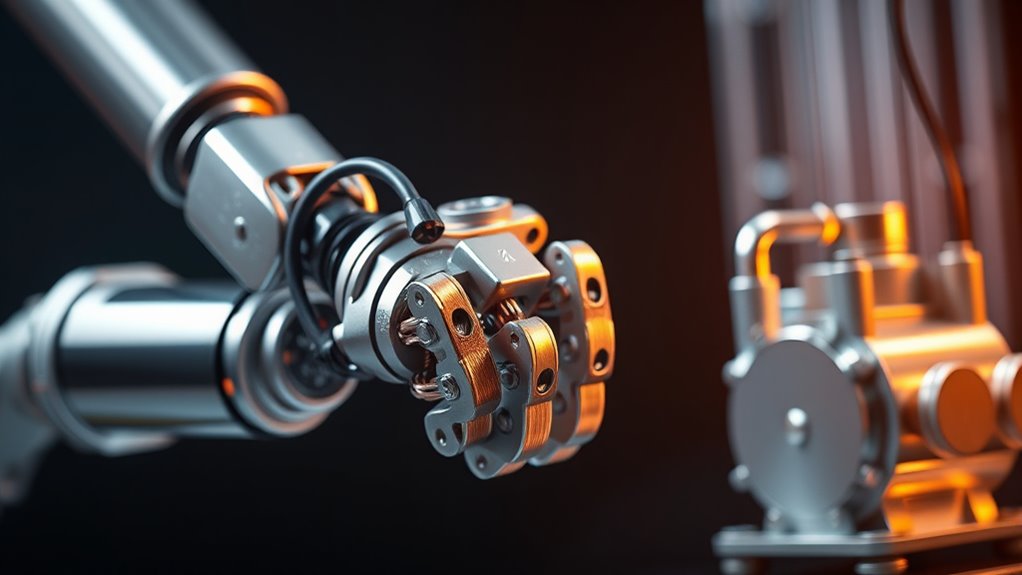
Understanding the three primary types—pneumatic, hydraulic, and electric—is essential for exploring energy sources for robotic actuators.
Pneumatic actuators use compressed air to generate motion, making them lightweight and cost-effective for fast, simple applications. They’re often chosen for tasks requiring quick action without heavy lifting.
Hydraulic actuators, on the other hand, rely on liquids under pressure to deliver high force and power. These are perfect for heavy-duty applications where substantial energy is needed, but come with added maintenance and complexity.
Finally, electric actuators convert electrical energy into mechanical motion, offering speed and precision. They’re favored in scenarios where accuracy is key, but may generate heat and need a consistent power source.
Your choice depends on the specific robotic application requirements.
Key Characteristics and Performance Metrics of Actuators
When selecting an actuator for a robotic application, understanding its key characteristics and performance metrics is important.
Actuator technology offers two main types: linear actuators, which provide linear motion, and rotary actuators, which enable rotary motion. You’ll need to evaluate performance metrics like force, speed, response time, and accuracy. These factors directly affect how well an actuator meets your robotic needs.
Efficiency is critical, as it shows how effectively an actuator converts energy into motion, with high-efficiency models reducing energy loss. Reliability and durability are also essential, ensuring that actuators can handle repeated use and diverse conditions.
Understanding actuator dynamics and kinematics helps analyze the forces and movements impacting your system’s overall performance and efficiency.
Innovations and Emerging Trends in Actuator Technology
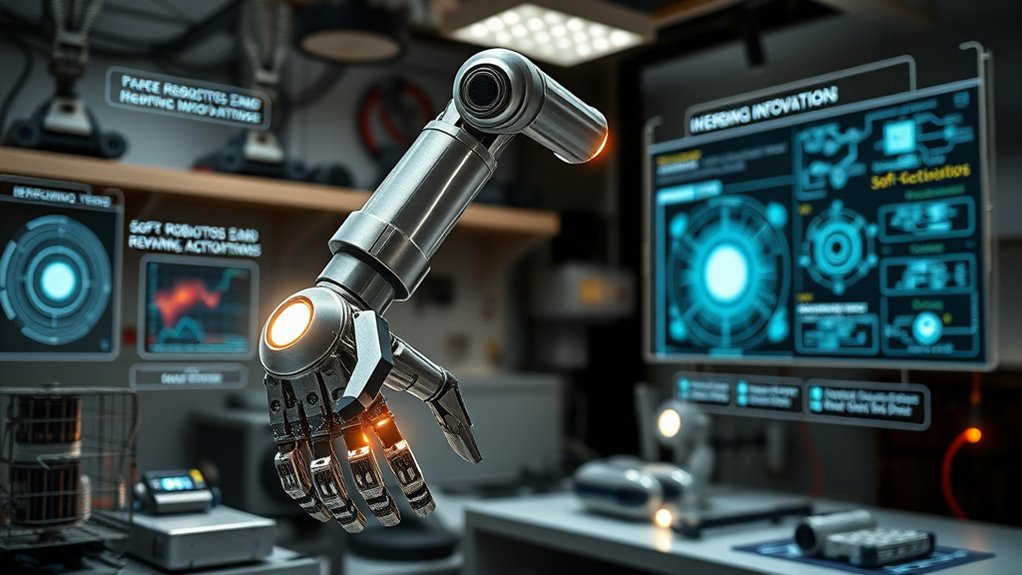
As actuator technology evolves, it’s embracing innovations that transform robotic applications. Innovative actuator designs now use smart materials like piezoelectric and shape-memory alloys, allowing precise movements without complex mechanics.
You see high-efficiency solutions that reduce energy waste through advanced algorithms, optimizing robotics’ power use. Smart actuators with integrated sensors dynamically adjust to environmental changes, making them ideal for industrial and home automation.
Soft actuators mimic biological systems, using flexible materials to create complex deformations and motions. They are adaptable and surpass traditional, rigid systems.
With Artificial Intelligence, actuators gain learning and decision-making abilities, enhancing robots’ efficiency and adaptability. These advancements set new standards for how robots interact with their environments, making them more intelligent and responsive.
Actuator Dynamics and Design Considerations
When exploring actuator dynamics, you should focus on the forces and motion analysis essential for optimizing robotic performance.
It’s important to consider efficiency and durability factors, as they directly impact how reliably your actuator will function over time.
Forces and Motion Analysis
Although often overlooked, understanding the dynamics of actuators is vital for optimizing robotic performance. Forces and motion analysis in actuator dynamics is important for predicting how your robot will move and respond. You’ll explore kinematics, examining velocity, acceleration, and positional accuracy to guarantee precision in movement. Hydraulic and pneumatic actuators rely heavily on fluid dynamics, where pressure and flow rates determine their effectiveness. Performance metrics such as force, torque, and speed shape your actuator’s design and selection process.
Here’s a quick comparison to help you understand better:
| Aspect | Hydraulic Actuators | Pneumatic Actuators |
|---|---|---|
| Force Generation | High | Moderate |
| Speed | Moderate | High |
| Accuracy and Precision | High | Lower than hydraulic |
| Ideal for | Heavy-duty applications | Lightweight tasks |
| Sensitivity to Environment | Less | More |
Efficiency and Durability Factors
To maximize a robot’s performance, you must focus on the efficiency and durability of its actuators. Actuator dynamics are essential in optimizing motion by analyzing forces and torques. This helps you meet key performance metrics like efficiency, which is how well energy converts to motion, and durability, indicating resistance to wear over time.
Understanding task-specific needs, such as required force, speed, and accuracy, is fundamental for effective operation when considering design. Selecting the right actuator types, whether electric, hydraulic, or pneumatic, directly affects efficiency and durability.
Systematic testing protocols validate performance against design specifications, ensuring discrepancies are resolved. By focusing on these dynamics and considerations, you enhance the overall performance of your robotic system.
Testing and Validation of Robotic Actuators
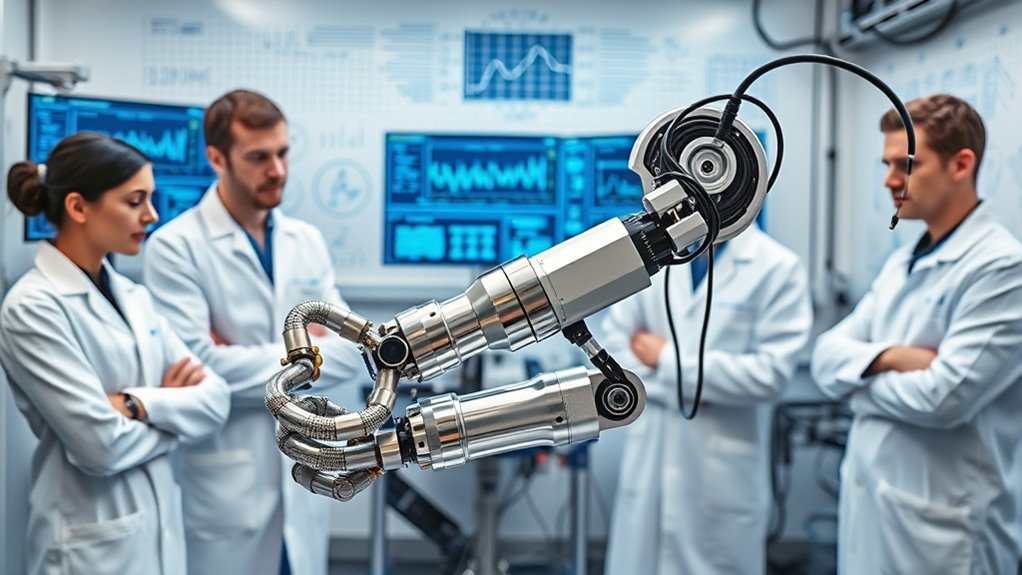
Testing robotic actuators is essential for guaranteeing they meet performance standards and operate reliably in real-world scenarios. You must manage them under controlled conditions to measure performance metrics like force, speed, and accuracy.
This systematic testing evaluates energy efficiency and durability, helping you spot potential design flaws. Validation involves comparing the tactuators ‘ output with expected benchmarks to verify reliability. This confirms that actuators will perform as needed.
Continuous improvement, based on testing feedback, is critical. It allows for design enhancements, optimizing performance over time. Proper testing and validation ensure these actuators consistently meet operational demands, providing a robust foundation for their use in various industrial and commercial settings.
Don’t skip these steps—they’re essential.
Real-World Applications of Actuators in Various Industries
Looking around, it’s clear that actuators play an essential role across many industries.
In automotive manufacturing, actuator applications in automation and robotics enhance efficiency by enabling robotic arms to perform precise tasks like welding.
In the medical field, actuators are used in applications such as robotic surgical systems, which allow for highly accurate, minimally invasive procedures.
The aerospace industry uses actuators to power aircraft mechanisms, ensuring safety and reliability.
Consumer electronics benefit from actuators in devices like robotic vacuum cleaners, automating tasks with minimal human intervention.
In the food processing industry, pneumatic actuators automate production lines, rapidly moving products through various stages.
Truly, actuators play an essential role across a wide range of applications.
Conclusion
In robotics, actuators are indispensable, acting as the robot’s muscle to convert energy into motion. You’ve learned about the different types and applications, from electric to hydraulic, and the energy sources powering them. Understanding their key characteristics and performance metrics is essential. With innovations and trends continuously emerging, actuator technology is advancing rapidly. Considering actuator dynamics, design, testing, and real-world applications, remember that they greatly enhance automation and operational capabilities across various industries.
FAQs
1. What Is the Function of an Actuator?
You’re looking at an actuator’s function to convert energy into motion for robots. It lets you control movements like arm rotations and gripper actions, essential for precise positioning, speed, and accuracy in robotic tasks.
2. What Is the Definition of an Actuator?
You’re asking about the definition of an actuator. It converts energy into mechanical motion in various systems. Based on your needs, actuators enable tasks like moving parts or controlling mechanisms, using energy sources like pneumatic, hydraulic, or electrical power.
3. What Do the Actuators Do?
You control actuators to convert energy into mechanical motion, allowing your robot to move, grip, or manipulate objects. They’re essential for tasks needing precision and speed, like assembling parts or picking items, impacting performance and efficiency.
4. What Is an Actuator for Dummies?
Think of an actuator as the robot’s muscles. It converts energy into movement, letting robots do things like open doors or lift objects. You’d see it when a robot moves or performs a task.