What Is a Stepper Motor? A Complete Beginner’s Guide
If you’re curious about precise control in mechanical systems, you’ll want to know what makes a stepper motor tick. Imagine a device that turns electrical pulses into exact movements, giving you control over angular position. These motors are essential in applications like 3D printers and CNC machines, where accuracy is key. But how do they achieve such precision? Let’s explore the inner workings and see what sets them apart.
Key Takeaways
- Stepper motors convert input pulses into precise angular movements for controlled motion.
- They energize electromagnets around a rotor to achieve discrete steps.
- Common types include permanent magnet, variable reluctance, and hybrid stepper motors.
- They offer reliable performance with full torque at standstill and no brushes.
- Stepper motors are widely used in 3D printers, CNC machines, and robotics.
Mechanism and Basics of Stepper Motors
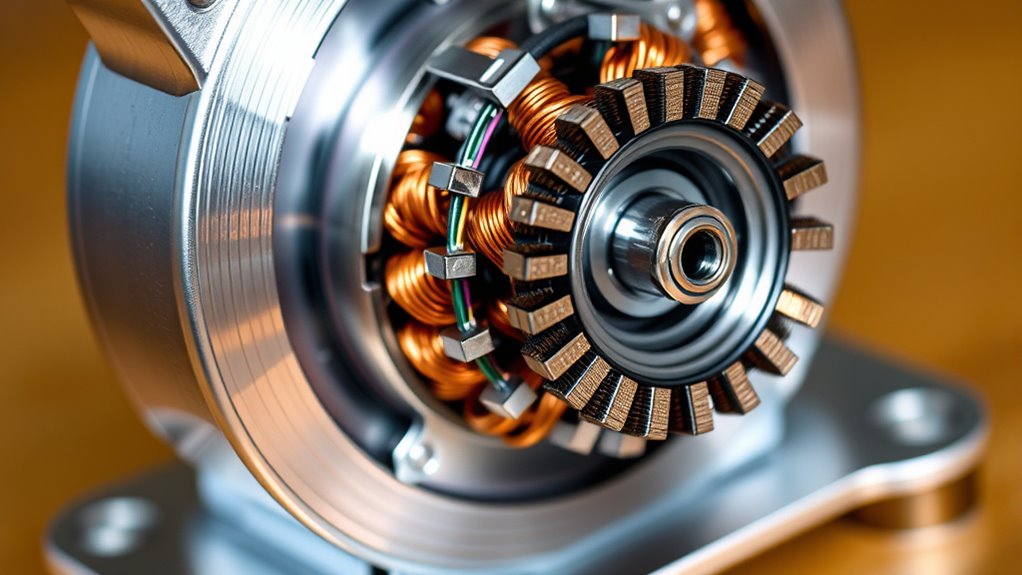
Stepper motors are essential in applications requiring precise control of angular rotation. They convert input pulses into discrete steps, allowing for exact angular movements.
The mechanism involves energizing toothed electromagnets around a central rotor. Each pulse shifts the motor shaft by a fixed angle, typically 1.8°, resulting in 200 steps per revolution.
In a bipolar stepper motor, the driving pattern A+ B+ A− B− is used, requiring two leads per phase. This enhances performance by providing high torque and precision control.
Factors like inductance and pulse frequency affect performance. Modern drivers use voltage-mode techniques to mimic sinusoidal waveforms, reducing static friction and improving responsiveness, especially during low-speed operations.
Types and Configurations of Stepper Motors
While stepper motors may seem straightforward, their diversity in types and configurations offers a variety of performance characteristics tailored to specific applications. You’ll encounter three main types: permanent magnet, variable reluctance, and hybrid stepper. Each type has unique benefits and uses. Configurations like unipolar and bipolar affect the motor’s torque and speed, with bipolar often being more powerful.
Here’s a quick comparison:
| Type | Configuration | Performance Feature |
|---|---|---|
| Permanent Magnet | Unipolar | Simplicity |
| Variable Reluctance | Bipolar | Higher Speed Capability |
| Hybrid Stepper | Both | Enhanced Torque & Control |
Eight-lead motors offer flexible winding arrangements that can be adapted to your needs. The stepper motor controller you choose will optimize these configurations, ensuring efficiency tailored to your specific application.
Phases and Driver Circuits in Stepper Motors
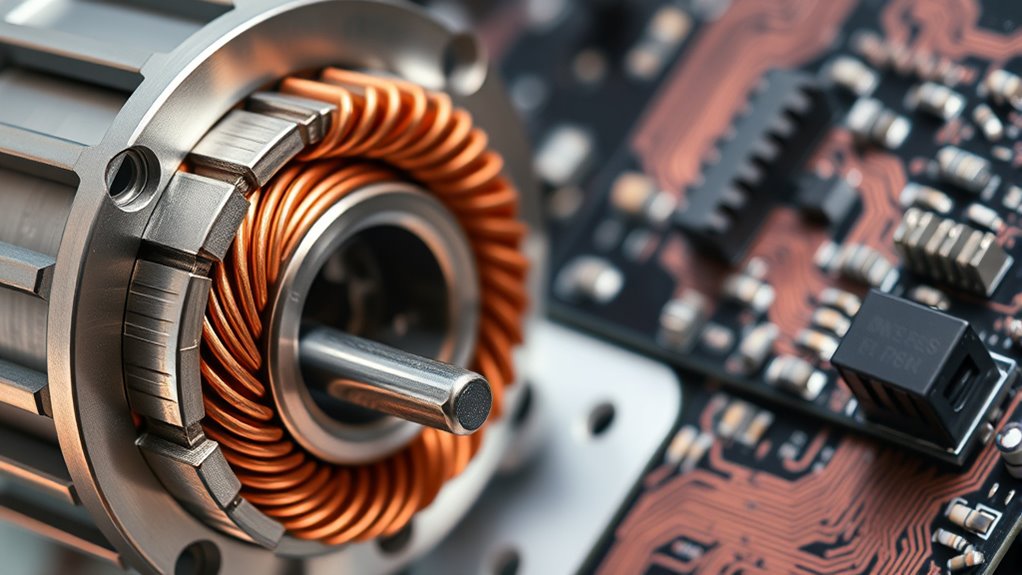
Understanding stepper motors’ phases and driver circuits is essential for optimizing their performance.
Stepper motors often come in bipolar and unipolar configurations, each affecting control and torque differently. In bipolar motors, current flows through pairs of single winding connections per phase, using an H-bridge driver circuit for precise control and enhanced torque.
Unipolar motors, with simpler driver circuits, use one winding with a center tap per phase, offering easier control but usually less torque.
Consider these key aspects:
- Bipolar advantages: Higher torque, complex control
- Unipolar simplicity: Easier control, lower torque
- Multi-phase benefits: Reduced vibration, improved motion control
- Driver circuits: Vital for performance, affecting current flow and efficiency
Choosing the right configuration and driver circuit impacts your motor’s performance and application suitability.
Performance Characteristics and Control Techniques
Phases and driver circuits lay the foundation for a stepper motor’s operation, and now it’s time to focus on how performance characteristics and control techniques elevate their functionality.
Multi-phase stepper motors offer lower vibration and higher power density, making them ideal for precision tasks. Half-stepping, which doubles steps per revolution, enhances angular resolution to 0.9° per step.
If you need even finer control, micro-stepping divides steps into 256 microsteps, achieving movements as small as 0.007° per step. Pull-in torque helps overcome static friction to guarantee effective low-speed operation. Avoid resonance issues that can lead to missed steps, especially around 200Hz. Implementing quick acceleration profiles and avoiding resonant speeds can mitigate these problems.
Applications, Advantages, and Disadvantages of Stepper Motors
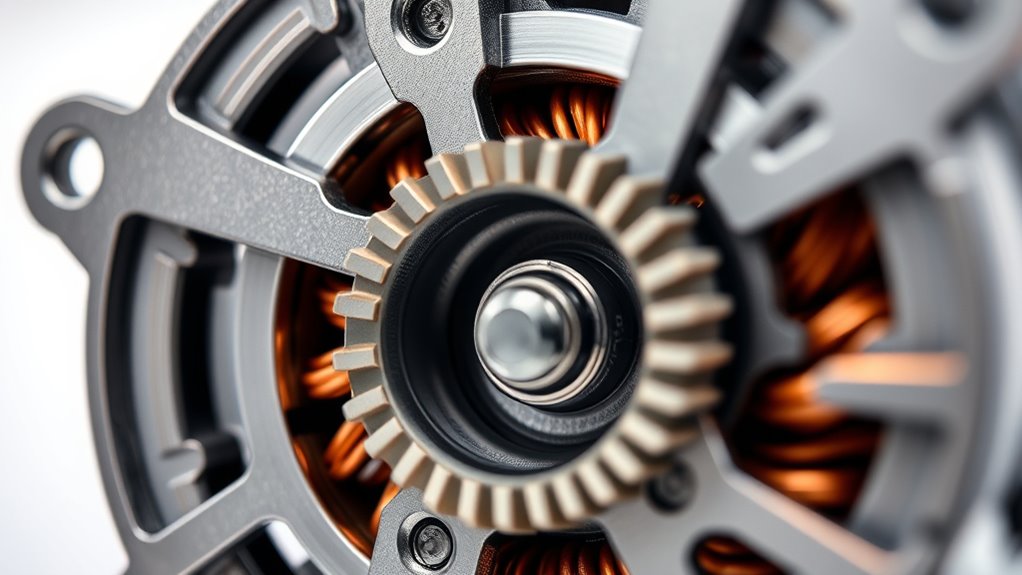
Because of their precision and reliability, stepper motors have carved out a niche in various precise positioning applications.
They’re perfect for applications requiring a high degree of control, like:
- 3D printers for intricate designs
- CNC machines for precise cuts
- Robotics for complex movements
- Automation systems for continuous rotation
The stepper motor’s advantages include high reliability and full torque at standstill, offering consistent performance.
Their brushless design means less maintenance, making them ideal for hobbyists and professionals.
However, they’ve disadvantages, such as resonance effects at low speeds, which can cause missed steps.
Additionally, torque and speed can be limited, affecting effectiveness in certain scenarios.
Despite these, they remain a cost-effective choice compared to servo motors.
Conclusion
So, now you’ve got a solid grasp of stepper motors. They’re essential for precision tasks, effortlessly converting electrical pulses into specific movements. Whether exploring different types or diving into driver circuits, you’ll find their reliability and consistent torque impressive. While they’re a favorite in automation and robotics, remember they have limitations, too. By understanding their strengths and weaknesses, you’re better equipped to choose the right motor for your projects.
FAQs
1. What Is a Stepper Motor Used For?
Stepper motors will likely be used in 3D printers, CNC machines, and robotics for precise control and positioning. They also enhance camera autofocus and aperture control, and guarantee accurate movement in scanners and printers.
2. What Is the Difference Between a Stepper Motor and a Normal Motor?
Unlike normal motors, stepper motors offer precise control with discrete steps and hold positions without feedback. Normal motors excel in continuous speed and torque but need additional components for accurate positioning and static load handling.
3. What Is the Difference Between a Servo Motor and a Stepper Motor?
Servo motors use feedback for precision, maintaining torque across speeds, but they’re pricier and more complex. Stepper motors offer cost-effective, discrete positioning and are ideal for low-speed applications, but struggle with resonance and torque at high speeds.
4. What Are the Advantages of Stepper Motors?
You’ll appreciate stepper motors for their precise control and ability to hold positions without power. They’re cost-effective, have a longer lifespan due to a brushless design, and are easier to control than servo motors.