

Types of Cables: Electrical, Networking, and Communication
When considering the various types of cables used in electrical and data transmission, understanding their specific functions and benefits is crucial. You’ll find main feeder wires designed for high voltage, non-metallic sheathed wires for residential wiring, and single conductor wires offering choices between copper and aluminum. Multi-conductor cables streamline complex wiring, while HDMI, DVI, and VGA cables handle high-definition signals. Ethernet cables guarantee robust network connectivity, coaxial cables provide reliable data transfer, and fiber optic cables deliver high bandwidth over long distances. But have you ever wondered which cable suits your particular needs?
Key Takeaways
- Electrical Cables: Include main feeder, panel feed, and non-metallic sheathed wires for various installations.
- Single Conductor Wires: Feature conductive materials like copper or aluminum, with insulation types like THHN and THWN.
- Multi-Conductor Cables: Essential for transmitting multiple signals or power sources in organized wiring setups.
- Video and Audio Cables: HDMI, DVI, and VGA cables for high-definition video and audio signal transmission.
- Networking Cables: Ethernet and coaxial cables ensure stable connections and data transmission in local area networks and telecommunications.
Electrical Cable Composition
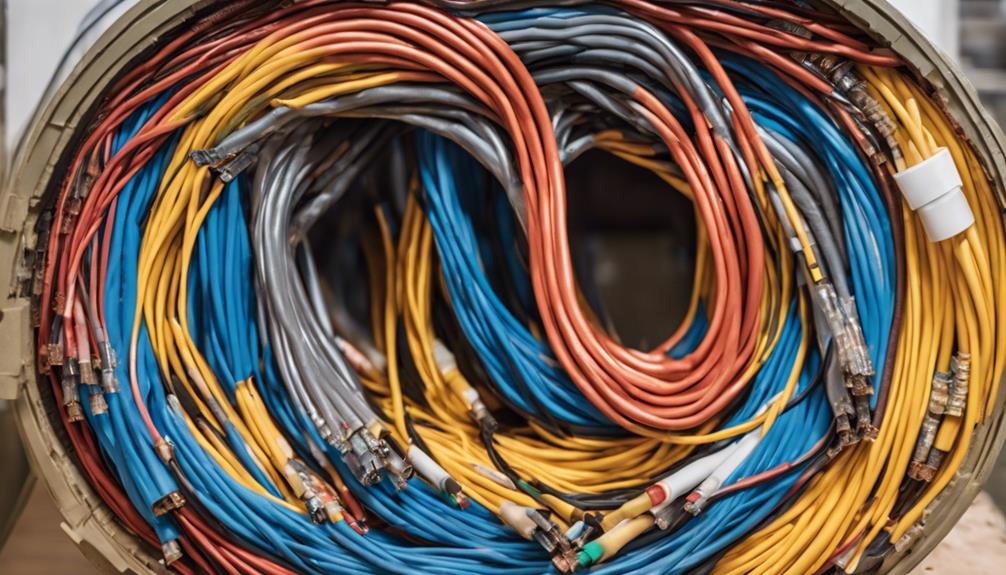
When it comes to electrical cable composition, it’s crucial to understand that these cables consist of multiple wires enclosed in a protective sheath. At the core of any electrical cable, you’ll find conductors, often made from copper, known for their excellent conductivity. These conductors are pivotal because they facilitate smooth electricity transmission through the cable.
Surrounding the conductors are insulating materials made from plastic, rubber, or other non-conductive substances. These materials are essential in preventing electrical leakage and protecting the wires from short circuits. They guarantee that electricity flows only where it should, enhancing safety and efficiency.
The outer sheaths of electrical cables provide an additional layer of protection. These sheaths safeguard the internal components from environmental factors like moisture, chemicals, and physical damage. This protective layer is indispensable for maintaining the cable’s integrity and performance.
Understanding the composition of electrical cables helps you select the right type for your specific electrical installations. Different cables are designed for various purposes, so knowing their makeup can guide you in making informed decisions, ensuring safety and functionality in your projects.
Main Feeder Wires
Understanding the composition and materials of main feeder wires, voltage capacity and ratings, and installation best practices is crucial when dealing with them. These large gauge cables, often made of copper, efficiently carry high electricity levels from the power source to the main distribution panel. Knowing how to properly install these wires, whether underground, overhead, or within conduits, is vital for safe and reliable power distribution.
Composition and Materials
The composition and materials of the main feeder wires are vital for their performance and durability. These heavy-duty cables are designed to carry high-voltage power from the main electrical supply to distribution panels. These cables typically consist of copper conductors renowned for their excellent conductivity and efficient power transmission. These electrical wires are insulated with materials like PVC (Polyvinyl Chloride) or XLPE (Cross-Linked Polyethylene) to guarantee safety and longevity.
Here’s a quick breakdown of what makes these cables effective:
- Copper Conductors: Copper is preferred due to its superior electrical conductivity, flexibility, and corrosion resistance.
- PVC Insulation: This insulation provides flexibility and resistance to moisture, chemicals, and abrasion.
- XLPE Insulation: XLPE offers higher thermal resistance and mechanical strength, making it suitable for harsh environments.
Main feeder wires are essential for delivering electricity to buildings, industrial facilities, and other large-scale applications. They come in various sizes and ampacities to meet different power requirements, ensuring a reliable and safe electrical supply. Proper installation and maintenance of these cables are key to their effectiveness and longevity.
Voltage Capacity and Ratings
Understanding main feeder wires’ voltage capacity and ratings is [ESSENTIAL] to [GUARANTEE] a reliable and efficient electrical system. These wires typically handle high voltage capacities, ranging from 120 to 480 volts, especially in industrial and commercial applications. Main feeder wires are your go-to solution for supplying main electrical panels when dealing with substantial power delivery over long distances.
Voltage ratings for these cables are [ESSENTIAL]—they [GUARANTEE] safety and efficiency by preventing overheating and minimizing voltage drops. If you’re selecting cables for large-scale electrical installations like factories, warehouses, or commercial buildings, understanding these ratings helps you choose the right cable size and type.
Main feeder cables are specifically designed to carry significant amounts of electrical power. Their high voltage capacity makes them ideal for extensive electrical systems that demand robust and reliable power delivery.
Whether setting up new electrical installations or upgrading existing ones, knowing the voltage capacity and ratings will guide you in making informed decisions, [GUARANTEEING] your electrical system operates smoothly and safely.
Installation Best Practices
Proper installation of main feeder wires guarantees a safe and efficient electrical system in any building or facility. Main feeder wires are pivotal in distributing power throughout the structure, so getting the installation right is essential.
Use appropriate electrical boxes and connectors to house the wires securely. This safeguards the power cables from potential damage and minimizes electrical hazards.
Following local building codes and regulations is non-negotiable. These codes guarantee that your installation meets the safety standards required by law, reducing the risk of electrical fires or failures.
Here are three best practices to keep in mind:
- Secure Fastening: Make sure the main feeder wires are firmly fastened to prevent any movement that could lead to wear and tear over time.
- Proper Protection: Use conduit or other protective measures to shield the wires from physical damage.
- Professional Installation: Hire professional electricians familiar with local building codes to ensure a safe and compliant installation.
Panel Feed Wires

Panel feed wires are essential in the seamless operation of electrical control panels. These high-grade wires and cables are designed to guarantee easy and secure installations within control panels, facilitating efficient power distribution. In industrial settings, they are vital for connecting various electrical components and ensuring that your control panel operates smoothly.
When you choose panel feed wires, you’re examining different sizes and specifications to meet your control panel’s specific power supply needs. Reliable panel feed wires are necessary for maintaining both functionality and safety. For example, twisted pairs can be used within these wires to reduce electromagnetic interference, securing a consistent power supply.
Here’s a swift overview to help you understand better:
| Feature | Description | Benefit |
|---|---|---|
| High-Grade Design | Specifically crafted for control panels | Secures safe installations |
| Various Sizes | Different sizes and specifications are available | Meets diverse power distribution needs |
| Industrial Use | Connects electrical components in panels | Smooth operation in industrial settings |
| Twisted Pairs | Included in some wires | Reduces electromagnetic interference |
| Reliability | Essential for maintaining functionality and safety | Secures consistent, safe power supply |
Non-Metallic Sheathed Wires
Non-metallic sheathed wires, often called NM cables, are staples in residential electrical systems. You’ll find these cables in almost every home, providing a dependable and cost-effective way to handle your electrical wiring needs. NM cables consist of two or more insulated conductors wrapped in a durable, non-metallic sheath that protects the wires from damage and makes installation a breeze.
You’ll appreciate their versatility and ease of use when working with NM cables. They can be installed in walls, ceilings, and even underground applications. Here are a few key points to note:
- Cost-effective: NM cables are budget-friendly, making them popular for homeowners and electricians.
- Easy Installation: These cables can easily maneuver through tight spaces thanks to their flexible sheath.
- Safety: NM cables are rated for specific voltages and temperatures and provide safe and reliable electrical connections.
Also, NM cables are color-coded, making it simple to identify the conductors inside, whether hot, neutral, or ground wires. So, next time you tackle a home wiring project, NM cables offer a reliable and straightforward solution.
Single Conductor Wires

When selecting single-conductor wires, consider the conductive materials available, such as copper or aluminum, each offering distinctive advantages.
The insulation and coating types, like THHN and THWN, also play a critical role in determining the wire’s suitability for different environments and applications.
Understanding these factors guarantees you choose the correct wire for your needs.
Conductive Material Choices
Choosing the correct conductive material for single-conductor wires is essential to guaranteeing efficiency and reliability in electrical applications. When selecting materials for cables and wires, you should consider copper, aluminum, and tinned copper, each offering unique advantages.
- Copper Wires: Copper is the go-to for conductors due to its high conductivity and corrosion resistance. It’s perfect for most electrical applications where efficiency and durability matter. Copper wires are typically encased in plastic to provide insulation and protection.
- Aluminum Wires: Aluminum wires are a solid alternative to copper wire if you’re looking for a lighter and more cost-effective option. However, keep in mind that aluminum has lower conductivity compared to copper. This means you might need a larger diameter wire to achieve the same level of performance, which can affect the design of your electrical system.
- Tinned Copper Wires: These copper wires coated with tin add an extra layer of protection. The tin coating improves the wire’s durability and makes it easier to solder, which can be particularly beneficial in environments prone to moisture or high humidity.
When choosing the right conductive material, always weigh factors like cost, conductivity requirements, and environmental conditions to make the best decision for your application.
Insulation and Coating Types
Selecting the right insulation and coating types is key tonight. Insulation and coating types are key single wiressulation materials that can dramatically affect the wire’s performance and suitability for specific applications.
PVC insulation is one of the most popular choices due to its cost-effectiveness and durability. Thanks to its flame-retardant properties and robustness, it is particularly useful for indoor applications. This type of insulation is perfect if you’re looking for something reliable and affordable.
XLPE insulation stands out for high-voltage applications. XLPE, or cross-linked polyethylene, offers excellent electrical properties and superior resistance to heat. When dealing with high-voltage environments, choosing XLPE insulation can provide the necessary protection and efficiency.
Rubber-coated single-conductor wires are another option known for their flexibility and resistance to abrasion. They’re a great choice if you need insulation that can withstand harsh environments or constant movement. They’re ideal for applications where the wire may be subject to physical stress or frequent bending.
Multi-Conductor Cables
Multi-conductor cables, consisting of multiple insulated conductors within a single sheath, are essential for applications that need to transmit numerous signals or power sources. These cables are perfect for organized wiring solutions in telecommunications, electronics, and automation. Using multi-conductor cables simplifies installation and reduces clutter, combining several wires into one neat package.
Each conductor within these cables can carry different types of signals or currents. This versatility makes multi-conductor cables invaluable when you need to manage the transmission of multiple signals simultaneously. Here’s why you might consider using them:
- Efficiency: Multi-conductor cables streamline complex wiring tasks, making equipment setup and maintenance straightforward.
- Space-saving: Integrating multiple insulated conductors into one sheath reduces the physical space required for wiring, which is vital in compact environments.
- Reliability: These cables offer consistent performance by minimizing the risk of signal interference between individual wires, ensuring reliable data or power transmission.
HDMI, DVI, and VGA Cables

After understanding the advantages of multi-conductor cables for organized wiring solutions, let’s discuss HDMI, DVI, and VGA cables, each designed for specific audio and visual needs.
HDMI cables are your go-to for transmitting high-definition audio and video signals, providing a clear and crisp multimedia experience. Whether streaming a movie or gaming, HDMI cables offer various connector types (A/B, C, D/E) to suit different device connections and resolutions.
DVI cables are ideal for connecting LCD monitors to video cards, ensuring high-quality visual output. They are. They are particularly useful for gaming or graphic design. If you need sharp visuals, DVI cables are a solid choice.
VGA cables, on the other hand, are designed for analog video signal transmission between CPUs and monitors. Though primarily used in older devices like projectors and TVs, VGA cables are still quite reliablthose setups.
| Cable Type | Primary Use |
|---|---|
| HDMI | High-definition audio and video transmission |
| DVI | Connecting LCD monitors to video cards |
| VGA | Analog video signal transmission for older devices |
| HDMI | Various connector types for different devices |
Ethernet Cables
Ethernet cables are vital components in wired networks, connecting devices like computers, routers, and switches to facilitate seamless communication within a local area network (LAN). They contain more wires than telephone cables, ensuring reliable data transmission and stable network connections. Ethernet cables come in various categories, such as Cat5, Cat6, and Cat7, each offering different data transfer speeds and capabilities.
When choosing Ethernet cables, you’ll encounter terms like “twisted” and “shielding.” Twisted pairs of wires within the cable reduce electromagnetic interference, pivotal for maintaining data integrity over longer distances. Shielded twisted pair (STP) cables go further by providing an extra protection against external electromagnetic interference, making them ideal for high-interference areas.
Here’s a quick breakdown of common Ethernet cable categories:
- Cat5e: Enhanced performance and reduced crosstalk interference; a popular choice for home and office networks.
- Cat6: Higher data transfer speeds and improved performance over longer distances.
- Cat7: Superior shielding and the highest data transfer speeds, suited for demanding applications.
Coaxial Cables
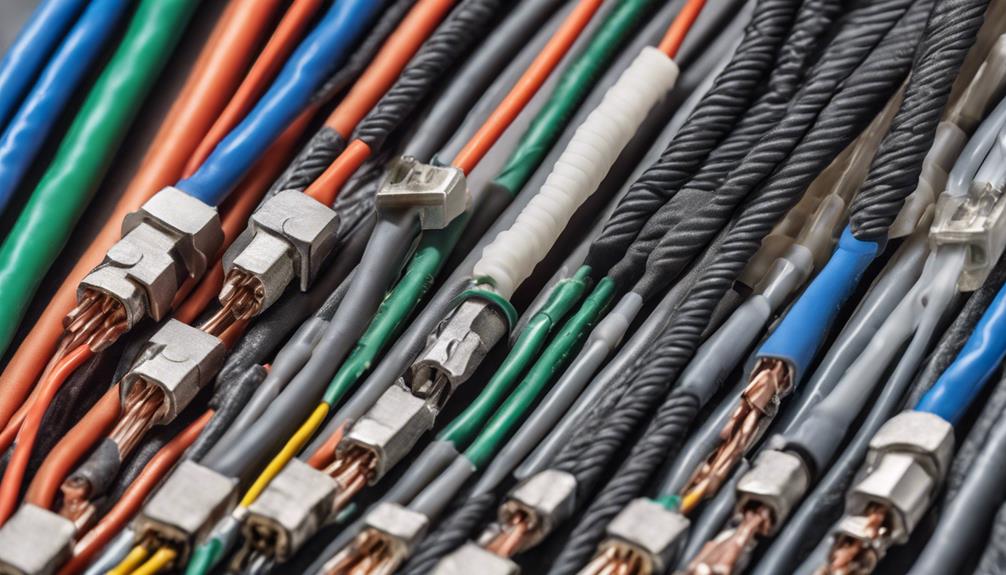
Regarding coaxial cables, you’ll notice their central conductor and metal shield, which block external interference. These cables are designed with a protective sheath to prevent physical damage and guarantee reliable signal transmission.
Commonly used in early computer networks, coaxial cables still find applications today thanks to their consistent performance.
Structure and Components
Understanding the structure and components of coaxial cables is essential for appreciating their effectiveness in data transmission. A coaxial cable comprises several key elements that work together to ensure dependable and efficient signal transfer.
First, the central conductor, usually made of copper or aluminum, carries the electrical signals. Surrounding this conductor is the dielectric insulator, a critical element that maintains the conductor’s position and guarantees minimal signal loss.
Next, you’ve got the metal shield, which plays a dual role. It protects the cable from physical damage and blocks external electromagnetic interference, ensuring that the signal remains clear and strong. The metal shield is often made of braided copper, aluminum foil, or both.
Finally, an outer plastic jacket encases all these components to provide additional protection.
Here’s a quick breakdown of the main components:
- Central Conductor: Carries the electrical signal.
- Dielectric Insulator: Maintains the conductor’s position and minimizes signal loss.
- Metal Shield: Protects against physical damage and electromagnetic interference.
This design makes coaxial cables reliable for various data transmission needs, effectively reducing signal loss and interference.
Common Applications
Why are coaxial cables so widely used? Coaxial cables are the go-to for transmitting television signals and internet data and connecting audio and video equipment. Their design includes a central conductor, an insulating layer, a metallic shield, and an outer insulating sheath, ensuring superior signal integrity. This specific structure allows them to efficiently transmit signals without interference, making them stand out among electrical cables.
Coaxial cables are often used in networking and telecommunications due to their high bandwidth capacity and resistance to electromagnetic interference (EMI). These qualities guarantee that your data streams smoothly, whether watching TV or surfing the web. Coaxial cables are also essential in CCTV systems, where clear and reliable video transmission is vital for security purposes.
In cable TV, coaxial cables connect video streams from the provider to your television, guaranteeing a clear picture and consistent service. “coaxial” refers to the inner conductor and outer shield sharing the same axis. This design feature maximizes signal efficiency. So, coaxial cables are your best bet when you need a dependable connection, especially for high-quality video and data transmission.
Fiber Optic Cables
Fiber optic cables are revolutionizing data transmission by using glass or plastic cores shielded by cladding and jackets. Due to minimal signal loss, these cables are ideal for long-distance communication. Fiber optic cables are the standard choice when you need to connect networks over vast distances. They come in two main types: single-mode and multi-mode fibers.
Single-mode fibers are ideal for longer distances because they allow light to travel directly down the fiber with minimal dispersion.
Multi-mode fibers, on the other hand, handle higher data rates but are better suited for shorter distances due to increased signal attenuation.
Here are three key benefits of using fiber optic cables:
- High Bandwidth: Fiber optic cables support notably higher data rates than traditional copper cables.
- Long-Distance: With minimal signal loss, they’re excellent for long-distance communication.
- Security: Fiber optic cables are less susceptible to electromagnetic interference, making your data transmission more secure.
Conclusion
When selecting the appropriate cable, you need to take into account your specific requirements. Each type has a unique role, from main feeder wires for high voltage needs to single conductor wires for cost-efficient solutions. HDMI, DVI, and VGA cables provide quality audio-visual experiences, while Ethernet, coaxial, and fiber optic cables ensure dependable data transmission. Understanding these options helps you make informed choices for your electrical and data transmission needs. Don’t underestimate the importance of the right cable!
FAQs
What are the main types of electrical cables?
Electrical cables transmit power and are classified based on their applications and construction. The most common types include:
- Coaxial Cable: Used for transmitting radio frequency signals, including TV and internet connections. Coaxial cables have a central conductor, insulating layer, metallic shield, and outer protective layer.
- Twisted Pair Cable: Often used for telephone and Ethernet networks. Twisted pair cables consist of wires twisted together to reduce electromagnetic interference.
- Power Cables: These are designed to carry electrical power. They vary in size and insulation based on their application, from home wiring to high-voltage transmission lines.
- Multi-core Cable: This type of cable contains multiple insulated conductors and is often used in industrial applications to provide control signals or power distribution.
Key Electrical Cables:
- Coaxial cable for TV and internet.
- Twisted pair cable for Ethernet and telephones.
- Power cables for electrical transmission.
- Multi-core cables for industrial use.
What are the different types of networking cables?
Networking cables are essential for establishing wired connections between devices in local area networks (LAN) and wide area networks (WAN). Common types include:
- Ethernet Cable (Cat5, Cat6, Cat7): Used for wired internet connections, Ethernet cables connect computers, routers, and network switches. The higher the category (e.g., Cat6 vs. Cat5), the faster and more reliable the data transfer.
- Fiber Optic Cable Transmits data using light signals and offers high-speed internet and network connections. It is often used for long-distance and high-bandwidth applications, such as data centers.
- Crossover Cable: A type of Ethernet cable used to directly connect two computers or devices without a switch or router.
Key Networking Cables:
- Ethernet cables (Cat5, Cat6) for LAN connections.
- Fiber optic cables for high-speed data transmission.
- Crossover cables for device-to-device connections.
What types of communication cables are commonly used?
Communication cables transmit voice, data, and video signals. The most common types are:
- Coaxial Cable: This cable transmits data over a central conductor insulated by a metallic shield, and it is used primarily for cable TV, satellite, and internet service providers.
- Fiber Optic Cable: Utilized in telecommunication networks due to its ability to transmit large volumes of data over long distances at high speeds using light signals.
- Twisted Pair Cable (STP/UTP): Shielded twisted pair (STP) and unshielded twisted pair (UTP) cables are used for voice and data communication, such as in telephone lines and Ethernet networks.
Common Communication Cables:
- Coaxial cables for TV and internet signals.
- Fiber optic cables for high-speed data communication.
- Twisted pair cables for telephones and Ethernet.
What is the difference between coaxial cable and twisted pair cable?
The main differences between coaxial cable and twisted pair cable lie in their structure and applications:
- Coaxial Cable: Consists of a central conductor surrounded by an insulating layer, a metallic shield, and an outer protective jacket. Coaxial cables are commonly used for TV signals, internet connections, and RF communication.
- Twisted Pair Cable: Consists of pairs of wires twisted around each other to minimize interference. These cables are mainly used in Ethernet networks, telecommunication systems, and telephone wiring.
Key Differences:
- Coaxial cable has a single conductor with insulation and shielding.
- Twisted pair cable consists of twisted wires to reduce interference.
- Coaxial is used for TV and the internet, while twisted pair is used for networks.
What are fiber optic cables, and how are they used?
Fiber optic cables are used to transmit data as light signals rather than electrical signals, offering high-speed and long-distance data transmission:
- Single-Mode Fiber: For long-distance communication, single-mode fiber has a smaller core and transmits light signals directly through the fiber, reducing signal loss over distances.
- Multi-Mode Fiber: Ideal for short-distance data transmission, multi-mode fiber has a larger core, allowing multiple light signals to travel at different angles. It is often used in local area networks (LAN) and data centers.
Key Uses of Fiber Optic Cables:
- Long-distance and high-speed internet.
- Data transmission in telecom networks.
- Local area networks and data centers.
