Quartz Oscillators – Precision Timing, Function, and Uses
When you start exploring quartz oscillators, you’ll find they hinge on the piezoelectric properties of quartz crystals to generate stable frequencies. The hexagonal structure of quartz is key, transforming mechanical stress into electrical signals with high precision. You might be surprised at the range of frequencies these oscillators cover, from tens of kHz to hundreds of MHz. Mechanisms like TCXOs and OCXOs and their temperature stability and aging compensation guarantee accuracy over time. But what sets them apart, and how do they maintain such reliability in electronic circuits?
Key Takeaways
- Quartz oscillators use piezoelectric quartz crystals to generate precise and stable resonant frequencies.
- They feature high Q factors exceeding 20,000, ensuring clean frequency response in filter circuits.
- Common frequencies range from tens of kHz to hundreds of MHz, with fundamental frequencies typically between 25MHz and 66MHz.
- Temperature stability from -40°C to 85°C is critical, with TCXOs and OCXOs enhancing precision.
- Aging effects cause gradual frequency drift, but TCXOs minimize this by stabilizing the operating temperature.
Working Principle
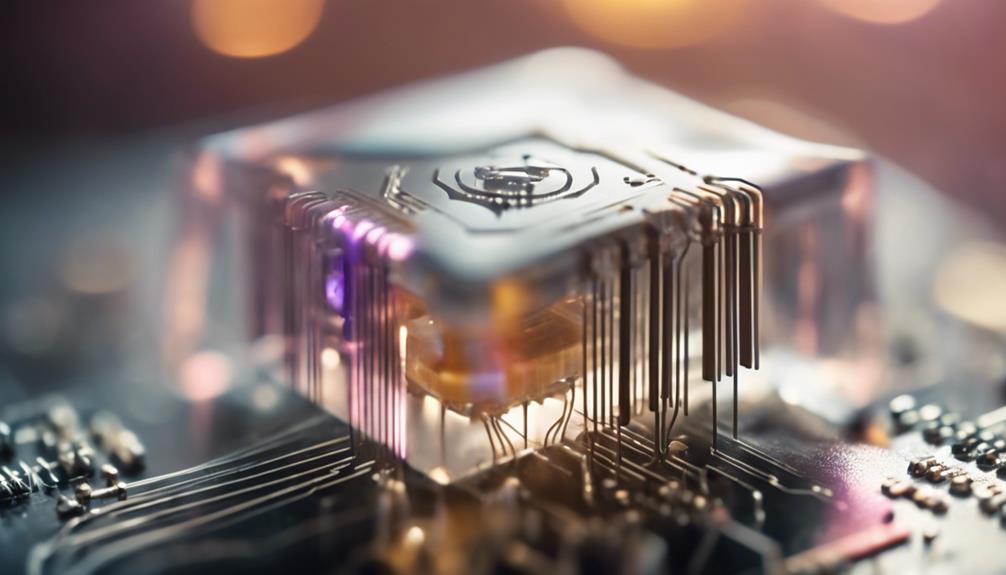
Quartz oscillators exploit the piezoelectric properties of quartz crystals to generate a stable and precise resonant frequency. When an electric field is applied to quartz crystals, they distort and create a piezoelectric resonator. This resonator vibrates at an incredibly accurate and stable resonant frequency, making it ideal for oscillator circuits.
In electronic circuits, quartz resonators replace traditional LC circuits because they offer superior performance at a lower cost. Quartz oscillators’ high Q factor, often exceeding 20,000, guarantees that they generate a stable and precise frequency. This high Q factor also means these oscillators can maintain a clean and sharp frequency response, effectively rejecting unwanted signals in filter circuits.
Quartz crystal oscillator circuits are essential in many applications because they produce high-frequency signals with remarkable accuracy. The circuit symbols for these resonators typically show the crystal held between two electrodes, underscoring their critical role. Using quartz crystals in oscillator circuits can achieve high precision and stability in your electronic designs, making these components indispensable in modern technology.
Crystal Structures
The hexagonal structure of quartz crystals, characterized by SiO4 tetrahedra, plays a significant role in their ability to control and stabilize frequencies in oscillator circuits. This unique crystal structure makes quartz crystal oscillators effective in maintaining precise frequency control and stability. The orderly crystal lattice guarantees that the oscillations remain consistent, essential for high Q factors and frequency stability in electronic circuits.
Quartz crystals exhibit piezoelectric properties, meaning they can convert mechanical stress into electrical signals. This property is key for oscillator circuits, allowing the crystal to generate and filter frequencies accurately. The high Q factors provide the crystalline structure and ensure that the oscillations do not degrade quickly, maintaining the desired frequency over time.
To better understand the importance of these properties, consider the following table:
| Property | Importance in Oscillators |
|---|---|
| Hexagonal Structure | Precise frequency control |
| SiO4 Tetrahedra | Stabilizes frequencies |
| Piezoelectric Properties | Converts mechanical to electrical |
| High Q Factors | Maintains oscillations in circuits |
Quartz crystal structures are indispensable for achieving the precise frequency and stability required in modern electronic circuits. Without these properties, quartz crystal oscillators couldn’t perform their critical functions.
Common Frequencies
Common frequencies for quartz oscillators range from tens of kHz to hundreds of MHz, catering to various applications. These oscillators are essential for generating stable clock signals in digital integrated circuits. Typically, fundamental frequencies range between 25MHz and 66MHz, ensuring precise control and operation.
Higher-frequency quartz oscillators can operate at overtone frequencies, such as the third, fifth, or seventh overtone. This capability allows them to achieve higher frequencies without compromising stability.
When selecting a quartz oscillator, you’ll often consider these common frequencies for varied applications:
- 32.768 kHz – Often used in wristwatches, providing the precise timing required for accurate timekeeping.
- 1 MHz to 50 MHz – Ideal for microcontrollers and other digital integrated circuits, offering reliable clock signals.
- 100 MHz to 200 MHz – Common in RF communication systems, ensuring stable signal transmission.
- Over 200 MHz – Used in specialized high-frequency applications, pushing the limits of precision and stability.
Each frequency range serves a different purpose but relies on quartz crystals’ fundamental and overtone properties to maintain accuracy. Understanding these common frequencies will help you appreciate quartz oscillators’ critical role in modern electronics.
Temperature Stability
Quartz oscillators are essential for maintaining accurate frequencies in various applications. They ensure stable performance over a wide temperature range, typically operating from -40°C to 85°C, ensuring your devices function reliably under different environmental conditions.
Temperature stability is critical for maintaining frequency accuracy in quartz oscillators. Temperature variations can affect the crystal frequency, leading to potential errors. Specialized crystal oscillator designs address these issues effectively address these issues effectively, like temperature-compensated crystal oscillators (TCXO) and oven-controlled crystal oscillators (OCXO). TCXOs adjust the crystal frequency in response to temperature changes, providing better stability. On the other hand, OCXOs maintain a constant, controlled temperature environment for the crystal, offering the highest strength and precision.
Here’s a quick comparison of TCXO and OCXO:
| Feature | TCXO | OCXO |
|---|---|---|
| Temperature Range | -40°C to 85°C | -40°C to 85°C |
| Stability | ±10ppm to ±100ppm | ±1ppm to ±10ppm |
| Mechanism | Temperature compensation | Oven-controlled environment |
Aging Effects

Understanding the effects of aging is essential for maintaining long-term frequency accuracy in quartz oscillators. Aging effects cause gradual frequency drift over time, influenced by mechanical stress and environmental conditions.
High-frequency crystals are particularly susceptible, impacting the crystal oscillator circuit that sustains your device’s performance. To combat these issues, you can turn to temperature-controlled crystal oscillators (TCXOs), which minimize aging effects by keeping the operating temperature stable.
Consider the following implications of aging effects:
- Frequency Drift: Over time, the quartz crystal used in your oscillator will deviate from its original frequency, affecting accuracy.
- Long-Term Stability: Without proper management, aging effects can compromise the stability and reliability of your devices.
- Mechanical Stress: Everyday wear and environmental factors can exacerbate aging, accelerating frequency changes.
- Compensation Needs: Implementing crystal aging compensation through calibration or using higher-grade crystals can help maintain precise frequency control.
Conclusion
You’ve seen how quartz oscillators leverage the piezoelectric properties of quartz crystals to deliver stable frequencies for electronic circuits. Their hexagonal crystal structure and high Q factors guarantee precise frequency responses.
Operating across a vast frequency range, these oscillators provide impressive temperature stability and compensate for aging with mechanisms like TCXOs and OCXOs.
In short, quartz oscillators are indispensable for reliable and accurate frequency generation.
FAQs
What Does a Quartz Oscillator Do?
You’re curious about what a quartz oscillator does.
It harnesses the piezoelectric effect to generate frequency and control in electronic circuits.
By applying voltage, it achieves a precise resonant frequency for timekeeping applications.
Its design guarantees excellent frequency stability and signal integrity.
Temperature compensation is often included to uphold performance.
This makes it ideal for critical functions in oscillator design and various electronic systems.
How Accurate Is the Quartz Oscillator?
You’re wondering about accuracy. It’s influenced by temperature stability, frequency drift, and aging effects.
Load capacitance and resonance frequency are vital, alongside quality factor and phase noise. Environmental factors also play a role, and calibration methods can enhance precision.
Voltage sensitivity might cause slight variations, but overall, accuracy is impressive. Controlling these aspects guarantees your device maintains high precision and reliability.
What Can I Use Instead of Quartz Oscillator?
For alternatives, consider Ceramic resonators, MEMS oscillators, or even Atomic clocks for higher precision.
RC oscillators and LC circuits offer simpler, cost-effective solutions. Silicon oscillators are another reliable option.
MEMS and Silicon oscillators are ideal for better temperature compensation and frequency stability.
Always weigh the cost comparison and power consumption to choose the best fit for your application.
What Is the Difference Between Quartz Crystal and Oscillator?
When comparing a quartz crystal and an oscillator, remember the crystal uses the piezoelectric effect to vibrate at a resonance frequency. It offers frequency stability thanks to its crystal lattice structure.
An oscillator integrates this crystal into a circuit, enhancing stability with temperature compensation and voltage control.
While the crystal might face issues like energy dissipation and aging, the oscillator minimizes harmonic distortion and mechanical stress.