Discover the World of Diodes

A Guide to Pin Photodiode Applications and Advancements

In the ever-evolving landscape of optoelectronics, the pin photodiode emerges as a cornerstone technology, seamlessly bridging the realms of light and electricity. With its intricate design and remarkable capabilities, the pin photodiode is a fundamental building block in countless industry applications. From telecommunications networks to cutting-edge medical devices, its ability to convert light into electrical current has revolutionized modern technology. This comprehensive guide will delve into the inner workings, applications, and recent advancements of pin photodiodes, shedding light on their pivotal role in shaping the future of optoelectronics.

What is a Pin Photodiode?

Pin Photodiode

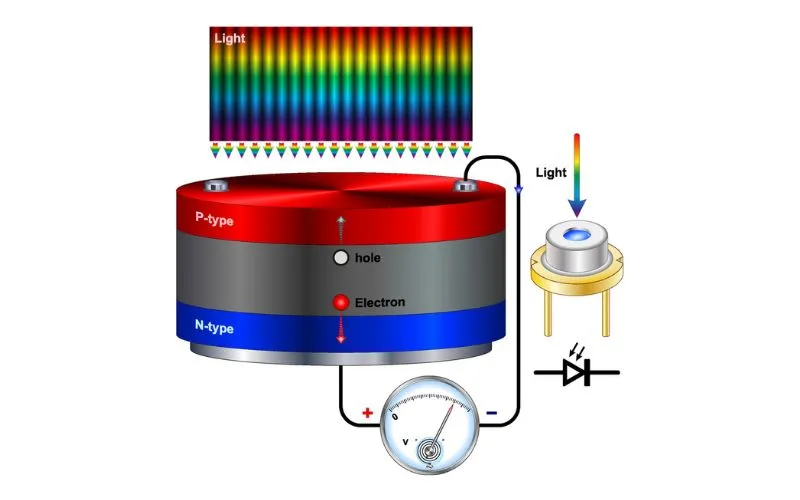
A pin photodiode, short for positive-intrinsic-negative photodiode, is a semiconductor device that converts light into electrical current. It comprises three layers: P-type (positive), Intrinsic (undoped or lightly doped), and N-type (negative). The intrinsic layer, devoid of dopants, provides a large region for light absorption.

How Does a Pin Photodiode Work?

  • Absorption of Photons: Incident photons strike the intrinsic layer of the pin photodiode.
  • Generation of Electron-Hole Pairs: The absorbed photons generate electron-hole pairs within the semiconductor material.
  • Electric Field Separation: An electric field exists between the P-type and N-type layers of the photodiode.
  • Direction of Charge Carriers: The electric field drives the electrons towards the N-type layer and the holes towards the P-type layer.
  • Generation of Photocurrent: As a result of this separation, a photocurrent flows in an external circuit connected to the photodiode.
  • Proportional to Incident Light Intensity: The magnitude of the photocurrent is proportional to the intensity of the incident light, allowing for light detection and measurement.

Applications of Pin Photodiode
Applications of Pin Photodiode

Due to their high sensitivity, wide spectral response range, and fast response times, pin photodiodes are extensively used across various industries. They are fundamental components in numerous systems and contribute to telecommunications, medical imaging, remote sensing, industrial automation, security, and surveillance advancements.

Telecommunications

Pin photodiodes are integral to fiber optic communication systems, where they serve as receivers for converting optical signals into electrical currents. Their high sensitivity and fast response times enable efficient data transmission over long distances.

Medical Imaging

In medical imaging devices, such as X-ray detectors and blood oxygenation measurement devices, pin photodiodes are crucial in converting incident radiation into electrical signals. Their ability to detect low levels of light ensures accurate imaging and diagnosis.

Remote Sensing

Pin photodiodes capture and analyze light signals from the Earth’s surface in satellite imaging systems and environmental monitoring devices. Their sensitivity across a broad spectrum enables precise data collection for applications in agriculture, forestry, and climate research.

Industrial Automation

In industrial automation, pin photodiodes are employed in light detection and ranging (LiDAR) systems, facilitating precise object detection and distance measurement. Their fast response times and low noise characteristics make them ideal for robotics and autonomous vehicle navigation.

Security and Surveillance

Pin photodiodes are crucial in security and surveillance applications, particularly in infrared night vision and motion sensors. Their sensitivity to near-infrared wavelengths enables enhanced detection capabilities in low-light conditions, ensuring reliable surveillance.

Advantages of Pin Photodiode

  • High sensitivity and low noise characteristics.
  • Wide spectral response range, covering ultraviolet to near-infrared wavelengths.
  • Fast response times are crucial for high-speed communication systems.
  • Low dark current, ensuring accurate signal detection even in low-light conditions.
  • Compact size and compatibility with integrated circuits for versatile applications.
Recent Advancements in Pin Photodiodes

Recent Advancements in Pin Photodiodes

Continuous research and development efforts have led to significant advancements in pin photodiode technology, aiming to improve their performance, reliability, and integration capabilities. These advancements pave the way for enhanced functionality and expanded application areas.

Improved Quantum Efficiency

Recent advancements focus on enhancing the quantum efficiency of pin photodiodes, thereby improving their ability to convert incident photons into electrons. This improvement results in higher sensitivity and improved signal-to-noise ratios in optoelectronic systems.

Reduced Dark Current

Efforts are underway to minimize the dark current of pin photodiodes, which is the unwanted current flow in the absence of light. The signal-to-noise ratio is enhanced by reducing dark current, leading to more accurate signal detection, particularly in low-light conditions.

Enhanced Packaging Techniques

Advancements in packaging techniques aim to develop compact and robust enclosures for pin photodiodes, enabling seamless integration into various systems and environments. These advancements ensure reliability and longevity, even in challenging operating conditions.

Integration with Nanomaterials

Researchers are exploring the integration of pin photodiodes with nanomaterials to enhance their sensitivity and response times further. Nanomaterials offer unique properties that can be exploited to optimize the performance of pin photodiodes for specific applications, such as biomedical imaging and environmental monitoring.

Conclusion

In conclusion, pin photodiodes are indispensable in optoelectronics, offering high sensitivity, wide spectral response range, and fast response times. Their versatility and reliability make them crucial for telecommunications, medical imaging, remote sensing, industrial automation, and security applications. Ongoing advancements drive improvements in performance and integration capabilities. Pin photodiodes continue to push the boundaries of innovation. They enable breakthroughs in various industries. Understanding their principles of operation and leveraging their advantages is essential for harnessing their full potential in diverse optoelectronic systems.

FAQs

How does a pin photodiode differ from other types of photodiodes?

Pin photodiodes differ primarily in structure, featuring an intrinsic layer between the P and N layers. This intrinsic layer allows for efficient light absorption, leading to higher sensitivity than other types, such as PN and avalanche photodiodes. Additionally, pin photodiodes typically exhibit lower dark current and faster response times, making them suitable for applications requiring high performance in low-light or high-speed environments.

Can pin photodiodes detect light beyond the visible spectrum?

Pin photodiodes have a wide spectral response range, extending from ultraviolet to near-infrared wavelengths. This broad range allows them to detect light beyond the visible spectrum, making them versatile across various applications. Pin photodiodes can be optimized for specific spectral ranges. This enables them to capture light in ultraviolet, visible, and near-infrared regions. They exhibit high sensitivity and efficiency.

Are pin photodiodes suitable for low-light conditions?

Pin photodiodes are well-suited for low-light conditions due to their low dark current and high sensitivity. The intrinsic layer within the pin photodiode structure provides a large region for light absorption, enabling efficient detection of weak light signals. Additionally, advancements in pin photodiode technology have led to improvements in quantum efficiency and noise performance, further enhancing their performance in low-light environments. As a result, pin photodiodes are widely used in applications such as night vision cameras, astronomical imaging, and environmental monitoring, where accurate detection of faint light signals is critical.

Jessica

Jessica, at just 27 years old, is a passionate trailblazer in the world of physics and engineering. Her insatiable curiosity about the mysteries of the universe and a knack for simplifying complex concepts have made her a rising star in the field. As a Quantum Mechanics Enthusiast, Jessica delves into the deepest realms of theoretical physics with a unique and engaging perspective. Her love for unraveling the secrets of the quantum world is infectious, making even the most perplexing ideas accessible to enthusiasts and newcomers alike.