Unveiling the Power of OR Gates in Digital Logic
In the vast realm of digital logic, the OR gate emerges as a fundamental and indispensable component, weaving its way into the very fabric of electronic circuits. Whether you are a seasoned engineer seeking a refresher or an enthusiastic learner eager to delve into the intricacies of digital electronics, this comprehensive guide aims to provide a detailed exploration of OR gates, covering their fundamental principles, applications, and the various facets of their implementation.
What is an OR Gate?
At its core, an OR gate is a crucial logic gate that performs a logical OR operation. This gate takes multiple binary inputs and produces an output 1 if at least one input is 1. Symbolized by the shape resembling an addition sign or an inverted “V,” the OR gate is a cornerstone in the design of digital systems.
OR Gate Truth Table
Understanding the truth table of an OR gate is pivotal to comprehending its behavior. The truth table showcases the output based on all possible combinations of inputs, revealing that the output is 1 when at least one input is 1.
| Input A | Input B | Output |
|---|---|---|
| 0 | 0 | 0 |
| 0 | 1 | 1 |
| 1 | 0 | 1 |
| 1 | 1 | 1 |
2 Input OR Gate
The 2-input OR gate is a fundamental configuration that embodies the essence of OR gate functionality. It combines two binary inputs and generates an output based on the logical OR operation.
3 Input OR Gate
Expanding beyond the 2-input realm, the 3-input OR gate adds complexity to the system. With three binary inputs, this gate produces an output 1 if at least one of the inputs is 1.
OR Gate Circuit Diagram
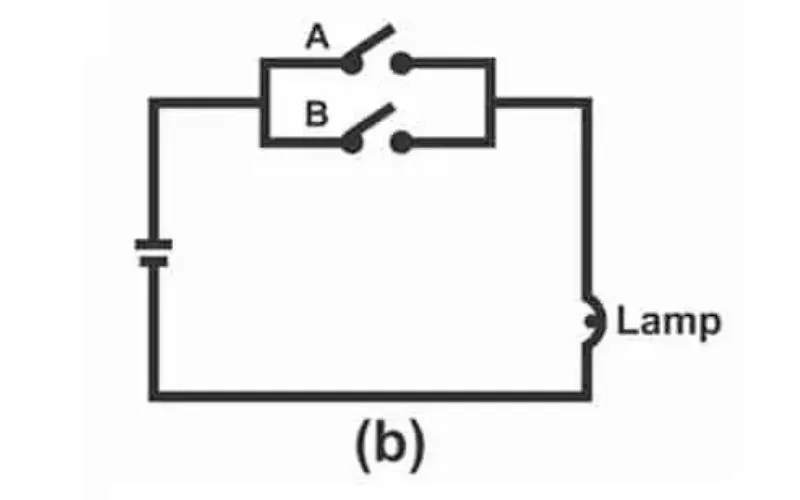
Visualizing the inner workings of an OR gate is facilitated through a circuit diagram. The diagram showcases the connection of components, providing a tangible representation of how the gate processes inputs to produce an output.
OR Gate Diode Circuit Diagram
In specific scenarios, OR gates can be implemented using diodes. The diode circuit diagram for an OR gate demonstrates an alternative approach to achieving logical OR operations in digital circuits.
OR Gate Transistor Circuit Diagram
As fundamental semiconductor devices, transistors are often employed in constructing digital circuits. The transistor circuit diagram for an OR gate illustrates how these devices can be strategically interconnected to achieve the desired logical outcomes.
OR Gate Integrated Circuits

Modern digital electronics often leverage integrated circuits for efficiency and compactness. OR gate integrated circuits encapsulate the functionality of OR gates within a single chip, streamlining the implementation of logical operations in complex systems.
Applications of OR Gates
The versatility of OR gates extends across myriad applications within digital electronics.
Data Validation
OR gates prove invaluable in scenarios where multiple conditions can signify a valid state. For instance, in a security system, the door may be unlocked if a key card or a password is valid.
Signal Conditioning
In signal processing, OR gates contribute to signal conditioning by merging multiple input signals into a unified output. This proves especially useful in scenarios where diverse triggers should initiate a common action.
Memory Units
OR gates play a crucial role in memory units, where they facilitate the writing and reading of data. By combining multiple signals, these gates enable the storage and retrieval of binary information.
Advantages of OR Gates

Understanding the advantages of OR gates further emphasizes their significance in digital logic design.
- Simplicity: OR gates are relatively simple to implement, making them attractive for various applications.
- Versatility: Their ability to handle multiple inputs and produce a straightforward output enhances their versatility.
- Complementarity: OR gates complement other logic gates, contributing to the overall functionality of complex circuits.
Common Misconceptions
Before delving into frequently asked questions, let’s dispel a common misconception:
- Misconception: OR gates only function with binary inputs.
- Reality: While OR gates are commonly associated with binary systems, they can be adapted to handle multiple inputs in various numerical systems.
FAQs
Can an OR gate have more than two inputs?
Yes, OR gates can have more than two inputs. In fact, OR gates are designed to accommodate multiple inputs, allowing for flexibility in various digital logic applications. The fundamental principle remains unchanged: the output is 1 if at least one of the inputs is 1, regardless of the number of inputs.
How does an OR gate differ from an XOR gate?
An OR gate produces an output 1 if at least one input is 1, whereas an XOR gate produces an output of 1 if the number of ‘true’ inputs is odd. While both gates involve logical addition, XOR gates exhibit distinct behavior in terms of parity, making them suitable for specific applications where exclusive conditions need to be met.
Can OR gates be used to perform arithmetic operations?
Conclusion
In conclusion, the OR gate’s significance in digital logic is evident through its fundamental role in binary operations. Its ability to generate an output of 1 when at least one input is 1 makes it a linchpin in creating logical circuits and facilitating decision-making processes in various electronic applications. As we explore the intricacies of OR gates in different configurations and circuit designs, their simplicity and adaptability become apparent, affirming their enduring importance in the ever-evolving field of digital electronics.
In the fast-paced world of technology, where innovation is relentless, the humble OR gate stands resilient as an elemental force shaping the landscape of digital systems. From its symbolic representation to practical implementations using diodes, transistors, and integrated circuits, the OR gate remains critical in synthesizing logical operations. Its legacy extends beyond conventional binary systems, finding relevance in diverse electronic domains, showcasing the enduring legacy of a seemingly elementary yet profoundly influential entity in electronics.