Understanding the Working Principle of Induction Motors
Induction motors are ubiquitous in our modern world. They power everything from household appliances to industrial machinery. But have you ever wondered how these workhorse motors operate? This comprehensive guide will delve into the working principle of induction motors. By the end of this article, you will clearly understand the inner workings of these essential devices.
What Is an Induction Motor?
Before we dive into the intricacies of induction motor operation, it’s crucial to grasp what an induction motor is and its significance. Thanks to their reliability and simplicity, induction motors are the most commonly used type of electric motor worldwide. They were first developed by Nikola Tesla in the late 19th century and have since become the workhorses of the industrial and residential world.
These motors operate on the principle of electromagnetic induction, where electrical energy is converted into mechanical energy. They are often found in applications where durability, efficiency, and low maintenance are essential. The next sections will break down the induction motor’s operation.
The Basic Components of an Induction Motor
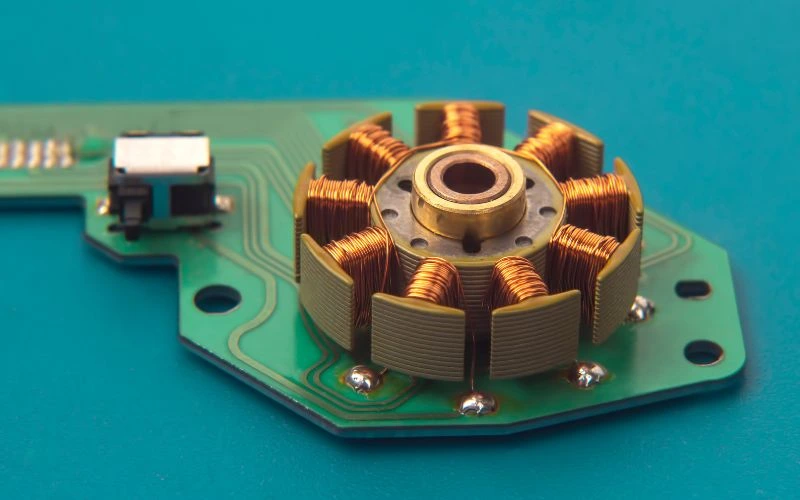
Induction motors consist of several key components, each playing a vital role in their operation:
Stator
The stator is the stationary part of the motor. It comprises a laminated iron core with evenly spaced slots for winding coils. When energized, these coils are connected to the power supply and create a rotating magnetic field. This magnetic field is crucial for inducing a current in the rotor.
Rotor
The rotor is the rotating part of the motor, typically located inside the stator. It can be constructed in various ways, such as squirrel cage or wound rotor designs. The rotor’s primary function is to interact with the rotating magnetic field created by the stator. This interaction causes the rotor to turn and produce mechanical motion.
Air Gap
The air gap is the small space between the stator and the rotor. It is essential for the motor’s operation, as it allows for transferring electromagnetic energy from the stator to the rotor. The size of the air gap is carefully controlled to optimize motor performance.
Bearings
Bearings support the rotor, allowing it to rotate with minimal friction. Proper bearing lubrication is crucial for the motor’s long-term operation.
End Bells
End bells enclose the stator and rotor, protecting them from environmental factors and providing mechanical stability to the motor.
The Working Principle of Induction Motors

Induction motors operate on the principle of electromagnetic induction, discovered by Michael Faraday in the early 19th century. This principle states that a changing magnetic field induces an electromotive force (EMF) in a nearby conductor. In the case of an induction motor, this conductor is the rotor.
The working principle of an induction motor can be broken down into the following steps:
Supplying Electrical Power
Current flows through the stator windings when the motor is connected to an electrical power source. This current creates a rotating magnetic field that alternates in polarity. The rotating magnetic field’s speed is determined by the frequency of the power supply, typically 50 or 60 Hz.
Magnetic Field Interaction
The stator’s rotating magnetic field induces a current in the rotor windings or bars. This induced current creates its magnetic field in the rotor. The rotor’s magnetic field interacts with the stator’s magnetic field, resulting in a torque that causes the rotor to start moving.
Rotor Rotation
As the rotor starts to rotate, it attempts to catch up with the rotating magnetic field of the stator. However, it can never quite reach the same speed due to the slip phenomenon. This difference in speed between the rotor and the stator’s magnetic field allows the motor to produce torque and mechanical motion continuously.
Steady-State Operation
Once the motor reaches its operating speed, it runs at a nearly constant speed, slightly slower than the synchronous speed (the speed of the rotating magnetic field). This steady-state operation is the normal mode of an induction motor and allows it to perform its intended work.
The Importance of Induction Motors
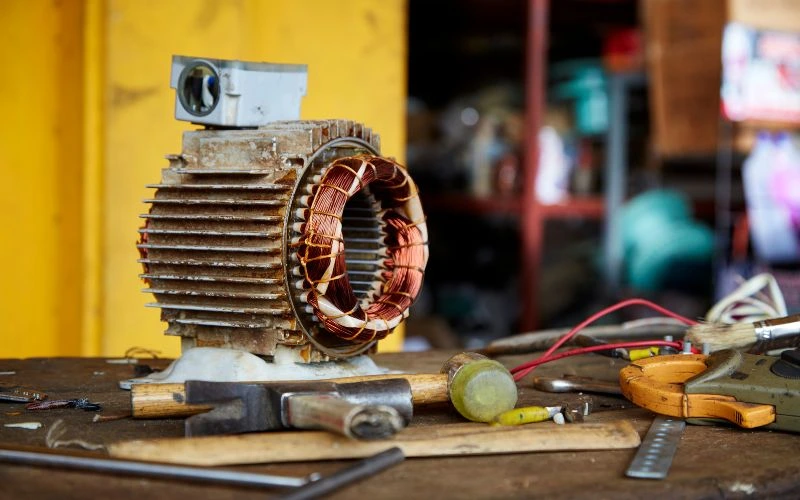
Induction motors play a vital role in various industries and applications. Here are some of the key reasons for their importance:
Versatility
Induction motors are incredibly versatile. They are used in various applications, from small household appliances to large industrial machinery. Whether it’s your refrigerator at home or a factory’s massive conveyor system, induction motors provide the necessary power.
Durability
One of the most significant advantages of induction motors is their durability. They have a simple design, no brushes or commutators, and common wear-and-tear components in other motors. This means that induction motors can run for many years with minimal maintenance.
Energy Efficiency
Energy efficiency is a top priority today, and induction motors deliver on this front. They are highly efficient when running at or near their rated load. This efficiency reduces energy consumption and lowers operational costs for businesses.
Low Maintenance
Due to their robust design and lack of frictional components like brushes, induction motors require minimal maintenance. This low maintenance requirement reduces downtime and operational costs for industries, making them an attractive choice for continuous use.
Cost-Effectiveness
Induction motors are cost-effective in terms of their initial purchase price and operational costs. Their longevity, energy efficiency, and low maintenance requirements make them a cost-effective choice for businesses and homeowners alike.
Conclusion
In conclusion, induction motors are fundamental devices with a straightforward yet ingenious working principle. These motors have become indispensable in our modern world by harnessing the power of electromagnetic induction. Understanding their components and how they operate is essential for anyone working with or relying on these workhorses of industry and everyday life.
FAQs
1. What is slip in an induction motor, and why is it important?
Slip is the difference between the synchronous speed (the speed of the rotating magnetic field) and the actual speed of the rotor. It is crucial in induction motors because it enables them to develop torque continuously. Without slip, the rotor would rotate at the same speed as the magnetic field, producing no relative motion or torque.
2. Are there different types of induction motors?
Yes, there are various induction motors, each designed for specific applications. The two primary categories are squirrel cage induction motors and wound rotor induction motors. Squirrel cage motors are commonly used in applications where simplicity and reliability are crucial, while wound rotor motors offer more control and are often found in industrial settings.
3. How efficient are induction motors?
Induction motors are known for their high efficiency, especially when operating near their rated load. Their efficiency can reach 85% or higher, making them an environmentally friendly and cost-effective choice for various applications.