Theorem

Explanation of Superposition Theorem in Electrical Engineering

The superposition theorem is a cornerstone in electrical engineering and circuit analysis, providing a robust framework for dissecting intricate linear circuits with multiple voltage and current sources. Its significance lies in its ability to simplify the analysis of complex networks by breaking them down into more manageable components. As a fundamental principle, the superposition theorem allows engineers to explore the behavior of each source independently, facilitating a systematic approach to problem-solving. This detailed exploration will delve into the superposition theorem’s principles, application procedures, and limitations, shedding light on its crucial role in addressing challenges posed by intricate electrical circuits.

Statement of the Theorem

This theorem applies to linear and bilateral networks. Let us see the statement of the theorem.

In any complex multisource network containing linear bilateral elements, the voltage across or current passing through any given aspect of the network is identical to the algebraic sum of the individual voltages or currents produced separately across or in that element by each source acting individually when all the residual references are replaced by their relevant internal resistances.

This theorem is also called the superposition principle. In other terms, it can be stated that the response in any element of a linear, bilateral network consisting of more than one source is the sum of the reactions produced by the sources, each acting independently. The answer means the voltage across the element or the current in the component. The superposition theorem does not apply to the power as power is proportional to the square of the current, which is not a linear function.

Explanation of Superposition Theorem

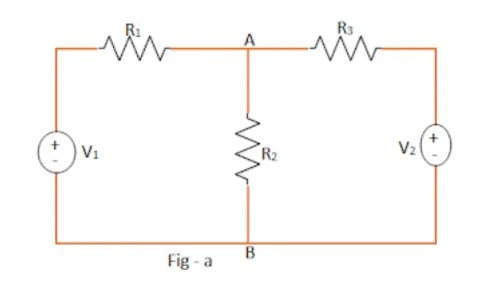
Consider a network, shown in Fig-a, having two voltage sources, V1 and V2.
Explanation of Superposition Theorem
Let us calculate the current in branch A of the network using the superposition theorem.

Step 1:

According to the superposition theorem, consider each source individually. Let source V1 volts act independently. At this time, other authorities should be replaced by internal impedances.
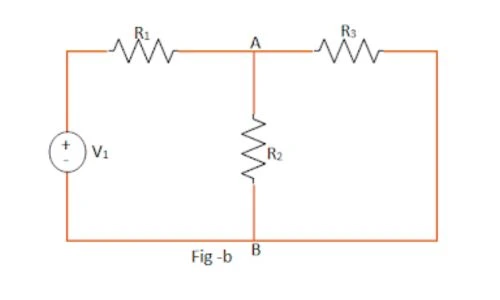
However, as the internal impedance of V2 is not given, the source of a short circuit should replace V2. This circuit becomes, as shown in Fig-b.
Explanation of Superposition Theorem
Using any network reduction techniques discussed earlier, obtain the current through branch A-B, i.e., IAB due to source V1 alone.

Step 2:

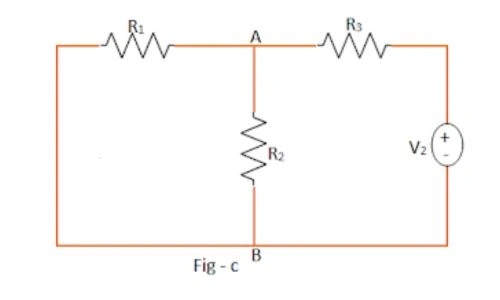
Now consider source V2 volts, with V1 replaced by a short circuit, to obtain the current through branches A-B. The equivalent circuit is shown in Fig.
Explanation of Superposition Theorem
Obtain IAB due to V2 alone using any network reduction techniques discussed.

Step 3:

According to the superposition theorem, the sum of currents through branches A is the sum of the currents through units A produced by every source acting separately.

Steps to Apply Superposition Theorem

  • Step 1: Decide on a single source acting alone. Short the other voltage sources and open the current sources if internal resistances are unknown. If known, replace them with their internal resistances.
  • Step 2: Find the current through or the voltage across the required element due to the source under consideration using a suitable network simplification technique.
  • Step 3: Repeat the above two steps for all the sources
  • Step 4: Add the effects produced by individual sources to obtain the total current in or voltage across the element.

Principles of the Superposition Theorem

The superposition theorem states that in a linear electrical circuit containing multiple sources (e.g., voltage and current sources), the response (voltage or current) at any point in the course can be found by considering the effect of each source individually while setting all other references to zero. After analyzing each source separately, you can superimpose or add the individual responses to find the total answer.

This theorem relies on two fundamental principles:

  • Linearity: The circuit must be linear, meaning that the relationship between voltage and current in its components (resistors, capacitors, inductors, etc.) must be linear and obey Ohm’s law. In other words, the circuit’s behavior must not change with varying voltage or current levels.
  • Superposition: Superposition assumes that the effects of individual sources are independent of one another. Therefore, you can analyze each source separately to find the total response while setting all other references to zero.

Principles of the Superposition Theorem

Assumptions and Limitations

It’s important to note that the superposition theorem has some limitations:

  • Linear Circuits Only: The application of this theorem is limited to linear circuits; it cannot be used to analyze non-linear components like diodes or transistors.
  • Independent Sources: The sources must be independent of each other. That is, changing one source should not affect the behavior of the others.
  • Time-Invariant Circuits: The circuit’s parameters, including resistance, capacitance, and inductance, should not change with time. In other words, the course must be time-invariant.

Procedure for Applying the Superposition Theorem

To apply the superposition theorem, follow these steps:

  • Turn off all independent voltage sources: Set all independent voltage sources to zero volts (replace them with short circuits). This effectively eliminates their influence on the course.
  • Analyze the circuit: Analyze the course as you would for a single source, considering only the effects of the remaining sources (current and dependent sources).
  • Determine the response: Calculate the circuit’s desired response (voltage or current) with only one source active.
  • Repeat for each source: Repeat steps 1-3 for each independent authority in the circuit.
  • Superimpose the responses: Finally, add up all the responses obtained in step 3 to find the total answer of the circuit with all sources active.

Applications of the Superposition Theorem

Widely employed in electrical engineering and circuit analysis, the superposition theorem finds applications in various scenarios, such as:

  • Network analysis: It simplifies the analysis of complex electrical networks with multiple sources.
  • Circuit design: Engineers use superposition to optimize and design circuits, especially in cases where multiple sources interact.
  • Transistor amplifier analysis: Engineers can apply superposition to analyze the behavior of transistor amplifier circuits, aiding their understanding.
  • Power distribution systems: Power systems engineers can utilize the Superposition Theorem to analyze complex power distribution networks.

Conclusion

In conclusion, the superposition theorem emerges as an indispensable analytical tool, offering a systematic and powerful approach to tackle the complexities of electrical circuits. By leveraging the principles of linearity and superposition, engineers gain a structured methodology to unravel intricate problems and optimize circuit designs. Beyond its applications in network analysis and circuit design, the superposition theorem extends its utility to analyzing transistor amplifiers and power distribution systems. As a foundational concept in electrical engineering, the superposition theorem continues to empower researchers and practitioners, which is pivotal in advancing the understanding and design of electrical circuits. Its enduring relevance underscores its position as an invaluable asset in the toolkit of electrical engineers.

FAQs

Can engineers apply the superposition theorem to circuits with non-linear components?

No, engineers cannot apply the superposition theorem to non-linear circuits. This theorem is explicitly designed for linear circuits, and the complexities introduced by non-linear components, such as diodes or transistors, exceed its capabilities. Engineers must resort to alternative analysis methods when dealing with circuits containing non-linear elements.

How does the superposition theorem handle time-varying circuits?

The superposition theorem assumes that the circuit parameters, including resistance, capacitance, and inductance, remain constant with time. Time-varying circuits, where these parameters change over time, fall outside the scope of the superposition theorem. Alternative techniques, such as Laplace transforms, may be more suitable to analyze such circuits.

Can the superposition theorem be used in circuits with dependent sources?

Although the superposition theorem primarily addresses independent sources, engineers can extend its application to circuits containing dependent sources under certain conditions. The crucial step involves independently analyzing each source while maintaining other references at zero. However, engineers must exercise caution and consider the specific characteristics of dependent sources to ensure the validity of their analyses.

Jessica

Jessica, at just 27 years old, is a passionate trailblazer in the world of physics and engineering. Her insatiable curiosity about the mysteries of the universe and a knack for simplifying complex concepts have made her a rising star in the field. As a Quantum Mechanics Enthusiast, Jessica delves into the deepest realms of theoretical physics with a unique and engaging perspective. Her love for unraveling the secrets of the quantum world is infectious, making even the most perplexing ideas accessible to enthusiasts and newcomers alike.

Leave a Reply

Your email address will not be published. Required fields are marked *