Differences Between Capacitors and Resistors
When you immerse yourself in electronic components, you’ll find that capacitors and resistors play vital yet distinct roles. You might wonder how they differ and why they’re essential in circuits. Capacitors store and release energy, while resistors manage current flow and voltage levels. Understanding these differences can transform how you approach circuit design. But how do these components work together to create functional and efficient circuits? There’s more to explore.
Key Takeaways
- Capacitors store energy in an electric field, while resistors oppose current flow.
- Capacitors are measured in farads, whereas resistors are measured in ohms.
- Capacitors affect voltage and current by storing and releasing energy; resistors dissipate energy as heat.
- Capacitors block DC signals but pass AC signals; resistors maintain constant current flow.
- Capacitors are used in timing and filtering circuits, while resistors manage current and voltage division.
Understanding Capacitors and Resistors

Capacitors and resistors are fundamental components in electronic circuits, each serving distinct purposes.
You’ll find that capacitors store electrical energy via their capacitance, measured in farads (F), while resistors oppose current flow with resistance measured in ohms (Ω).
Capacitors affect voltage and current by storing and releasing energy, whereas resistors limit current and dissipate energy as heat, leading to power loss.
In an RC circuit, the interaction between capacitors and resistors is essential, with the time constant τ = RC controlling signal timing.
Capacitors can pass AC but block DC, which is useful for filtering.
Meanwhile, resistors maintain constant current, stabilizing voltage levels.
Understanding these components’ roles helps you design efficient circuits and manage electric charge effectively.
The Role of Capacitors in Electronic Circuits

When exploring the role of capacitors in electronic circuits, you’ll find they play an essential part in managing and optimizing electrical performance. Capacitors store energy in an electric field, helping smooth voltage fluctuations and guarantee consistent current flow. The charge (Q) they hold in timing circuits determines how quickly they release energy. This is vital for controlling voltage changes and creating stable electronic circuits.
| Application | Function |
|---|---|
| Timing Circuits | Control charge release, stabilize current |
| Filter out Noise | Provide reactive impedance, block high-frequency interference |
| Coupling and Decoupling | Allow AC signals, block DC to maintain signal integrity |
The Functionality of Resistors in Circuit Design
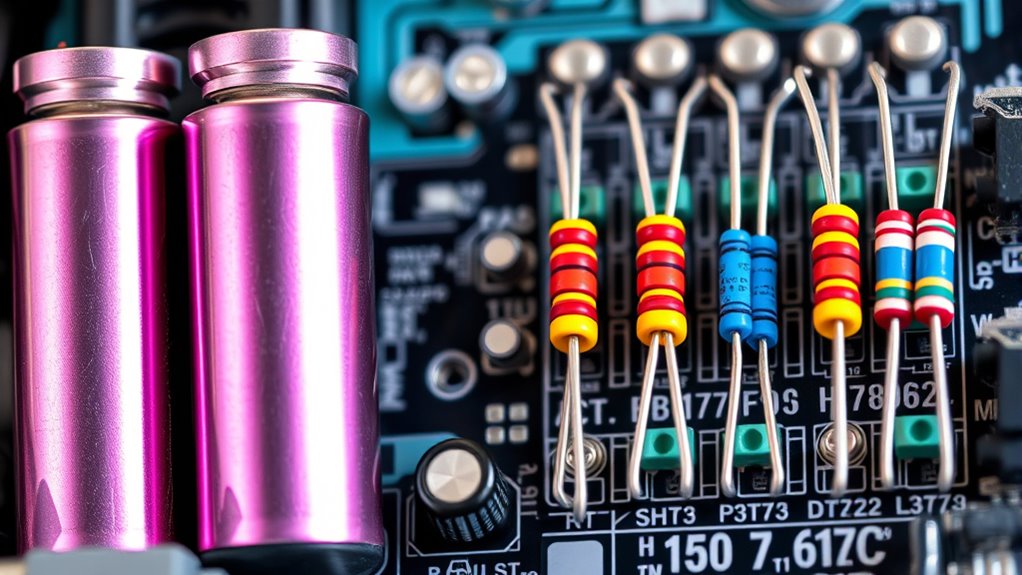
Resistors play a pivotal role in circuit design by controlling the flow of electric current and shaping how electrical energy is distributed. They limit the current flow in a circuit by adhering to Ohm’s Law (V = IR), where resistance is key in determining current levels. This functionality is essential in applications like current limiting and voltage division.
You can guarantee stable operation with resistors by effectively managing how voltage is divided across components.
Moreover, the power dissipated in resistors, calculated as P = I²R, highlights the need for thermal management, as higher currents generate more heat.
Key Differences

While exploring electronic components, capacitors and resistors serve distinct roles with unique characteristics. A capacitor stores electric charge in an electric field and is measured in farads. It impacts both voltage and current dynamics in electronic circuits.
On the other hand, a resistor is measured in ohms and resists electric current, dissipating energy as heat following Ohm’s Law.
In circuits, resistors provide consistent resistance across frequencies, while capacitors’ capacitance allows them to pass AC and block DC. When connected in series, capacitors decrease total capacitance, whereas resistors increase total resistance, showcasing their contrasting circuit effects.
Consequently, while a resistor limits current, it affects charge flow, demonstrating their differing yet complementary functions in electronic circuits.
Applications and Implications

Although electronic circuits might seem complex, understanding the roles of capacitors and resistors can simplify things. Capacitors store energy in an electric field and control timing circuits, while they oppose the current flow, ensuring consistent current levels. In RC circuits, combining these components smooths the output from a voltage source, enhances frequency response, and aids transient voltage suppression. Capacitors handle sudden spikes, vital for power stability, whereas resistors prevent component damage by managing current.
| Function | Capacitors (C) | Resistors |
|---|---|---|
| Energy Storage | High (store energy) | Low (dissipate) |
| Current Flow Control | N/A | Oppose |
| Voltage Stability | Transient suppression | N/A |
| Timing Circuits | Essential | Supportive |
| Signal Processing | Waveform modulation | Gain adjustment |
These components are key in signal processing and diverse applications.
Conclusion
In short, you now know that capacitors and resistors are essential components in electronic circuits, each serving unique roles. It stores and manages energy, passing AC while blocking DC, making them perfect for timing and filtering. Meanwhile, resistors regulate current and maintain voltage consistency by dissipating energy as heat. By understanding these differences, you can better design circuits that efficiently manage energy and guarantee stability, ultimately enhancing the performance of your electronic projects.
FAQs
1. Can I Use a Capacitor Instead of a Resistor?
You can’t use a capacitor instead of a resistor. Capacitors store energy, while resistors dissipate it as heat. This fundamental difference means they serve distinct roles in circuits, making capacitors unsuitable for tasks requiring constant resistance.
2. How Do You Identify a Capacitor and a Resistor?
You identify a capacitor by its two metal plates and capacitance value in farads, whereas a resistor is cylindrical or rectangular with resistance in ohms, often color-coded. Capacitors store energy; resistors dissipate it as heat.
3. Does a Capacitor Act as a Resistor?
A capacitor doesn’t act as a resistor. At the same time, it limits the current by converting energy into heat, and capacitors store and release energy later. They block DC and pass AC, behaving differently from resistors across frequency ranges.
4. Is a Capacitor a Resistance?
You might think a capacitor acts like a resistance but doesn’t. It store energy in an electric field and release it when needed. They specialize in energy storage, not opposing current flow.