Delving into the Principle Operation of Synchronous Motors
By delving into the principle operation of synchronous motors, we aim to provide a comprehensive understanding of their construction, working principles, and applications. Whether you are an engineer, student, or enthusiast interested in electric machines, this article will serve as a valuable resource for comprehending the intricacies of synchronous motors and their importance in electrical engineering. So, let’s explore synchronous motors and unravel the principles behind their efficient and synchronized operation.
Characteristics of synchronous motor
 Some important characteristics of synchronous motor
- It runs at a constant speed (i.e.) at a synchronous speed determined by the number of poles and the frequency or not at all. The only way to change its speed is to vary the supply frequency.
- It can operate under various power factors, such as lagging, leading, and unity. Hence it can be used for power factor correction and torque to drive loads.
- The main drawback of a synchronous motor is that it is not self-starting. Hence it has to be run up to synchronous speed by some external means before it can be connected to the supply. This drawback is ignored because of its constant and variable power factor working condition.
Construction
A synchronous motor is identical in construction to an AC generator or alternator. The synchronous motor has a stator and rotor. A three-phase winding is placed in the stator, drawing current from an AC source and producing a rotating magnetic field.
The construction of synchronous motors is designed to facilitate the synchronization between the stator’s rotating magnetic field and the rotor’s magnetic field. This synchronization enables the engine to operate at a fixed, synchronous speed.

Let’s explore the key components of synchronous motors:
Stator
The stator is the stationary part of the synchronous motor and provides the primary magnetic field. It consists of the following components:
- Stator Core: The stator core is typically thin silicon steel laminated to minimize eddy current losses. The laminated construction reduces energy losses due to magnetic hysteresis and eddy currents.
- Stator Windings: The stator winding is a set of three-phase windings placed in slots around the stator core. These windings are distributed evenly at an angle of 120 degrees electrically apart to create a rotating magnetic field when energized with AC.
- Slot: Slots are cavities or openings in the stator core where the stator windings are placed. The shape and number of slots influence the motor’s performance and efficiency.
Rotor
The rotor consists of electromagnetic poles. The construction of the rotor can be salient pole type or non-salient pole type. The rotor pole draws the current from a DC source and gives a DC electromagnetic field for locking with the rotating magnetic field.
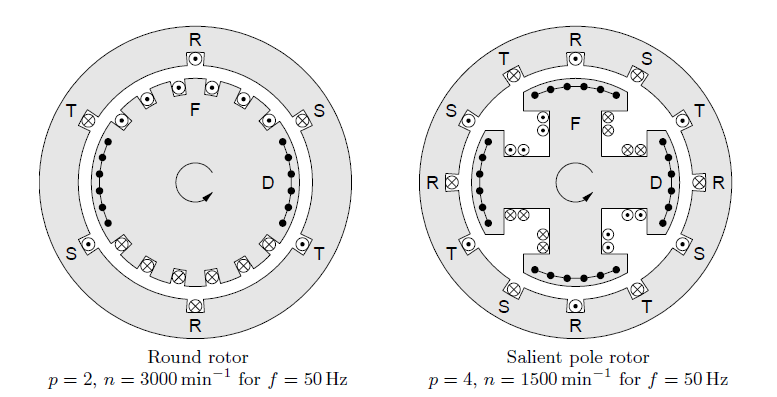
There are two main types of rotors used in synchronous motors:
- Salient Pole Rotor: In this type of rotor, the pole pieces (known as salient poles) project outward from the rotor surface. The pole pieces are made of laminated steel to reduce eddy current losses. The rotor windings are wound around these poles, and they can be excited with a DC to create the magnetic field.
- Non-Salient Pole (Cylindrical) Rotor: This type of rotor has a cylindrical shape without protruding poles. The rotor is either made of a permanent magnet or has a DC-excited winding embedded within it. Permanent magnet rotors have interests that generate a constant magnetic field, while DC-excited rotors require a DC to create the magnetic field.
Excitation System
An excitation system is used to supply DC to the rotor winding for synchronous motors with a wound rotor. This excitation system ensures that the rotor’s magnetic field remains synchronized with the stator’s rotating magnetic field. The excitation can be provided by an external DC power source or a separate exciter mounted on the motor shaft.
Bearings
Synchronous motors have bearings that support the rotor shaft and allow it to rotate smoothly within the stator. Depending on the motor’s size and application, various approaches can be used, such as ball or sleeve bearings.
Frame and Enclosure
The motor’s frame is a rigid structure that houses all the internal components and provides mechanical support. The frame is usually steel and has openings for ventilation to dissipate heat generated during motor operation. The enclosure protects the motor from environmental factors, dust, and moisture, and it also contributes to the overall safety of the engine.
Principle of Operation

Now there is a reaction between the stator and rotor poles. Like poles NS and Nr of stator and rotor repel each other. Because the stator field moves in a clockwise direction, Nr and Sr of the rotor tend to rotate in the anticlockwise direction.
Half a cycle later, the position of the stator poles is interchanged due to RF. This reverse of stator polarity is very rapid. Ns is at point Y and SS is at point X. Now Ns attracts Sr, and Ss attracts Nr. The rotor now tends to rotate clockwise; thus, the rotor is faced with a torque changing in quick succession in every half cycle. First, the rotor moves in an anticlockwise direction and then in a clockwise direction at every half of a process. Due to inertia, the rotor cannot move in any direction and becomes stationary. Therefore the synchronous motor has no starting torque and cannot start independently.
- Synchronous motors operate based on a rotating magnetic field created by the stator windings.
- AC in stator windings generates the rotating magnetic field.
- The rotor turns at the same speed as the rotating magnetic field.
- A consistent gap is maintained between the stator and rotor.
- Rotor locks in step with the rotating field.
- The interaction of stator and rotor fields generates torque.
- Synchronous motors have zero slips for precise speed control.
- They are used when constant speed is crucial, like power generation.
- High efficiency due to minimal slip losses.
- A permanent magnet or field-wound type.
- I am adjusting excitation for power factor correction.
- Field-wound type allows controllable parameters.
- Lower starting torque compared to induction motors.
- Excitation changes alter the power factor and phase angle.
- Maintaining synchronization is essential.
- They can operate as generators when mechanically driven faster.
- Synchronous speed depends on frequency and poles.
- Stable operation under varying loads.
- More complex due to synchronization and excitation.
- Modern control systems enhance adaptability
Conclusion
By understanding the convoluted principles, we gain insight into how synchronous motors harness the power of electromagnetic fields and synchronous speed to deliver consistent performance. Their ability to maintain synchronous operation, even under diverse loads, requires them in various industrial applications.