Capacitance of Parallel Plate Capacitor: Key Concepts Explained
When you think about the capacitance of a parallel plate capacitor, you’re considering how it stores electric charge based on simple yet critical factors: the permittivity of the material between the plates, the area of the plates, and the distance separating them. Adjusting these can greatly impact the capacitor’s performance in electronic circuits. Imagine tailoring a capacitor’s efficiency just by tweaking these variables. But how do these changes affect the overall functionality of a device? Understanding this relationship isn’t just theoretical—it’s the key to accessing the potential of modern electronics.
Key Takeaways
- Capacitance is calculated using the formula C = ε₀ * A / d, where A is plate area and d is separation distance.
- Increasing the plate area or using a high dielectric material enhances the capacitance of a parallel plate capacitor.
- Capacitance is inversely related to plate separation, meaning reducing the gap increases stored charge.
- Dielectric materials between plates boost capacitance by polarizing and strengthening the electric field.
- Understanding these factors helps optimize capacitors for efficient energy storage in electronic devices.
Understanding Capacitance Basics
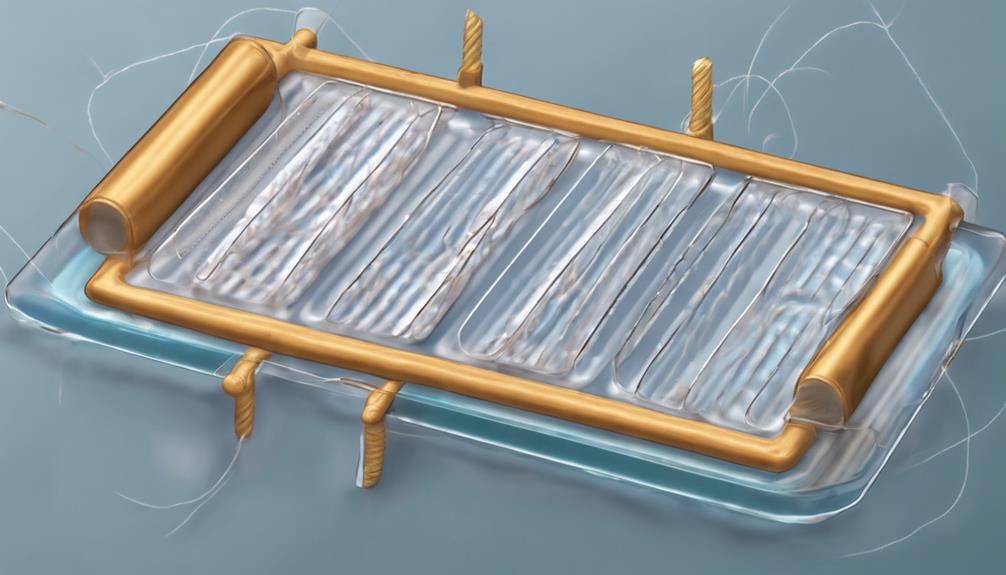
Capacitance plays a significant role in the functionality of a parallel plate capacitor. Capacitance is the ability of the capacitor to store electric charge. Imagine two plates facing each other; these plates hold the charge, and the amount they can store depends on several factors.
First, consider the separation distance between the plates. The closer they are, the stronger the electric field and the more charge they can store.
Another essential factor is permittivity, a material property between the plates that affects how well the electric field can be established. Higher permittivity means better electric charge storage, enhancing the capacitor’s overall capacitance.
The size of the plates also influences capacitance; larger plates can hold more charge because they provide more surface area.
Understanding these basics is crucial because higher capacitance values mean a greater capacity for stored charge, which is key to designing effective circuits and electronic devices. By controlling factors like plate size, separation distance, and permittivity, you can optimize a capacitor’s ability to store energy effectively.
Calculating Capacitance Formula
Imagine two metal plates in a parallel plate capacitor, poised to store energy. Understanding how to calculate the capacitance of these plates is essential for designing effective circuits. The formula you’ll use is C = ε₀ * A / d. Here, C represents capacitance, ε₀ is the permittivity of free space (approximately 8.854 x 10^-12 F/m), A is the plate area, and d is the separation distance between the plates.
The permittivity factor, ε₀, plays a pivotal role in determining how well the capacitor can store electric fields between the plates. A key takeaway is that capacitance is directly proportional to the plate area. This means that if you increase the area of the plates, the capacitance also increases, allowing more energy to be stored.
Conversely, capacitance is inversely related to the separation distance. As the distance between the plates decreases, the capacitance increases, strengthening the electric fields. This inverse relationship highlights the importance of carefully considering the separation distance in your designs.
Mastering this formula enables you to tailor capacitors for various electronic applications, optimizing energy storage based on your needs.
Role of Dielectric Materials
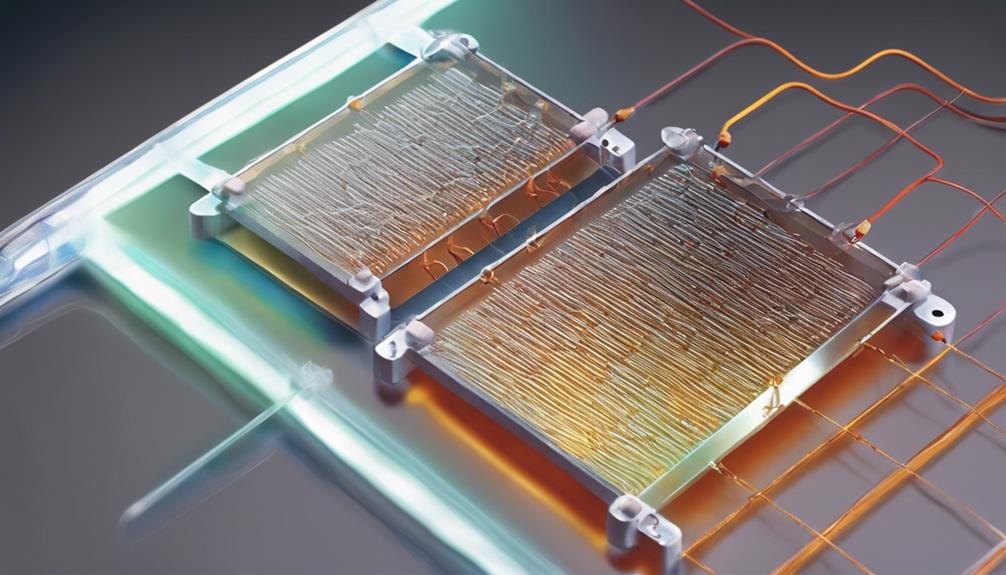
Incorporating dielectric materials into a parallel plate capacitor can greatly enhance its performance. When these materials are added between the plates, they increase the capacitor’s capacitance by polarizing and strengthening the electric field. This polarization allows the capacitor to store more charge without a dielectric.
Fundamentally, the dielectric materials work their magic by reducing the electric field strength between the plates, enabling more energy to be stored in the electric field.
The effectiveness of these materials largely depends on their dielectric constant (k). A higher dielectric constant signifies a greater ability to increase capacitance. So, to boost your capacitor’s charge storage capacity, choosing a material with a high dielectric constant is key.
Different materials come with varying dielectric constants and strengths, which significantly impact the overall capacitance of the system.
Electric Field Influence
When considering the electric field’s influence on a parallel plate capacitor, you need to focus on the uniform electric field created by the voltage difference and the separation between the plates. This electric field directly affects the capacitance of the capacitor, which is how much charge it can store.
Uniform Electric Field
The electric field in a parallel plate capacitor is consistently even, meaning its intensity and orientation don’t vary between the plates. This even electric field between two plates is a defining characteristic of parallel plate capacitors. It’s essential because it directly influences how charges distribute themselves across the surfaces.
The electric field strength depends on the voltage difference and the distance between the plates, determining how much energy is stored in a capacitor. Furthermore, inserting a dielectric material between the plates can impact this field, typically enhancing the capacitor’s ability to store charge by reducing the field strength for a given charge.
You’ll find that the electric field always points from the positive plate to the negative one. This consistent direction is crucial for understanding how capacitors function in circuits. The even field guarantees the entire plate surface experiences the same force on charges, contributing to efficient energy storage and retrieval.
Recognizing these principles helps you grasp how capacitors behave in various electronic applications. Whether you’re designing circuits or studying their fundamentals, appreciating the even electric field’s role is necessary for leveraging capacitors effectively.
Voltage and Separation
The uniform electric field in a parallel plate capacitor is essential to understanding how voltage and separation affect its performance. When you apply voltage across the parallel plates, you set up an electric field between them. The strength of this electric field is directly proportional to the voltage applied. Increase the voltage, and you’ll boost the electric field intensity, influencing how much charge the capacitor can store.
Now, consider the separation distance between the plates. This distance impacts the electric field strength; a smaller separation means a stronger electric field. The capacitance of a parallel plate capacitor is inversely related to this separation distance. So, if you decrease the distance between the plates, you enhance the capacitance, allowing for more charge storage.
Understanding these relationships is crucial. The electric field remains uniform, with lines running perpendicular to the plates and moving from the positive to the negative plate. Balancing voltage and separation distance helps optimize capacitance and charge density.
Dielectric Impact Analysis
Introducing a dielectric material into a parallel plate capacitor fundamentally changes how the electric field behaves between the plates. When you add a dielectric, it alters the electric field strength, reducing its intensity. This happens because the dielectric material works to oppose the electric field created by the charges on the plates.
As a result, the capacitor’s ability to store charge improves, boosting its capacitance and energy efficiency.
The key to understanding this enhancement lies in the dielectric’s relative permittivity, also known as the dielectric constant. A higher relative permittivity means that the dielectric can store more electric energy, which translates to a greater increase in the capacitor’s overall capacitance.
With an optimized choice of dielectric, you can significantly enhance charge storage capacity, making the capacitor more efficient.
To truly optimize your capacitor’s performance, consider how different dielectrics affect the electric field. The choice of dielectric material can substantially affect how effectively the capacitor functions, especially in applications requiring high energy efficiency.
Practical Calculation Examples
When tackling practical calculation examples for a parallel plate capacitor, applying the formula C = ε₀ * A / d is important. This formula is your guide to determining the capacitance of a parallel plate capacitor. Here, ε₀ represents the permittivity of free space, A stands for the plate area, and d denotes the plate separation. By adjusting these variables, you can optimize the capacitor’s efficiency in energy storage, which is essential for electronic circuits. Understanding this relationship is crucial for electrical engineers who design and improve electronic devices.
Let’s consider a practical example. Suppose you need to calculate the capacitance for a capacitor with a plate area of 0.02 square meters and a separation of 0.001 meters. Using the permittivity of free space value, ε₀ = 8.85 x 10⁻¹² F/m, plug these values into the formula. You get C = 8.85 x 10⁻¹² * 0.02 / 0.001, resulting in a capacitance of 1.77 x 10⁰ farads. This calculation is essential to ensuring devices like smartphones and computers operate efficiently. Mastering these calculations will enhance your capability to contribute significantly to advanced electronic applications.
Applications in Electronics
Building on the practical calculations, you’ll find that capacitors are fundamental in electronics, playing an important role in storing energy and filtering signals. At the core of this function is the capacitance of a parallel plate capacitor, which determines how efficiently it can store electric charge. These capacitors are composed of two conducting plates separated by an insulating material. The material between the plates is essential as it influences how much charge can be stored per unit voltage.
Capacitors are indispensable components in devices like smartphones, computers, and power supplies.
Imagine the following scenarios where capacitors enhance electronic systems:
- Smartphones: Capacitors stabilize voltage to guarantee smooth operation, even with fluctuating power sources.
- Computers filter out noise, improving the clarity and reliability of data signals transmitted through circuits.
- Power supplies: Capacitors store energy and release it when needed, ensuring consistent power delivery.
- Audio systems enhance sound quality by smoothing out fluctuations and reducing distortion.
Understanding the capacitance of parallel plate capacitors allows you to optimize energy storage and circuit design, ultimately boosting the performance and efficiency of electronic devices. Capacitors in electronics aren’t just passive components; they’re the unsung heroes stabilizing and enhancing your everyday tech experiences.
Conclusion
Understanding the capacitance of a parallel plate capacitor, you’ve explored core factors like permittivity, plate area, and separation distance. By mastering the calculations and recognizing the impact of dielectric materials and electric fields, you’re now equipped to optimize capacitors for electronic devices. Whether in smartphones, computers, or power supplies, your ability to adjust these variables guarantees efficient energy storage and signal filtering, enhancing the performance and reliability of modern electronics.
FAQs
1. How to Calculate the Capacitance of a Parallel Plate Capacitor?
To calculate capacitance, consider the dielectric material and permittivity constant. Analyze the electric field, plate separation, and voltage difference. Evaluate how charge distribution impacts energy storage. Use the formula involving these factors for accurate results.
2. What Is the Formula for Parallel Capacitance?
To find the formula for parallel capacitance, consider dielectric material and capacitor geometry. The electric field affects energy storage, and voltage difference and plate separation influence charge distribution. Understanding this helps in optimizing devices for better performance.
3. What Is the Capacitance of a Capacitor in Parallel?
When calculating the capacitance of capacitors in parallel, consider the dielectric material, distance between plates, and electric field. These factors impact charge storage and energy storage. Effective capacitor design optimizes capacitance calculation for better performance in electronic applications.
4. What Is the Capacitance of a Parallel Plate Capacitor Having Plates?
You’ve got a parallel plate capacitor, and its capacitance depends on energy storage, dielectric material, plate separation, electric field, charge distribution, voltage difference, and capacitor construction. Adjust these factors to influence how well it stores charge.