Exploring the Marvelous Applications of Hall Effect
When we delve into physics, we often encounter concepts that help us understand the universe’s fundamental principles and find practical applications in our everyday lives. One such phenomenon is the Hall effect, a fundamental concept that has found its way into numerous technologies and industries. This comprehensive guide will explore the intriguing principle of the Hall effect, the underlying theory, and its wide-ranging applications in various fields.
Understanding the Principle of Hall Effect
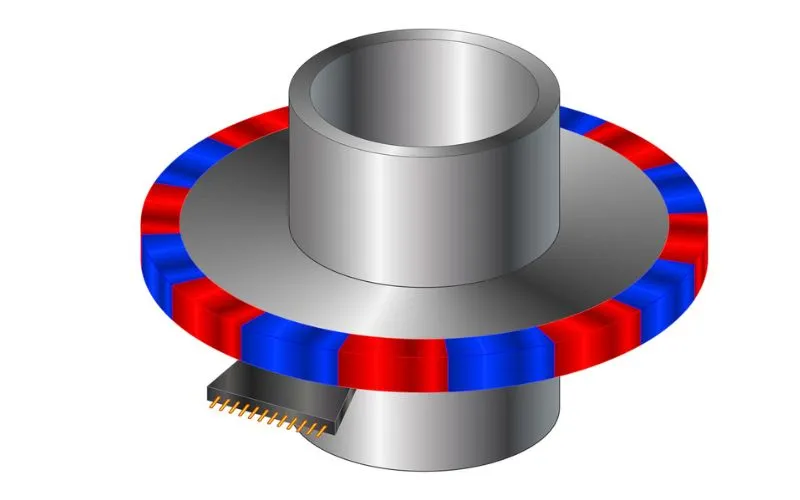
The Hall Effect is a phenomenon discovered by physicist Edwin Hall in 1879, where an electric voltage is generated perpendicular to the flow of current in a conductor under the influence of a magnetic field. It’s a fundamental concept that forms the basis for various practical applications, from magnetic field sensing to current measurement.
What is the Hall Effect?
The Hall effect is a fundamental phenomenon discovered by American physicist Edwin Hall in 1879. It refers to generating an electric voltage across a conductor transverse to an electric current and a magnetic field. This voltage, known as the Hall voltage, is a direct result of the motion of charged particles, typically electrons, within the conductor when subjected to a magnetic field.
How Does the Hall Effect Work?
The Hall effect occurs due to the Lorentz force acting on moving charged particles. Electrons move in a specific direction when an electric current flows through a conductor. When a magnetic field is applied perpendicular to the current flow, it exerts a force on these moving electrons, causing them to deviate from their original path. As a result, a voltage difference is created across the conductor, leading to the Hall voltage.
Exploring the Theory Behind the Hall Effect
Quantum Mechanics and the Hall Effect
The Hall effect can be understood more deeply through quantum mechanics. According to this theory, electrons exhibit wave-like behavior and occupy energy levels within the conductor’s atomic structure. When subjected to a magnetic field, these energy levels split into discrete Landau levels, causing electrons to follow curved paths. This phenomenon ultimately leads to the generation of the Hall voltage.
Hall Coefficient and Mobility
The Hall coefficient (R_H) is crucial in understanding the Hall effect. It quantifies the relationship between the induced Hall voltage, the current, and the magnetic field. Mobility (μ) of charge carriers in the conductor also plays a significant role. It represents the ease with which electrons move through the material and directly affects the magnitude of the Hall voltage.
Applications of the Hall Effect
The Hall effect may have been discovered over a century ago, but its applications continue to shape our modern world. Here are some of the remarkable areas where the Hall effect finds practical use:
Magnetic Field Sensing
The Hall effect is extensively used in sensors for measuring magnetic fields. Hall effect sensors are employed in various devices, including compasses, automotive applications (speed sensors and ignition control), and industrial equipment to detect and measure magnetic fields accurately.
Current Measurement
In electronic circuits, accurately measuring current is crucial. Hall effect current sensors offer a non-contact method for measuring electrical current. These sensors find applications in power distribution, electric vehicles, and renewable energy systems, ensuring precise monitoring and control.
Proximity and Position Sensing
The Hall effect is employed in proximity sensors and position sensors. These sensors can detect the presence or absence of a magnetic field or determine the precise position of an object. Applications range from detecting the opening and closing of laptop lids to ensuring the correct operation of touchless faucets in public restrooms.
Speed Detection in Rotating Machinery
Hall effect sensors detect the speed and direction of rotation in machinery such as fans, motors, and gears. This information is crucial for maintaining optimal performance, preventing overheating, and ensuring safety in various industrial processes.
Hall Effect Thrusters in Spacecraft
In aerospace engineering, the Hall effect is utilized in Hall effect thrusters. These propulsion systems use electromagnetic fields to accelerate ions and generate thrust in spacecraft, making them efficient and ideal for long-duration missions, such as deep-space exploration.
Advancements and Future Prospects
As technology advances, the Hall effect’s applications are likely to expand even further. Researchers are exploring new materials and techniques to harness the Hall effect innovatively. For instance, developing topological insulators has opened up possibilities for creating novel electronic devices with unique properties.
Conclusion
Initially a scientific curiosity, the Hall effect has evolved into a cornerstone of modern technology. Its ability to convert the interaction between magnetic fields and moving charge carriers into useful electrical signals has made it indispensable in numerous applications. From enhancing our understanding of fundamental physics to enabling cutting-edge technologies, the Hall effect plays a pivotal role in shaping our world. As we push the boundaries of scientific discovery and technological innovation, the Hall effect will remain vital to our future endeavors.
FAQs
1. What are the key components of the Hall effect?
The key components of the Hall effect include a conductor, an electric current passing through it, and a magnetic field applied perpendicular to the current flow. When these elements interact, the Hall voltage is generated.
2. How is the Hall effect used in everyday life?
The Hall effect has a wide range of practical applications, including magnetic field sensing, current measurement, proximity and position sensing, speed detection in rotating machinery, and propulsion systems for spacecraft.
3. What are some recent advancements in Hall effect technology?
Recent advancements include the exploration of topological insulators and their potential for creating innovative electronic devices. Additionally, ongoing research seeks to improve the sensitivity and precision of Hall effect sensors for various applications.