What Is LVDT? | Working Principle & Applications
You’re likely familiar with many measurement devices, but have you ever wondered about the intricacies of an LVDT? As a Linear Variable Differential Transformer, it plays a key role in precise linear position measurements. With its unique arrangement of coils and a movable core, it transforms movement into electrical signals. But how exactly does it achieve such accuracy, and what makes it indispensable in aerospace and robotics? Let’s explore its fascinating mechanics.
Key Takeaways
- LVDT stands for Linear Variable Differential Transformer, a type of linear position transducer.
- It consists of a primary and two secondary coils with a ferromagnetic core that moves freely.
- LVDTs operate on mutual inductance, producing voltage outputs proportional to core position.
- They provide high precision and reliability and are used in industries like aerospace and robotics.
- LVDTs offer frictionless operation and high durability and function well in extreme conditions.
Understanding the Structure of an LVDT
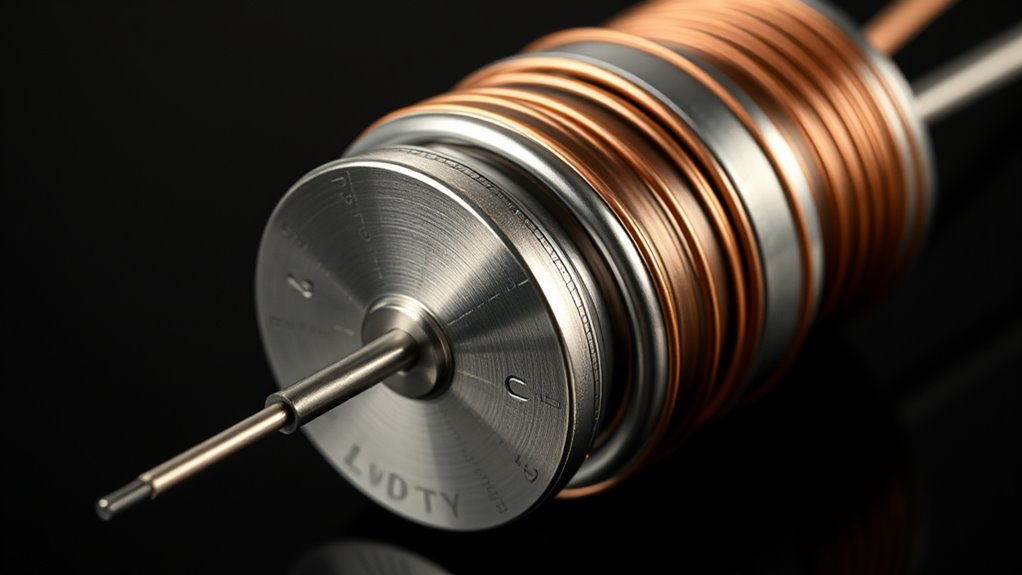
When diving into the structure of an LVDT (Linear Variable Differential Transformer), you’ll find it consists of three distinct coils. A primary coil is centrally located, flanked by two secondary coils that are electrically 180 degrees out of phase.
When you apply alternating current, the primary coil generates a varying magnetic field. This magnetic field interacts with a cylindrical ferromagnetic core that slides within an insulated tube, ensuring frictionless operation.
As the core moves, it induces voltages in the secondary coils. The LVDT’s output voltage, known as the differential voltage, reflects the core’s position, offering precise direction and amplitude data.
Thanks to its robust design, the LVDT accommodates diverse environmental conditions, maintaining precision and durability without physical wear.
Principles of Operation
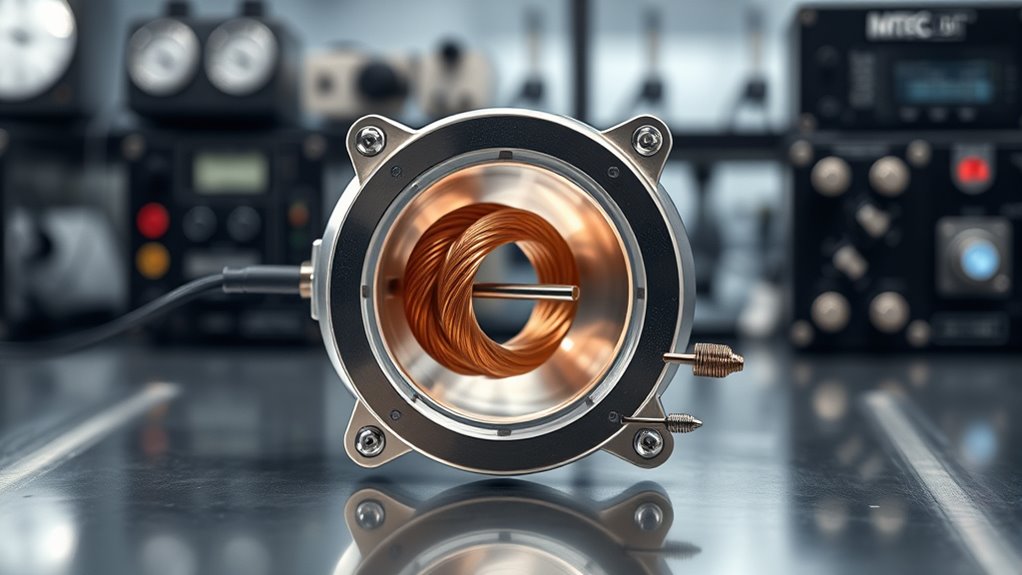
With a clear understanding of the LVDT’s structure, let’s explore how it operates.
The LVDT functions as a linear transducer using the principle of mutual inductance. Its core design applies an alternating current to the primary coil, creating a magnetic field. This field induces voltages in the two secondary coils based on the position of a ferromagnetic core sliding within the device.
As the core moves, the induced voltages in the secondary coils change, which affects the output voltage. This differential output voltage linearly correlates with the core’s position, indicating the direction and magnitude of linear displacement.
At the null position, induced voltages equalize, producing zero output. Modern LVDTs often use signal conditioning to convert this AC signal into a usable DC format.
Types and Applications of LVDTs
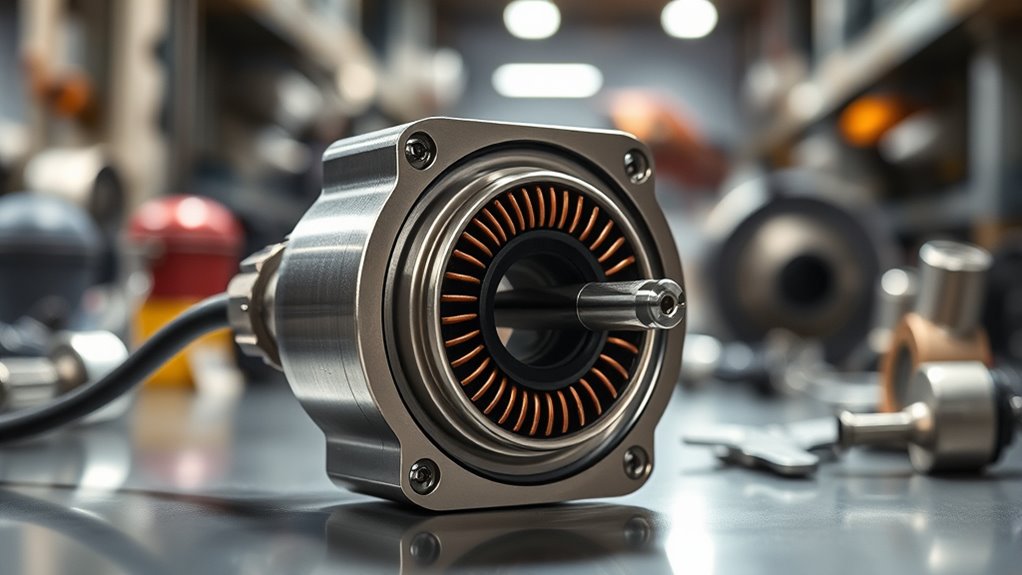
Although LVDTs might seem complex, they come in various types, each designed for specific applications.
These sensors are essential in many fields, from Miniature DC Output Displacement Transducers to Force-Extended Actuators. They’re widely used in industrial applications for precise position feedback in servomechanisms and automated measurement systems.
LVDTs guarantee high accuracy and reliability in robotics. Aerospace industries rely on them for critical system monitoring, such as landing gear positioning.
Here’s what to take into account:
- Measurement ranges: From 0.02 mm to ±20.0 mm.
- Operating temperatures: Suitable for -32ºF to 257ºF.
- Applications: Robotics, aerospace, and industrial settings.
- High-accuracy models: Like the LD320 series for demanding environments.
- Accuracy: Defined by percentage deviation, guaranteeing precise measurements.
Advantages of Using LVDTs

Even though LVDTs might initially seem intricate, their advantages make them an invaluable choice for precision measurement tasks.
As a linear displacement transducer, an LVDT offers frictionless operation, leading to virtually infinite mechanical life. This guarantees reliable measurements without the wear and tear typical of contact-based systems.
With outstanding repeatability and linearity, they’re perfect for applications requiring precise, consistent outputs. Their robust design allows them to withstand harsh conditions, including high vibrations and temperatures from -32ºF to over 257ºF.
Their versatility is evident as they remain functional as absolute position sensors, retaining accurate data even after power loss. Insensitivity to cross-axis motion further enhances their reliability, making them essential in various demanding environments.
Key Specifications and Selection Criteria
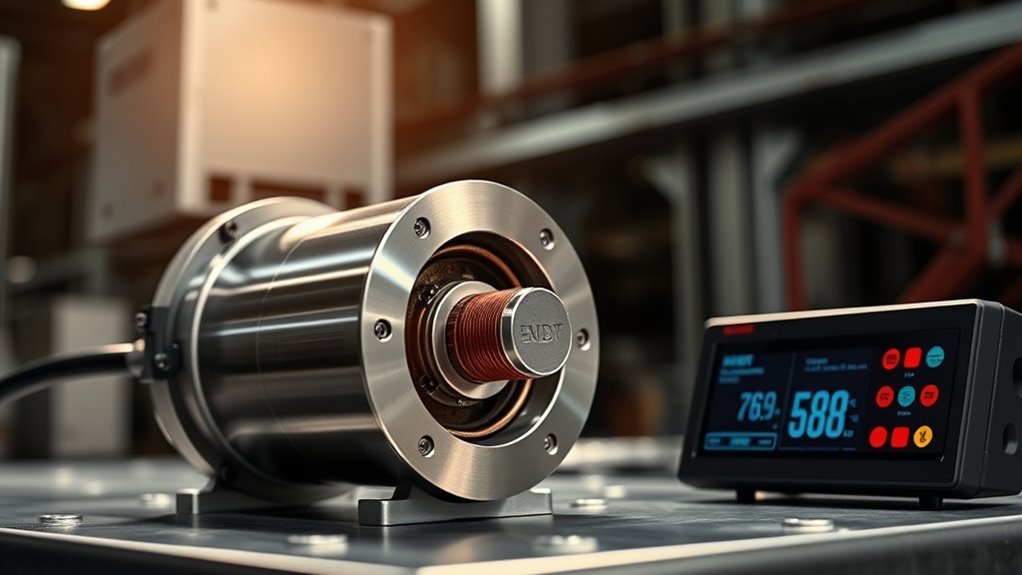
Selecting the right LVDT hinges on understanding its key specifications, which guarantee peak performance for your application.
You’ll want to consider several essential factors when evaluating displacement transducers for industrial applications.
- Linearity: Measures how much the output deviates from the ideal straight-line relationship, expressed as a percentage.
- Measurement Ranges vary from 0.02 mm to ±20.0 mm, offering flexibility for different tasks.
- Accuracy: Defines the percentage deviation from actual measurement values, which is vital for precision.
- Output Options: Include voltage output signals, current, or frequency, allowing for versatile system integration.
- Operating Temperature: Ranges from -32ºF to over 257ºF, ensuring suitability for various environments.
These selection criteria help you choose an LVDT that meets your specific needs.
Electrical Operation and Signal Conditioning
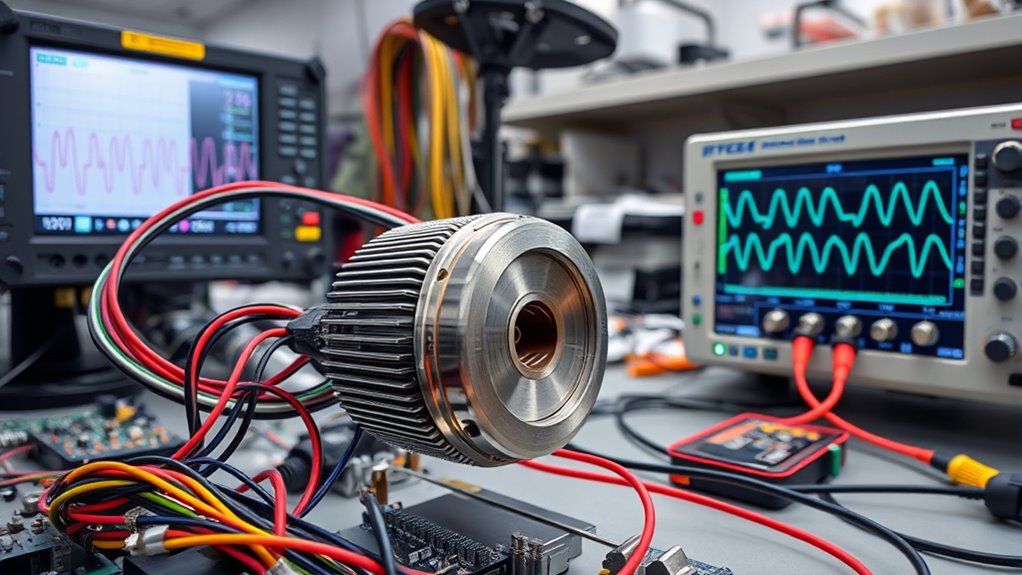
The electrical operation of an LVDT consists of three fundamental components: the primary winding and two secondary windings. Applying AC excitation to the primary winding creates mutual inductance, inducing currents in the secondary windings.
The differential voltage between these secondary coils forms the LVDT’s output voltage, varying linearly with core displacement. This output voltage indicates the direction and amplitude of the core’s movement.
Signal conditioning is essential in converting this electrical signal from AC to a usable DC voltage. A demodulator is typically used for this, ensuring accuracy and minimizing drift.
Modern systems might operate directly with DC but retain AC characteristics through effective signal conditioning, improving their versatility across different applications.
Innovations and Future Trends in LVDT Technology

Innovations in LVDT technology are transforming the landscape with high-precision measurement advances, offering enhanced accuracy and flexibility.
Manufacturers focus on creating robust housings that withstand harsh environments, ensuring reliability even in extreme conditions.
As signal processing technologies improve, expect LVDTs to provide superior data acquisition and real-time monitoring, making them indispensable across various industries.
High-Precision Measurement Advances
As LVDT technology advances, high-precision measurement is becoming increasingly attainable due to recent innovations. High-accuracy AC LVDT displacement sensors can now achieve remarkable measurement precision, with accuracy levels within ±0.1% of full scale.
Enhanced signal conditioning modules support improved processing, enabling LVDTs to operate in various configurations efficiently. These advancements include:
- Miniature Sensors: Perfect for compact spaces in aerospace and robotics, maintaining high performance.
- Digital Output: Facilitates seamless integration with modern control systems in industrial automation.
- Hermetically Sealed Designs: Boosts robustness for extreme conditions, enhancing performance stability.
- Industrial Automation: Improved integration and data transmission capabilities for better control.
- Performance Stability guarantees long-term reliability even in harsh environments, reinforcing trust in LVDT applications.
Enhanced Environmental Durability
While LVDT technology continues to evolve, enhanced environmental durability is at the forefront of recent innovations.
Hermetically sealed sensors provide unmatched protection against moisture and corrosive environments, ensuring LVDTs perform reliably even in harsh conditions.
With new materials and coatings, LVDTs withstand extreme temperatures, from cryogenic levels to over 1200°F, without sacrificing performance.
Advancements in magnetic shielding considerably reduce electromagnetic interference, enhancing robustness in noisy industrial settings.
Epoxy encapsulation techniques extend operational life by offering moisture resistance and durability against vibration and shock.
Smart sensor technologies promise to increase LVDT versatility, enabling real-time monitoring and diagnostics in challenging environments and ensuring these sensors remain reliable and efficient for years.
Signal Processing Innovations
Signal processing innovations in LVDT technology are revolutionizing the way these sensors operate. By incorporating advanced LVDT signal conditioning, you can achieve enhanced accuracy in measurement precision.
These innovations utilize phase synchronous demodulation techniques to stabilize the output voltage, reducing circuit drift and enhancing reliability. The high-accuracy AC LVDT displacement sensors, like the LD320 series, thrive in harsh environments, maintaining performance despite high vibration and shock.
- Versatility: Direct current operation retains alternating current benefits.
- Precision: Phase synchronous techniques improve output voltage accuracy.
- Durability: Hermetically sealed probes guarantee function in extreme conditions.
- Compactness: Miniature LVDTs fit aerospace and defense requirements.
- Reliability: High-accuracy sensors withstand harsh environments.
These advancements broaden the operational scope of LVDTs, making them indispensable in various fields.
Conclusion
Thanks to their clever structure and operation, you’ve learned that LVDTs are essential for precise linear position measurement. They’re versatile, finding uses in fields like aerospace and robotics. With benefits like high accuracy and reliability, LVDTs stand out among position sensors. When selecting one, focus on key specifications and consider signal conditioning needs. As technology advances, expect innovations that enhance LVDTs’ performance, making them even more crucial in various applications.
FAQs
1. Is LVDT an Inductive Transducer?
You’re curious if an LVDT is an inductive transducer. It is, indeed. It uses mutual inductance between coils to measure linear displacement, offering high sensitivity and repeatability because there’s no mechanical wear involved.
2. Is LVDT an Active Transducer?
You might think an LVDT is active, but it’s passive. It doesn’t generate energy; it converts mechanical motion into an electrical signal, needing an external power source. LVDTs provide reliable, consistent measurements.
3. What Are the Advantages and Disadvantages of LVDT?
LVDTs offer advantages like infinite resolution and robust environmental resistance. However, they also have disadvantages, such as sensitivity to electromagnetic interference and the need for external signal conditioning. Proper shielding is essential.
4. What Is an Example of an LVDT Sensor? Are you curious about LVDT sensors?
Look at the LD400 series. It’s a miniature DC output displacement transducer that is perfect for precise measurements in tight spaces. The LD320 offers high accuracy, while the LD620 excels in harsh environments.