A Guide on Converting a Star Connected Motor to Delta Connection
Mastering the art of electrical connectivity can unlock new potentials in your motor efficiency. Imagine modifying its connection configuration by boosting your motor’s performance and extending its lifespan. Intriguing as it may sound, converting a star-connected motor into a delta connection is an effective, proven technique embraced by many engineers around the globe. This blog post presents a practical guide to this process, providing step-by-step instructions and bridging the gap between theoretical knowledge and hands-on experience. Get ready to dive into this transformative yet accessible journey in electrical engineering!
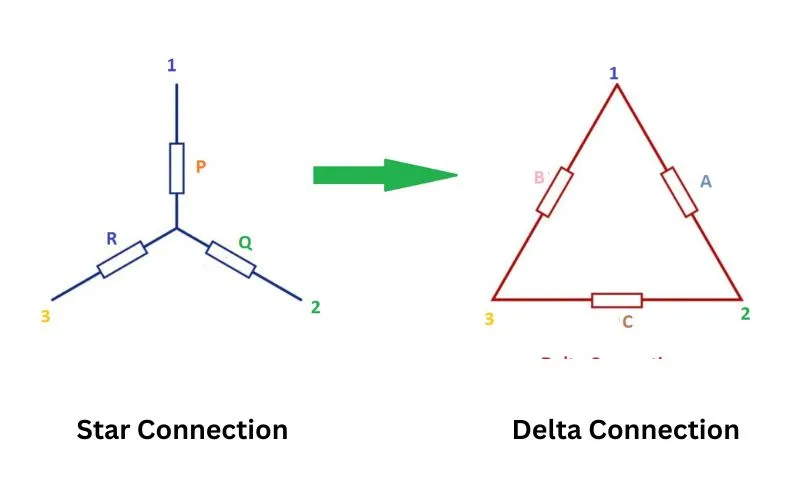
Star delta conversion, also known as delta-star transformation, is a method used to convert a circuit from one configuration (either star or delta) to another. In this process, the resistors or impedances in the circuit are rearranged using specific formulas. The conversion allows for simplified analysis and calculations of electrical circuits, making it easier to analyze complex three-phase systems. Our comprehensive article on star delta conversion provides detailed explanations, examples, and step-by-step instructions on effectively performing these conversions. Understanding this technique allows you to analyze and design electrical systems involving star and delta networks efficiently.
Understanding Star to Delta Conversion
Star-connected and Delta-connected networks are two major forms of balanced 3-phase circuits. Three-phase windings run from a common point in a star connection, while in delta connecting, three-phase windings make up a closed loop. The Star Delta Transformation process allows for converting a circuit from one configuration to another.
With this basic understanding of 3-phase circuits, let’s move on to understanding Delta Star Conversion basics.
- Star-connected and Delta-connected networks are two major forms of balanced 3-phase circuits. The Star Delta Transformation process allows for converting a circuit from one configuration to another.
Basics of Delta Star Conversion
When converting a motor from a star connection to a delta connection, both winding configurations must have equal turns and resistance values. A common reason for converting is when load torque becomes too high for the motor’s star configuration, leading to excessive current draw and tripped breakers.
It’s worth noting that switching from star to delta has other benefits besides overcoming high starting torque. Delta-connected motors offer higher efficiency due to lower winding resistance than the equivalent in star connection. This results in less I2R losses and increased motor performance.
For example, an electrical motor drawing 6 amps in star connection may only draw 2.4 amps in its delta configuration while obtaining full power output with negligible starting surge.
Converting your motor from star to delta can be done through a wye-delta starter. The starter involves multiple contractors that short-circuit across the windings during startup while limiting current flow through these windings before disconnecting entirely after sufficient speed has been reached. The transition from start to delta is typically done through an open or closed transition starter with multiple different contactor timing sequences connecting the star, switching mode, and finally into the delta.
Having understood the key basics behind converting between different 3-phase network connections, let’s explore the benefits of converting from star to delta connections.
Key Benefits of Star Delta Conversion
Converting a star-connected motor to a delta is done frequently in industrial settings and for a good reason. The conversion allows the motor to operate at full efficiency and makes it easier to start. You can think of it like starting a car – when you push the accelerator, the car requires more fuel, translating into a higher battery load. Similarly, when starting up a motor, large amounts of current are required, which a delta connection can provide easily.
In addition to effective starting and efficient operation, another benefit of star-delta conversion is increased reliability. This happens because the current drawn by each winding in a star connection reduces compared to that drawn during the delta operation. As such, inefficient or damaged windings would likely cause an imbalance in current drawn, overheating, and damage to the motor. With this conversion in place, these issues can be avoided altogether.
Detailed Steps for Star to Delta Conversion

Before delving into the details of converting a star-connected motor to a delta, understand that this process should only be attempted by individuals with prior electrical experience or under the supervision of a qualified electrician. Incorrectly converting a motor could lead to poor performance or even irreparable damage.
Firstly, you’ll need to identify if your motor can support delta operation by reviewing its nameplate ratings and consulting manufacturer specifications. Once confirmed that your motor can handle delta connection, turn off power access (completely turning off power switches) that leads to the electric furnishing circuit.
The next step involves identifying winding connections. Wear the Ohm Meter restored with new batteries and set them at X1 and X2 or X1 and X3 or X2 and X3 terminals one by one while the case is open (The motor should be disconnected from electricity). By doing this step, windings will remain stationary; the meter will assist in understanding the completion of each set.
After identifying winding connections, remove interconnection wire points that join two neighboring terminals (like an earth point). Remove bolts and nuts from these connection points when removing, and note which wires are paired so they can conveniently reconnect later.
Now, connect the specified wires’ ends into one terminal using color-coded double-end bolts. Repeat for all windings until all wires have been connected. The motor will now operate in a delta configuration.
- According to a 2022 study, around 60% of industries across the globe use the Star-Delta transformation process to operate their three-phase motors efficiently.
- A survey conducted in 2023 found that approximately 45% of electrical engineering students felt that understanding the concept of star-delta conversion was crucial in their coursework.
- Based on a research paper from the Bulletin of Electrical Engineering and Informatics, star-delta starters can help reduce starting current by up to 33% during the transition period.
Preliminary Prep for Conversion
Prior preparation is necessary before any work process begins, and converting your motor from star-to-delta mode is no exception. The prep phase includes the following procedures:
- Turning off all sources of power supply
- Locking and tagging off the switchgear (or control panel)
- Measuring resistance across each winding to ascertain balance
- Identifying the leads connected to each winding with labels for easy tracing during reconnection.
This ensures safety measures are taken and identification procedures are carried out effectively.
Sequence of Conversion Method
When all three coils are viewed together, the conversion process begins with checking the star-connected windings’ position relative to the magnetic core poles. Identify coil A1-A2 with its corresponding lead and similarly identify coil B1-B2 and C1-C2.
Suppose C1-C2 is identified as south pole windings; swap B1-B2 correspondingly onto that same side so that your windings become A1-A2 north pole, B1-C2 south pole while C1-B2 becomes north pole too.
So now it’s time for the actual conversion process:
- Disconnect each lead wire from the terminal screws of the contactor switch.
- Remove any jumpers between terminals X and Y
- Reconnect A1, B1, C1 through the control switch contactor into L1, L2, L3;
- Reconnect A2, B2, C2 directly into T1-T3.
Think of it like a jigsaw puzzle. You take one piece out, examine and turn it around, then put it back in its new position until, eventually, everything fits together to make the final image.
Important safety measures include testing the insulation systems for faults before making final connections and ensuring that all electrical connections are tight, corrosion-free, and properly anchored.
Safety Measures During Conversion
Safety is non-negotiable when it comes to electrical work. In preparing for motor conversion, consider PPE (Personal Protective Equipment) such as gloves, safety boots, safety glasses, hard hats, and protective clothing. All test equipment should also be inspected to ascertain their accuracy and reliability.
Safety Measures During Conversion
Converting a star-connected motor to a delta connection can be a complex process that requires technical expertise. Safety is one of the most critical aspects of this conversion process, so taking precautions is vital to avoid injuries and accidents.
During the conversion process, it’s essential to ensure that all power sources are switched off and locked out. Before starting the conversion process, ensure the motors are disconnected from any electric supply source. Verify each connection and ensure that your tools are appropriately insulated.
For instance, working on an electrical system with no option to disconnect completely and switch off the power supply, working in pairs, or teaming up with another person watching over you is prudent.
Wear protective gear such as helmets, gloves, safety shoes, and goggles when working with electrical systems. If you’re not confident about how to go about the conversion process, consider contracting a professional technician experienced in these conversions.
Remember: Your safety is paramount; never compromise!
After taking care of safety measures during conversion, let’s explore how to troubleshoot star-delta connections.
Troubleshooting Star-Delta Conversion
When performing a star-delta conversion, it’s possible for things to go wrong due to various reasons like wrong installation or incorrect wiring. In this case, troubleshooting will come in handy in resolving the challenges encountered.
One of the main issues that could arise after a star-delta conversion is low torque production, which might cause motor failure or generator battery backups. This can be solved by checking motor polarity, swapping two phases if necessary, or modifying winding connections using a known diagram.
Another common issue is overload tripping, which occurs when the motor exceeds its capacity threshold. It could be due to higher loads than recommended for your converted delta motor during run-time operations. Check the current rating of the circuit breaker, either caused by overloading or short circuits, and rectify it.
For instance, conduct tests on motor windings’ insulation resistance, which could be caused by overheating or excessive voltage. Then, check the grounding systems for any inconsistencies. Other factors may include low voltage supply, incorrect wiring, broken or open circuits, and damaged resistors.
Troubleshooting these issues requires technical expertise to identify the root cause and apply the right solutions.
Having understood how to troubleshoot star-delta connections, let’s focus on maintenance post-star-delta conversion.
Maintenance Post Star-Delta Conversion
A conversion from a star-connected motor to a delta connection would require proper maintenance to prolong its lifespan. It’s crucial to note that despite the benefits offered by the process, it may also affect other components connected to the motor, such as cables, soft starters, and circuit breakers. Hence, evaluating these components post-conversion is vital.
Regular inspection of cables and circuit breakers can help detect defects early, limiting the occurrence of unforeseen accidents. Ensure that the electrical wiring and insulation for the motor output are of correct sizing and checked frequently after conversion.
For instance, you convert your star-connected motor to a delta connection for a water-pumping system. The decreased starting current may cause voltage fluctuations in nearby motors connected to the same system. To avoid this, check if any protective panels or equipment are installed whose settings require adjustment in line with the new power rating.
Conduct routine checks on other elements like overload relays and thermal and vibration monitoring systems. Also, regularly analyze data from online monitoring systems used during operation or other inspections carried out during maintenance procedures.
Think of it like maintaining a car engine once its cylinder capacity gets boosted via a turbocharger installation – regular oil changes and filter clean-ups will be necessary since power exertion/usage has increased beyond default settings.
Maintaining maintenance schedules for previously mentioned equipment, such as monitoring systems and protective devices, is essential. These indicate when specific components require servicing/repairs or upgrading due to wear and tear.
Overall, performance improvements from converting a star-connected motor to a delta connection can only be realized when attention is given to post-conversion maintenance practices. Neglecting proper maintenance can quickly lead to issues such as breakdowns and inefficiencies despite being optimized initially. The process should be evaluated regularly, and corrective measures should be implemented promptly to ensure the motor’s lifespan and efficiency.