A Guide to Unlocking the Potential of Astable Multivibrators
Astable multivibrators, also known as oscillators or free-running multivibrators, are essential electronic circuits widely used in various applications. These circuits are particularly popular among electronics enthusiasts, engineers, and hobbyists due to their versatility and straightforward design. In this in-depth guide, we will delve into the world of astable multivibrators, exploring their working principles, applications, advantages, and more.
What is an Astable Multivibrator?
An astable multivibrator is an electronic circuit that generates a continuous square wave output. It is characterized by its ability to continuously switch between its two unstable states without any external triggering. In simpler terms, it’s a free-running oscillator that constantly oscillates between high and low states.
Why are Astable Multivibrators Important?
Astable multivibrators play a crucial role in electronic circuit design. They are used for various purposes, including clock generation, signal generation, and timing applications. Their simplicity and reliability make them attractive to hobbyists and professionals.
Astable Multivibrator Basics
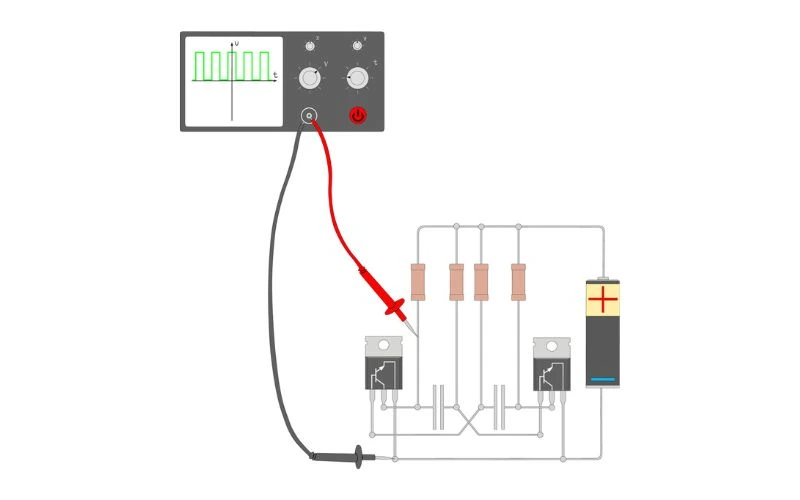
At its core, an astable multivibrator is a circuit continuously oscillating between its unstable states, creating a square wave output. This oscillation occurs due to the charge and discharge of capacitors within the circuit, resulting in a symmetrical square wave with a 50% duty cycle.
How does an Astable Multivibrator work?
An astable multivibrator typically consists of two transistors, capacitors, and resistors arranged in a feedback loop. The circuit is designed to continuously switch between its unstable states, creating a square-wave output. This switching action results from the circuit’s charging and discharging of the capacitors.
Operation in Astable Multivibrator
The operation of an astable multivibrator can be broken down into two phases:
- Charging Phase: During this phase, one capacitor charges while the other discharges.
- Discharging Phase: In this phase, the roles reverse, with the previously charging capacitor now discharging and vice versa.
This continuous charging cycle and discharging creates astable multivibrators’ square wave output characteristics.
Waveform of Astable Multivibrator
The waveform produced by an astable multivibrator is a symmetrical square wave. It has a 50% duty cycle, meaning that the high and low states are equal in duration. This makes it suitable for various timing and signal-generation applications.
Design and Components
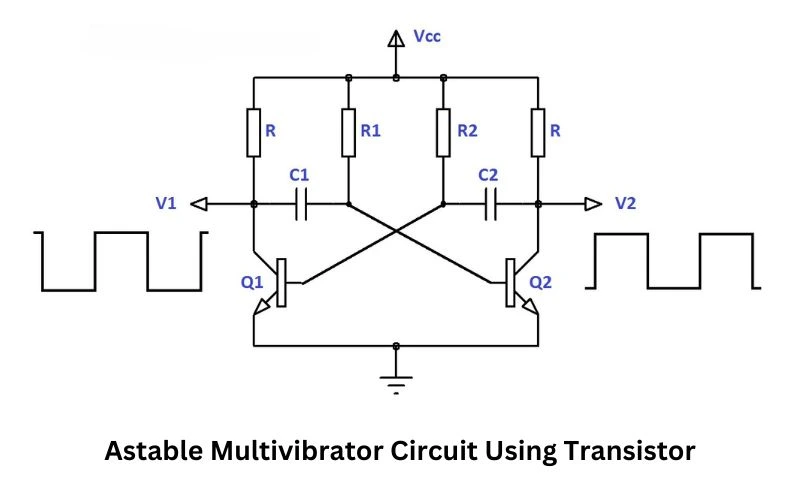
The design of an astable multivibrator typically involves transistors, resistors, and capacitors arranged in a specific feedback loop. The values of these components determine the circuit’s frequency and duty cycle, allowing for customization based on specific requirements.
Astable Multivibrator Circuit Using Transistor
The core components of an astable multivibrator circuit include two transistors, resistors, and capacitors. The arrangement of these components determines the circuit’s frequency and duty cycle. Here’s a basic schematic of an astable multivibrator circuit:
Frequency and Time Calculations of Astable Multivibrator
To calculate the frequency and time parameters of an astable multivibrator, you can use the following formulas:
- Frequency (f) = 1 / (2 * R * C)
- High Time (Th) = 0.693 * R1 * C1
- Low Time (Tl) = 0.693 * R2 * C2
- Duty Cycle = (Th / (Th + Tl)) * 100%
R and C are the circuit’s resistance and capacitance values, and R1, R2, C1, and C2 are the values of specific components.
Applications of Astable Multivibrator
Astable multivibrators find versatile applications in electronics, serving as clock generators, signal generators, and timers. They are used wherever precise timing and square wave signal generation are needed. Additionally, their simplicity and cost-effectiveness make them attractive for various DIY projects.
Where are Astable Multivibrators Used?
Astable multivibrators find applications in various fields, including:
- Clock Generation: They are used in digital electronics to generate clock pulses for synchronous operations.
- Signal Generation: Astable multivibrators are employed in signal generators for producing square wave and pulse waveforms.
- Timing Applications: They are used in timers and delay circuits.
- LED Flashers: Astable multivibrators can create LED flasher circuits for decorative and indicator purposes.
Advantages of Astable Multivibrators
The advantages of using astable multivibrators include:
- Simplicity: They have a straightforward design with minimal components.
- Stability: Astable multivibrators produce highly stable square wave outputs.
- Wide Frequency Range: By selecting appropriate components, you can achieve a wide range of frequencies.
- Low Cost: The components required for an astable multivibrator are cost-effective.
Astable Multivibrator vs. Other Oscillators
Astable multivibrators are just one type of oscillator. Comparing them to other oscillators:
- Astable vs. Monostable: Astable multivibrators produce continuous oscillations, while monostable multivibrators generate a single pulse in response to an external trigger.
- Astable vs. Crystal Oscillator: Crystal oscillators are highly stable but more complex and expensive than astable multivibrators.
- Astable vs. Relaxation Oscillator: Relaxation oscillators use a relaxation phenomenon like a neon lamp or a UJT, while astable multivibrators rely on transistors and capacitors.
Troubleshooting and Tips
Common Issues with Astable Multivibrators
When working with astable multivibrators, you may encounter common issues such as:
- Incorrect Frequency: Check component values and connections.
- Uneven Duty Cycle: Ensure the resistors and capacitors are matched correctly.
- No Oscillation: Verify transistor connections and biasing.
Tips for Building and Testing Astable Multivibrators
To ensure successful astable multivibrator projects, follow these tips:
- Double-check component values and connections.
- Use a breadboard for prototyping before soldering.
- Oscilloscopes are valuable tools for troubleshooting and fine-tuning.
Advanced Configurations and Modifications
Experienced enthusiasts can explore advanced configurations and modifications to tailor astable multivibrators for specific applications, including:
- Adding potentiometers for frequency adjustment.
- Incorporating additional transistors for more complex waveforms.
- Integrating feedback loops for precise timing.
Conclusion
FAQs
What is the purpose of an Astable Multivibrator?
An astable multivibrator is primarily used for generating continuous square wave signals, making it valuable in applications like clock generation, signal generation, and timing circuits.
How do I calculate the frequency of an Astable Multivibrator?
The frequency of an astable multivibrator can be calculated using the formula Frequency (f) = 1 / (2 * R * C), where R is the resistance and C is the capacitance in the circuit.
Can I use Astable Multivibrators in audio applications?
Astable multivibrators can generate audio frequencies, but they are generally unsuitable for high-quality audio applications due to their square wave output, which contains harmonics. Other oscillator types, like sine wave or crystal oscillators, are preferred for audio purposes.