3 Phase Induction Motor Diagram: A Complete Guide
When you look at a 3 3-phase induction Motor diagram, it reveals the intricate dance between the stator and rotor. The stator’s windings, set 120 degrees apart, create a rotating magnetic field that beckons the rotor into motion. This dynamic interaction lies at the heart of the motor’s efficiency. Curious about how each component contributes to this seamless operation? There’s more to discover about its principles and applications that might surprise you.
Key Takeaways
- A 3-phase induction motor diagram clearly illustrates the stator and rotor components.
- The stator in the diagram shows windings positioned 120 degrees apart.
- The rotor can be depicted as either a squirrel cage or a slip-ring design.
- The diagram highlights the interaction between the rotating magnetic field and the rotor.
- Key details include the relationship between synchronous speed, slip, and torque production.
Understanding the Components of a 3-Phase Induction Motor
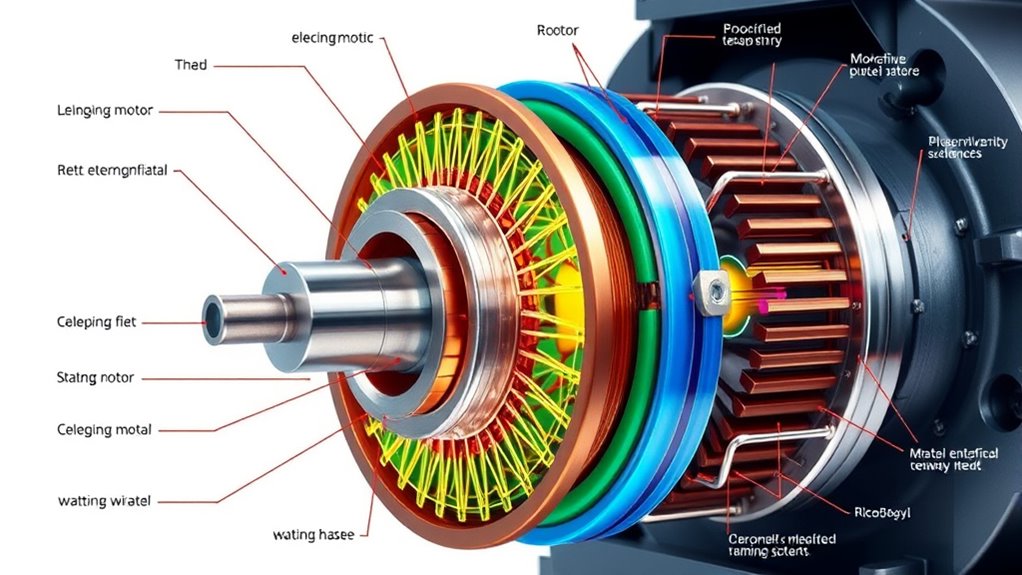
When you immerse yourself in the world of 3-phase induction motors, understanding their components is essential.
At the heart of this motor, the stator and rotor play significant roles. The stator, made of laminated steel, houses windings that are key to creating a rotating magnetic field. These windings are positioned 120 degrees apart to align with the three phases of AC power, affecting the motor’s synchronous speed and torque.
The rotor, either a squirrel cage or slip-ring design, is suspended within this magnetic field. As it interacts with the stator’s rotating magnetic field, induced currents generate torque, causing the rotor to turn.
The difference between the synchronous speed and rotor speed is known as slip, an important aspect of motor performance.
Operating Principles of a 3-Phase Induction Motor
Building on your understanding of the components of a 3-phase induction motor, let’s examine how these parts work together to initiate the motor’s motion.
Three-phase induction motors operate using electromagnetic induction. The stator winding creates rotating magnetic fields that induce current in the rotor. This induced current generates torque, driving the rotor to move.
The motor’s synchronous speed depends on the supply frequency and the number of poles, but the actual rotor speed is slightly less due to slip, which is essential for torque production.
For peak performance:
- Understand synchronous speed: It’s calculated using the formula (n_s = 120f/p).
- Recognize the slip’s role: It guarantees motor efficiency and torque.
- Consider efficiency: It typically ranges from 85% to 97%, which significantly influences the suitability of industrial applications.
Applications and Benefits of 3-Phase Induction Motors

Three-phase induction motors are widely used in industrial settings due to their reliability and efficiency. You’ll find these motors in about 80% of all industrial applications, where they excel at converting electrical energy into mechanical power.
Their high power output makes them ideal for heavy-duty tasks, such as running pumps, compressors, and conveyor systems. With their steady supply of energy, they guarantee smooth operation and reduce vibrations.
Additionally, they boast an impressive efficiency range of 85-97%, which minimizes energy consumption and lowers operational costs. By using variable-frequency drives, you can control speed and torque, thereby enhancing the versatility of systems such as HVAC and electric traction.
These features make them indispensable for energy-efficient designs in modern industries.
Conclusion
In exploring the 3-phase induction motor, you’ve seen how its components work together to generate motion. Through the interaction between the stator’s rotating magnetic field and the rotor, these motors operate efficiently and reliably. Their design makes them ideal for various applications, offering durability and low maintenance. By understanding their principles, you can appreciate the benefits these motors bring to industries worldwide, making them a cornerstone in modern mechanical systems.
FAQs
1. What Is a Phase Induction Motor?
You’re looking at a phase induction motor, which transforms electrical energy into mechanical energy using AC. It consists of a stator and a rotor. Single-phase motors require additional circuitry, whereas three-phase motors offer greater efficiency and stability.
2. How Does a 3-Phase Induction Motor Work?
You apply three-phase voltages to the stator, creating a rotating magnetic field. This induces EMF in the rotor, causing current flow and torque. The rotor’s slip enables torque, with motor speed determined by the supply frequency and the number of poles.
3. What Is the Difference Between 1-Phase and 3-Phase Induction Motors?
You’ll notice that single-phase motors require additional starting components and provide less torque, making them ideal for smaller applications. In contrast, three-phase motors offer consistent power and higher efficiency, suitable for industrial use with heavier machinery.
4. Why is a 1 1-phase induction Motor Self-Starting?
You might wonder why a 1-phase induction motor is self-starting. It’s because of its starting winding with a capacitor, creating a phase difference. This phase shift generates a rotating magnetic field, which effectively initiates rotor movement.