

Common Applications of Servo Motors | Industrial & Everyday Uses
Given their widespread use in many industries, you’re likely familiar with servo motors. These motors provide precise control, making them indispensable for accuracy and reliability. Servo motors are pivotal in everything from robotics and CNC machines to medical devices and communication systems. But what exactly makes them so versatile and essential across different fields? Let’s explore how they enhance technology and operations in various sectors. Learn more about Common Applications of Servo Motors.
Key Takeaways
- Servo motors enable precise angular movements in robotic arms for welding, painting, and assembly tasks.
- CNC machines provide precision control for intricate tool movements and accurate manufacturing.
- They enhance precision and functionality in medical devices, such as surgical robots and diagnostic equipment.
- Used in communication systems, they adjust antennas and satellite dishes for optimal signal transmission.
- In solar tracking, servo motors adjust panels to maximize sun exposure, improving energy efficiency.
Servo Motors in Robotics

Servo motors are indispensable in robotics, playing an essential role in the precise angular movements important for various tasks. When considering robotic arms, consider how servo motors provide the precise control needed for picking, placing, welding, and painting.
These motors offer accurate position feedback thanks to integrated sensors, allowing robots to execute tasks with remarkable precision. Their compact design and high force density make them perfect for diverse applications, from surgical robots to automated assembly lines.
Role of Servo Motors in Industrial Automation
In industrial automation, servo motors are essential in boosting production efficiency and precision.
They control robotic arms for tasks like welding and assembly with incredible accuracy, minimizing errors and enhancing output.
Enhancing Production Efficiency
Imagine boosting production efficiency by up to 30%—that’s the power of integrating servo motors into industrial automation. With their precision and power, servo motors excel in position control and adaptable control systems, proving indispensable in industrial applications. They enhance production efficiency by optimizing conveyor systems, ensuring accurate starts and stops to streamline workflow. Robotic arms equipped with servo motors tackle high-accuracy tasks like welding and painting, minimizing human error.
Here’s how servo motors transform industries:
| Function | Benefit |
|---|---|
| Conveyor Systems | Reduced Downtime |
| Robotic Arms | Increased Production Speed |
| CNC Machining | High-Quality Output |
| Tool Positioning | Precise Control |
| Automation Integration | Operational Efficiency |
Precision in Manufacturing Tasks
Building on servo motors’ enhanced production efficiency, let’s explore their role in precision manufacturing tasks.
Servo motors precisely control angular positions, which is essential for automated manufacturing processes like assembly lines and CNC machining. In industrial automation, they’re indispensable for driving robotic arms in high-precision tasks such as welding, painting, and intricate assembly. This greatly reduces human error and boosts productivity.
Servo motors also excel in conveyor systems, ensuring synchronized movement and control for labeling, packaging, and material handling. They facilitate real-time feedback and adjustments in industrial machinery, enhancing repeatability and quality.
Applications of Servo Motors in CNC Machines

In CNC machines, servo motors are essential in achieving precision in tool movement and ensuring both speed and position control.
These motors help maintain high manufacturing quality by allowing for intricate designs and complex geometries with consistent accuracy.
Advanced control algorithms provide real-time adjustments, enhancing the overall efficiency of machining processes.
Precision in Tool Movement
When you explore the domain of CNC machines, the role of servo motors becomes evident in achieving precision in tool movement, which is crucial for high-quality manufacturing.
Servo motors provide the precision control necessary to manipulate the position and speed of tools in a CNC machine. They guarantee that each task, from cutting to engraving, is executed flawlessly. A feedback system continuously monitors and adjusts the tool’s position, enhancing accuracy and repeatability.
Here’s why servo motors are essential in CNC operations:
- Precision: Achieve intricate details with minimal error.
- Position and Speed: Adjust tools smoothly for complex tasks.
- Feedback System: Real-time adjustments for peak performance.
- Control Necessary: Ensure consistent quality for identical parts.
- Efficiency: Reduce cycle times and boost productivity.
These factors make servo motors indispensable in modern manufacturing.
Speed and Position Control
Servo motors are at the heart of CNC machines, ensuring precise speed and position control. They enable the machine to execute intricate milling and 3D printing tasks seamlessly. With real-time feedback, servo motors constantly adjust the tool’s trajectory, maintaining accuracy and reducing mechanical wear. This function is essential for high-precision industries where consistency is key. The control circuit of a CNC machine uses this feedback to manage speed and positioning, ensuring each part is identical to the last.
| Benefits | Functions |
|---|---|
| Real-time feedback | Precise positioning |
| Smooth acceleration | Speed and position control |
| High torque at low speeds | Complex task efficiency |
Enhanced Manufacturing Quality
Precision is paramount in CNC manufacturing, where servo motors play an essential role in enhancing quality.
Servo motors precisely control axes, guaranteeing accurate positioning for cutting, drilling, and engraving tasks. A position sensor within the system allows for enhanced repeatability, assuring consistent production of high-quality components.
CNC machines benefit greatly from precise servo motor control, which helps maintain ideal speeds and torque.
Consider these advantages:
- Enhanced repeatability: Achieve consistent quality with every cycle.
- Real-time adjustments: Advanced feedback systems minimize errors.
- Improved efficiency: Reduced cycle times boost productivity.
- Accurate positioning: Precise control of axes guarantees perfect cuts.
- Ideal performance: Servo motors provide stability in high-demand tasks.
Incorporating servo motors greatly boosts manufacturing quality.
Use of Servo Motors in Medical Devices
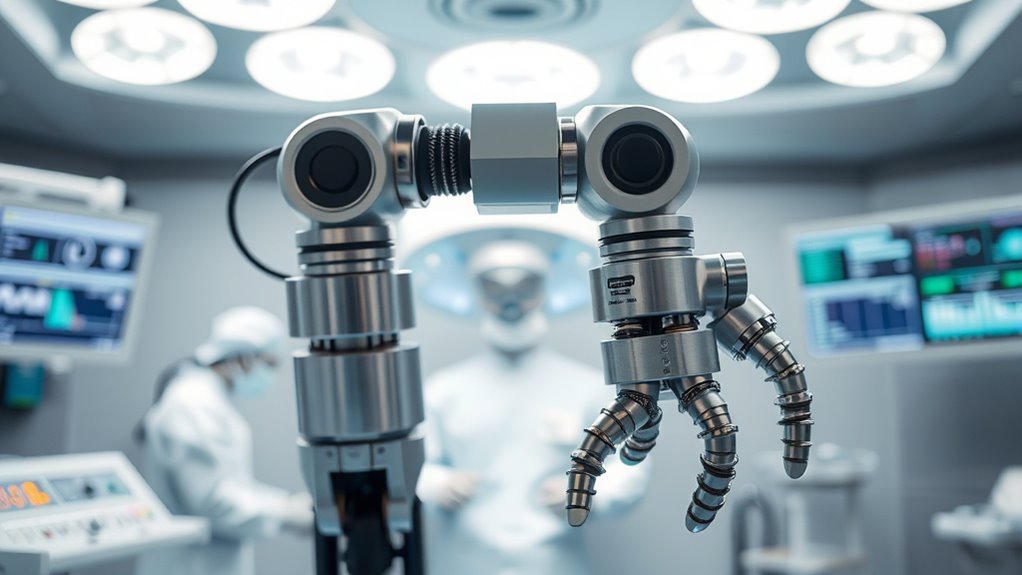
In modern medical technology, servo motors play a vital role in enhancing the functionality and precision of various devices. These motors are integral to medical devices, offering precision control essential for high-stakes environments.
In diagnostic equipment like MRI and CT scanners, servo motors guarantee that imaging components move accurately, delivering precise images for better diagnosis. Surgical robots utilize servo motors to perform delicate procedures, such as minimally invasive surgeries, with unmatched accuracy and safety.
These motors also benefit prosthetics, offering improved responsiveness and natural limb movement. Additionally, servo motors allow for controlled movement in devices like insulin pumps and ventilators, guaranteeing accurate dosage delivery and patient monitoring.
This technology is fundamental in advancing medical care and patient outcomes.
Servo Motors in Communication Systems
In communication systems, servo motors hold a pivotal position, ensuring ideal performance and reliability. They’re essential for adjusting antennas in satellite systems and optimizing signal transmission and reception.
You’ll find servo motors control the precise alignment in radar systems, enhancing tracking and detection accuracy. Here’s how they play an important role:
- Satellite Dish Positioning: Automatically adjusts to follow satellites across the sky.
- Real-Time Feedback: Provides continuous adjustments to maintain stable connections.
- Signal Transmission: Enhances the quality of data exchange in networks.
- Pan and Tilt Control: Used in surveillance cameras for dynamic area monitoring.
- Alignment and Tracking: Fundamental in radar systems for moving target detection.
Servo motors are indispensable in maintaining the efficiency and effectiveness of communication systems.
Importance of Servo Motors in Surveillance and Tracking

As you explore the surveillance and tracking domain, servo motors are just as important as communication systems.
These motors significantly position antennas within surveillance systems, guaranteeing accurate alignment for ideal signal transmission and reception.
In camera systems, servo motors enable precise lens adjustments, facilitating clear images and dynamic tracking of subjects.
Surveillance robots rely on servo motors for mobility and pan-and-tilt movements, providing real-time subject tracking.
Additionally, solar tracking systems use servo motors to adjust solar panels, maximizing sun exposure and boosting energy efficiency for surveillance installations.
In radar systems, servo motors guarantee accurate positioning, which is essential for effectively monitoring and tracking moving objects across various environments.
Servo Motors in Elevator Technology
When considering elevator technology, servo motors ensure seamless and efficient operation. They offer precise positioning and motion control, allowing elevators to accelerate and decelerate smoothly. This results in a more comfortable ride and enhances safety by automatically adjusting speeds based on load and travel distance.
Servo motors are indispensable in high-rise buildings, providing reliable performance with minimal maintenance.
Here are some key applications and benefits:
- Enhanced energy efficiency: Optimizes power usage during idle and active phases.
- Advanced feedback systems: Improves safety and operational precision.
- Reduced wait times: Quick and reliable service in busy environments.
- Consistent performance: Essential for multi-floor operations.
- Improved user experience: Elevators move with comfort and reliability.
Servo motors are vital for modern elevator systems.
Conclusion
You’ve seen how servo motors are indispensable in various fields, from robotics to medical devices. They enhance precision and efficiency in every application, ensuring smooth operations and outstanding results. Whether in CNC machines or communication systems, servo motors deliver the necessary reliability and control. By embracing this technology, you’re optimizing performance across industries. So, next time you encounter a precise movement or seamless operation, you’ll likely know a servo motor is behind it.
FAQs
1. What Are the Applications of Servo Motors?
You see servo motors in action everywhere, from controlling robotic joints to powering CNC machines. They enhance precision in medical devices, adjust antennas in communication systems, and drive industrial automation. They’re essential for precise, efficient operations.
2. Where Are Servo Motors Commonly Used?
Servo motors are essential in robotics, industrial automation, CNC machines, medical devices, and communication systems. They help with precise movements, improving accuracy and efficiency in tasks like welding, cutting, surgery, and signal alignment.
3. What Are the Applications of a Servo System?
You’re wondering about servo system applications. They enhance precision in robotics, streamline industrial automation, perfect CNC machining, advance medical devices, and optimize communication systems by adjusting antennas. Each plays a vital role in its respective field.
4. Where Are Servos Used in Real Life?
You’ll find servos in everyday life, from automated doors and camera focus systems to model airplanes and drones. They control precise movements, making them essential in various gadgets and industries for their reliability and efficiency.
