Analysing the Characteristics of a DC Series Generator
A DC series generator is a direct current (D.C.) generator with several unique characteristics, making it well-suited for specific applications. Unlike other D.C. generators, the series generator has its field winding connected in series with the armature winding. This configuration results in distinct performance traits and operating principles. Understanding the characteristics of a D.C. series generator is crucial for engineers, electricians, and anyone working with D.C. power systems.
What is a DC Series Generator?
A DC series generator is a direct current (DC) electrical generator characterized by its specific configuration of field and armature winding. It belongs to the family of DC generators and is widely used in various applications due to its unique characteristics and performance capabilities.
Definition and Basic Concept
The DC series generator is a machine that converts mechanical energy into electrical energy through electromagnetic induction. It operates on the fundamental principle of Faraday’s law of electromagnetic induction, where a changing magnetic field induces an electromotive force (EMF) in a conductor, generating electricity.
Construction and Components
A DC series generator consists of several essential components, each playing a vital role in its functioning:
- Armature Winding: The armature winding is the generator’s primary winding, comprising multiple wire coils wound on an armature core. When the armature rotates within the magnetic field, it generates the electrical output.
- Field Winding: The field winding is another crucial winding in the generator, typically wound with fewer turns of thicker wire than the armature. It creates the magnetic field necessary for electromagnetic induction.
- Commutator: The commutator is a rotary switch made of copper segments attached to the armature shaft. It ensures that the generated electrical current flows in the desired direction through the external circuit.
- Brushes: Brushes are stationary conductive elements in contact with the commutator. They transfer the generated current from the rotating armature to the external load circuit.
- Shaft and Bearings: The post provides mechanical support to the armature, enabling it to rotate smoothly within the generator. Bearings reduce friction, ensuring efficient rotation and minimizing wear and tear.
The fig below shows the circuit diagram of a series wound Generator. Since only one current flows through the full machine, the load current is the same because of the exciting wind.

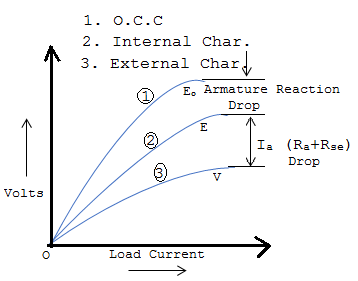
Below the fig, the first curve shows a series generator’s open circuit characteristic curve. It will be obtained by experimentation by cutting off the field winding from the machine and exciting it from a separate D.C. supply, as mentioned in the O.C.C. of the D.C. Generator.
Terminology of Armature Winding
The external characteristic of a series generator is shown in the curve above Fig. This curve shows the relation between terminal voltage and load current IL:
Therefore, external characteristics can lie below internal features by an amount equal to resistance unit drop [i.e., Ia(Ra + Rse)] within the machine.
The internal and external characteristics of a D.C. series generator will be premeditated from each other, as shown in the below Fig.
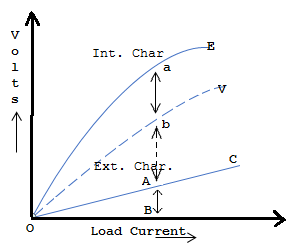
Suppose we tend to give the interior characteristic of the generator. Let the graph O.C. represent the resistance of the full machine, i.e., Ra + Rse. If the load current is O.B., the drop in the device is A.B., i.e., A.B. = Ohmic drop in the machine = O.B. (Ra+Rse).
Now draw a perpendicular line from point B and mark a point b on this line, such as ab = A.B. Then point b can lie on the external characteristic of the generator. Following a similar procedure, different points of external factors will be situated. Examining that we will conjointly plot internal characteristics from external characteristics is simple.
Conclusion
In conclusion, analyzing the performance characteristics of a D.C. series generator reveals its versatility, power generation capabilities, and adaptability to varying loads. Each character plays a vital role in defining the generator’s overall performance, from field flux variation to high torque at low speeds, armature reaction, efficiency considerations, dynamic response, and control mechanisms. By comprehending these characteristics, engineers, and operators can optimize the generator’s operation, ensuring efficient power conversion, stability, and reliability in various applications. As technology advances and new challenges emerge, continued analysis and understanding of the performance characteristics of D.C. series generators will pave the way for further improvements in power generation efficiency and effectiveness.