Star to Delta Conversion | Electrical Network Transformation
You’re probably familiar with the complexities of three-phase circuits and how challenging they can be. Star to Delta conversion is an invaluable technique that can simplify these circuits, making them much easier to handle. You can maintain the essential voltage and current values by converting a star configuration into an equivalent delta network. This conversion is key for optimizing electrical systems, but what’s the process behind it, and why does it matter so much?
Understanding Star to Delta Conversion
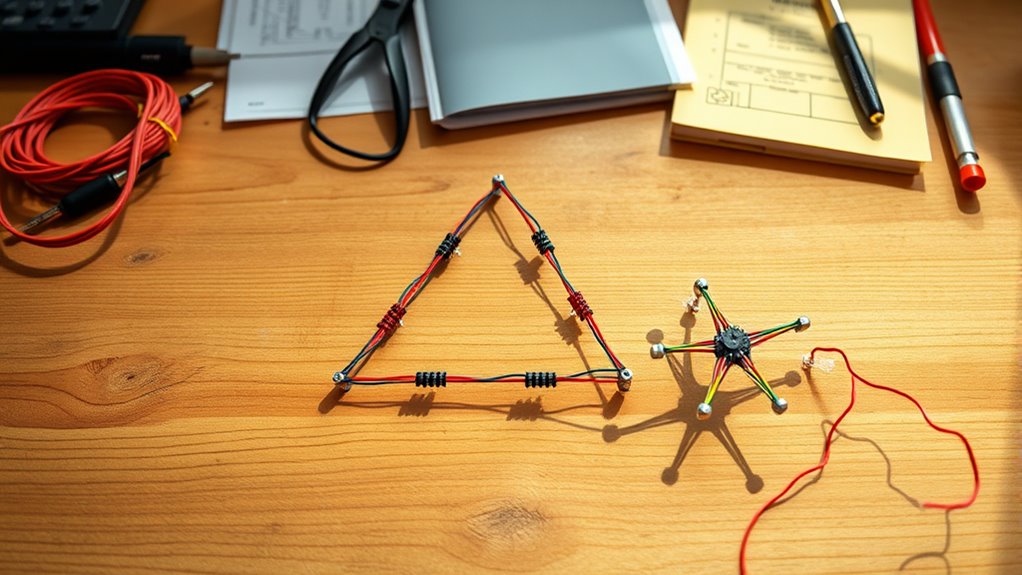
When diving into electrical circuits, understanding starto delta conversion is essential. This process transforms a star configuration of resistors into an equivalent delta network, simplifying circuit analysis. To achieve this star transformation, use the relationship ( R_A = frac{R_1 R_2}{R_1 + R_2 + R_3} ) for the delta resistor, with similar formulas for ( R_B ) and ( R_C ).
This conversion is particularly handy in three-phase circuits, ensuring the same voltage and current values are maintained across the network. If the star resistances are equal, each delta resistance will be three times the star resistance, making calculations straightforward. Mastering this conversion is key to efficiently analyzing and designing intricate electrical systems.
Importance in Circuit Analysis
Mastering Star to Delta conversion is essential for simplifying complex electrical networks and making your circuit analysis more efficient. This transformation allows you to easily calculate equivalent resistances and impedances, vital for enhancing electrical system design. By streamlining these processes, you can tackle maintenance and design challenges with greater accuracy and speed.
Simplifying Complex Networks
Understanding star to delta conversion is essential for simplifying complex networks in circuit analysis. It allows you to replace a star configuration with an equivalent delta configuration, making calculations of resistances and impedances much easier. This transformation keeps circuit equivalence intact by maintaining the same impedance between any two terminals, allowing for systematic analysis.
Imagine the benefits:
- Streamlined Calculations: Move seamlessly between configurations without losing accuracy.
- Enhanced Understanding: Visualize circuits better by converting Y shapes to closed loops.
- Efficient Problem Solving: Tackle complex three-phase circuits with confidence.
- Optimized Performance: Fine-tune circuit behavior for improved application results.
Enhancing Electrical System Design
Although circuit analysis can be complex, Starto Deltaconversion plays an essential role in enhancing electrical system design. You can simplify the analysis by converting a complicated network into an equivalent star network, making it easier to calculate equivalent resistances. This transformation maintains consistent impedance, guaranteeing efficient power distribution without altering circuit performance.
| Conversion Type | Benefits | Application |
|---|---|---|
| Star to Delta | Simplifies calculations | Three-phase systems |
| Delta to Star | Reduces number of components | Circuit optimization |
| Consistent Impedance | Guarantees power distribution | Electrical system design |
Understanding these conversions helps you predict how circuits behave under different loads, streamlining the design process. Using Starto Delta conversion techniques, you can optimize circuit layouts, leading to more reliable and efficient electrical systems.
Mathematical Derivation of Conversion Formulas

Examine how to derive equations for the Star network to understand the mathematical derivation of conversion formulas. By focusing on the resistors’ relationships, you can calculate the Delta resistances using specific formulas. This systematic approach guarantees you accurately transform Star configurations into Delta networks, maintaining equivalent power consumption.
Deriving Star Network Equations
When converting between Star (Y) and Delta (Δ) network configurations, it’s vital to derive the equations accurately to confirm proper circuit analysis. The conversion involves using relationships between resistances at the terminals. Each Delta resistor is the product of two Star resistors at the same terminal, divided by the sum of all Star resistances. Specifically, use the formulas:
- ( R_1 = frac{R_A R_B}{R_A + R_B + R_C} )
- ( R_2 = frac{R_B R_C}{R_A + R_B + R_C} )
- ( R_3 = frac{R_C R_A}{R_A + R_B + R_C} )
- Symmetry Insight: When all Star resistances are equal, each Delta resistance is three times the Star resistance, showcasing a proportional relationship.
Understanding these equations guarantees precision in circuit analysis and conversion between Star and Delta networks.
Calculating Delta Resistances
Understanding the mathematical derivation of conversion formulas between Star and Delta configurations is essential for accurate circuit analysis. When dealing with a Delta transformation, you must use formulas to guarantee that the Delta ta-connected resistances behave equivalently to their Star counterparts. For each Delta resistance (R1, R2, R3), use these formulas: (R_1 = R_A + R_B + frac{R_A R_B}{R_C}), (R_2 = R_B + R_C + frac{R_B R_C}{R_A}), and (R_3 = R_C + R_A + frac{R_C R_A}{R_B}). These equations maintain power equivalence and preserve voltage and current relationships. Curiously, if the Star resistances are equal, the resulting Delta resistances will be three times those values, highlighting a clear proportionality. Mastering these conversions simplifies complex circuit analysis.
Practical Applications in Electrical Engineering
Although electrical engineering can be complex, mastering the Star to Delta conversion simplifies many challenges. This transformation is essential for analyzing 3-phase electrical networks, allowing you to calculate an equivalent Δ. Doing so will streamline the load-balancing process, ensuring power is equally distributed across three phases and reducing the risk of phase overload. Additionally, this conversion helps minimize starting currents and enhances torque in motor connections.
Practical applications of Star to Delta conversion include:
- Load balancing: Distributes power evenly, preventing overload.
- Motor connections: Reduces starting current, improving performance.
- Efficient designs: Simplifies circuits, boosting reliability.
- Troubleshooting: This optimizes performance in real-world scenarios.
With this knowledge, you can design more efficient and dependable electrical systems.
Example Calculations for Delta Resistances
Let’s plunge into the practical side of Star to Delta conversion with some example calculations for Delta resistances. Imagine a resistor network that’s SStarconnected with resistances R_A = 6Ω, R_B = 18Ω, and R_C = 3Ω. To convert this into an equivalent Delta network, use the formulas: R1 = R_A + R_B + (R_A * R_B / R_C), R2 = R_B + R_C + (R_B * R_C / R_A), and R3 = R_C + R_A + (R_C * R_A / R_B). Calculating these gives you R1 = 10Ω, R2 = 60Ω, and R3 = 30Ω. This conversion is vital for maintaining your circuit’s power and operational characteristics while simplifying analysis. Mastering these transformations enhances your ability to address complex circuit problems effectively.
Tools and Techniques for Simplifying Circuits
Having the right tools and techniques at your disposal makes simplification much easier when tackling complex electrical circuits. Star-to-delta conversion is a powerful method that transforms a star network into an equivalent delta network, streamlining circuit analysis. This transformation maintains equivalent impedances, enabling you to handle complicated systems, particularly in three-phase setups.
To simplify circuits efficiently, consider these tools and techniques:
- Formulas: Use the specific equations that relate star and delta resistances for accurate conversions.
- Calculators: Employ these to automate calculations and guarantee precision in your transformations.
- Software applications: Leverage these to model networks digitally, saving time and reducing errors.
- Diagramming tools: Visualize your network transformations to understand better and communicate circuit changes.
Mastering the start to delta transformation is essential for any engineer.
Visual Demonstrations and Learning Resources

Understanding star to delta conversion becomes more intuitive when you engage with visual demonstrations and learning resources. Instructional videos give you step-by-step guidance, making complex networks easier to navigate. Diagrams clearly illustrate the differences between star (Y) and Delta (Δ) configurations, boosting your comprehension of these geometric relationships. Interactive tools and calculators let you input star resistance values and get equivalent delta resistances, simplifying the conversion process. Additionally, practical examples in learning materials show real-world applications, reinforcing theoretical concepts.
| Resource Type | Benefit |
|---|---|
| Instructional Videos | Step-by-step guidance |
| Diagrams | Visualize geometric differences |
| Interactive Tools | Simplify conversion with input/output |
Online tutorials highlight common mistakes, ensuring you grasp the correct methodologies for effective circuit simplification.
Conclusion
You’ve explored the intricacies of Starto Delta conversion, grasping its significance in simplifying complex circuits. Understanding and applying mathematical formulas can efficiently transform configurations for ideal circuit design. Whether it’s load balancing or motor connections, this technique is essential in your toolkit for effective electrical engineering. Keep examining practical examples and utilize available tools to enhance your skills, ensuring you’re well-equipped to tackle any circuit analysis challenge.
FAQs
1. How Do You Convert a Star to a Delta?
To convert, calculate each Delta resistance as the sum of products of Star resistances divided by the opposite Star resistance. Guarantee you maintain total resistance equivalence across terminals. This conversion greatly simplifies three-phase circuit analysis.
2. Why Is Star to Delta Conversion Required?
You must perform this conversion to simplify circuit analysis, optimize motor performance, and guarantee balanced power distribution. It helps reduce starting currents, maintain voltage levels, and makes troubleshooting easier by isolating faults within electrical systems.
3. What Is the Star to Delta Law?
You need the Starto Delta law to convert star resistances into equivalent ones. Formulas guarantee accurate transformation while maintaining electrical properties. The conversion simplifies circuit analysis, especially in three-phase systems, making your work easier.
4. How Long Does It Take to Change From Star to Delta?
For simpler circuits, the conversion can be completed quickly, often in 10-15 minutes. However, if you’re dealing with more complex systems, expect it to take several hours, especially when physical rewiring or simulations are involved.