Shunt Resistance: Definition, Importance & Applications
You’re probably aware that shunt resistance is essential in electrical circuits, but have you considered how it affects current measurement accuracy and circuit protection? Offering a low-resistance path guarantees precise monitoring and safeguards against overloads. This seemingly simple resistor can greatly impact system efficiency, especially in applications like solar cells. Curious about the intricacies and underlying science? Let’s explore how shunt resistors shape circuit performance.
Key Takeaways
- Shunt resistance provides a low-resistance path for accurate current measurement and protects components from overcurrent situations.
- It is crucial in solar cell efficiency, affecting fill factor and power output.
- Current measurement with shunt resistors relies on Ohm’s Law and precise voltage drop readings.
- Use low-temperature coefficient materials for stability and low resistance values to minimize power loss.
- Noise reduction and filtering are achieved through optimized impedance and the incorporation of shunt capacitors.
Understanding Shunt Resistance in Electrical Circuits

Understanding shunt resistance is vital when measuring high currents in electrical circuits. A shunt resistor provides a low-resistance path for current, allowing you to measure high currents accurately without damaging your measurement device. You prevent overload by sending a small portion of the current through the device.
The voltage drop across a shunt resistor is directly proportional to the current flowing through it. Using Ohm’s law, you can calculate the total current from this voltage drop and the known shunt resistance. Typically made from materials like manganin, shunt resistors maintain consistent readings despite temperature changes.
Proper circuit placement, often on the grounded side, minimizes errors and guarantees accurate readings by reducing common-mode voltage effects.
The Role of Shunt Resistors in Solar Cells

Understanding shunt resistance in electrical circuits provides a strong foundation for exploring its role in solar cells. Shunt resistors create low-resistance paths, diverting current flowing from light, which can cause power losses, especially under low-light conditions.
These effects are more pronounced at lower voltages, where parallel resistance impacts a solar cell’s performance. A low shunt resistance can hurt the fill factor, reducing the solar panel’s power output.
High precision is vital in maintaining ideal performance and controlling shunt resistances.
- Impact: Low shunt resistance leads to significant power losses in solar cells.
- Efficiency: Affected fill factor due to shunt resistance reduces the power output.
- Design: High precision in shunt resistance measurement is essential for maximizing power output.
Calculating Current With Shunt Resistors

To calculate current with a shunt resistor, you’ll use Ohm’s Law, I = V/R, where you measure the voltage drop across the shunt in millivolts.
Selecting a precision resistor is essential to guarantee accurate readings while preventing excessive power loss.
Ensure the shunt is rated to handle the maximum current and voltage drop you expect in your circuit.
Ohm’s Law Application
Although the concept might initially seem intimidating, applying Ohm’s Law to calculate current with shunt resistors is straightforward. You need the shunt’s resistance value and the voltage drop across it.
Using the formula I = V/R, where I is the current, V is the voltage, and R is the resistance, you can determine the current flowing through the circuit. For instance, with a shunt resistor of 0.01 ohms and a 0.1-volt drop, the current is 10 amps.
Accurate measurement of current values relies on precise resistance and correct placement to avoid common-mode voltage effects.
- Understand the formula: I = V/R.
- Measure accurately: Confirm precise voltage drop readings
- Place correctly: Minimize common-mode voltage effects
Precision Resistor Selection
Choosing the right shunt resistor is vital for precise current measurements in your circuit. First, ensure your shunt resistor can handle the maximum current expected in your setup. This prevents overheating and potential failure.
Next, select a precision resistor with a low-temperature coefficient of resistance, often made from manganin, to maintain accuracy despite temperature variations. By placing the shunt resistor parallel to your ammeter, you create an ammeter shunt that protects the device by dividing the current proportionally.
To calculate current, use Ohm’s law: I = V/R, where V is the voltage drop across your shunt resistor and R is its resistance. Proper mounting and wiring are vital to avoid shorts and secure connections, guaranteeing accurate readings.
Voltage Drop Measurement
After selecting the right shunt resistor for your circuit, you should measure the voltage drop across it to calculate the current accurately.
Placing shunt resistors in parallel with an ammeter creates a low-resistance path, preventing damage while allowing precise current measurements.
Using Ohm’s Law (I = V / R), measure the current by determining the voltage drop and considering the shunt resistance. Typically, the voltage drop is standardized at 50 or 100 mV, ensuring consistent calculations.
Positioning the shunt on the grounded side minimizes common-mode voltage, ensuring accurate readings.
Keep these tips in mind:
- Ensure proper shunt placement to reduce common-mode voltage.
- Use standardized voltage drops for consistency.
- Select appropriate shunt ratings to prevent overheating.
Impact of Shunt Resistance on Fill Factor

Shunt resistance is crucial in determining the fill factor when examining solar cell efficiency, especially under low-light conditions.
Lower shunt resistance provides alternative paths, acting as current shunts that reduce the current flow through the junction. This results in diminished fill factor and increased power losses, which are particularly problematic when estimating power output at low light levels.
Lower shunt resistance decreases the fill factor, affecting a solar cell’s operational efficiency. The slope of the IV curve near the short-circuit current can be used to estimate shunt resistance, offering insights into the cell’s performance.
Applications of Shunt Resistors in Current Measurement

Although shunt resistors might seem simple, they’re indispensable in current measurement applications because they can safely and accurately handle large currents.
A shunt provides a low-resistance path parallel to an ammeter, guaranteeing accurate readings without damage. By creating a voltage drop proportional to the electrical current, you can calculate the current using Ohm’s law with the known resistance of the shunt.
They often measure high current in battery monitoring systems, manage charging currents, and provide circuit overload protection.
Here’s how you can benefit from using shunt resistors:
- Accurate measurement: Guarantees precise current calculations.
- Durability: Materials like manganin offer stability across temperatures.
- Versatility: Available in various types for specific ranges.
Shunt Resistors in Photovoltaic Systems

Understanding shunt resistance is essential for maintaining energy efficiency when working with photovoltaic systems.
Low shunt resistance can lead to significant power losses, so it’s important to calculate its impact accurately.
Impact on Energy Efficiency
Shunt resistance plays an important role in determining energy efficiency in photovoltaic systems. Low shunt resistance can lead to significant power losses by creating alternative current paths. This reduces solar cells’ output voltage and energy efficiency, especially under low-light conditions.
Diminished shunt resistance often reduces fill factor and maximum power output, affecting the system’s energy harvesting capability. Monitoring and minimizing shunt resistance are essential to achieve ideal performance, as manufacturing defects can exacerbate energy losses.
Consider these key points:
- Low shunt resistance: Reduces the fill factor and maximum power output.
- Energy efficiency: Directly impacted by variations in shunt resistance.
- Monitoring: Important for maintaining the long-term performance and reliability of solar panels.
Calculation Methods
To effectively calculate shunt resistance in photovoltaic systems, you’ll need to focus on analyzing the slope of the IV curve near the short-circuit current.
This approach lets you determine how the shunt resistance impacts the solar cell’s performance, especially under low-light conditions. Shunt resistance is essential, as it influences both the fill factor and efficiency.
High-frequency noise can obscure accurate readings, so ensure your measurement setup minimizes interference.
Protecting Circuits With Shunt Resistors
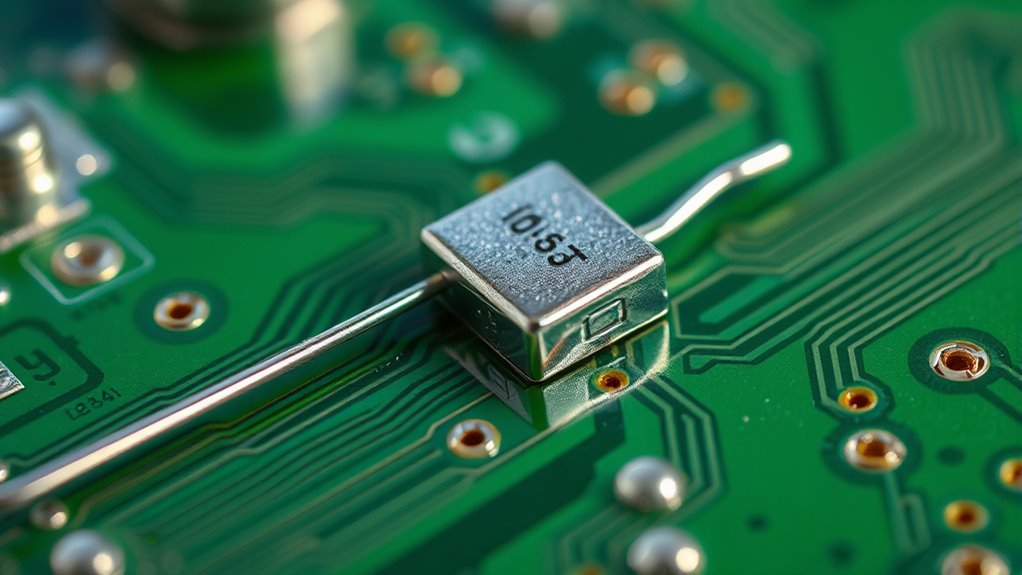
Although circuits can be vulnerable to overcurrent situations, shunt resistors offer a reliable defense by providing a low-resistance path for excess current to bypass sensitive components. This protects your circuit and allows you to monitor current levels by measuring the voltage drop across the shunt resistor.
Properly placing the shunt resistor on the grounded side of the circuit enhances accuracy by reducing common-mode voltage.
Incorporating shunt resistors into your circuit design offers several advantages:
- Monitor and control: Monitor current levels to guarantee safe operation.
- Prevent damage: Divert excess current away from sensitive components.
- Maintain accuracy: Position on the grounded side for precise current measurement.
Materials and Design of Shunt Resistors

When selecting materials for shunt resistors, focus on those with low-temperature coefficients, like manganin, to guarantee stable resistance across varying temperatures.
The design emphasizes low resistance values to reduce power loss and heat, which are vital for efficiency. Optimizing these factors helps maintain accuracy and reliability in your applications.
Low-Resistance Material Selection
Selecting low-resistance materials for shunt resistors is vital for guaranteeing accurate current measurement and dependable performance. When choosing materials, consider high-precision manganin, renowned for its low temperature coefficients. This assures minimal resistance variation with temperature changes, guaranteeing shunt resistors maintain their integrity under varying conditions.
Opting for low-resistance materials between 1 mΩ and 10 mΩ is vital. This allows the resistor to handle large currents while minimizing voltage drop, enhancing accuracy.
- Manganin: Offers stable resistance and low thermal drift, making it ideal for precision applications.
- Power Dissipation: Guarantee materials can effectively dissipate power according to the application’s current demands.
- Overheating Prevention: Selecting the right material prevents overheating, guaranteeing longevity and reliability of shunt resistors.
Temperature Coefficient Optimization
After selecting low-resistance materials, focus on optimizing the temperature coefficient of shunt resistors. Choosing materials like manganin or copper-nickel alloys is vital, known for their minimal temperature coefficient changes. This guarantees the resistance remains stable across temperature fluctuations, which is important for precision applications.
You’ll want to design shunt resistors with a small thermal mass to facilitate rapid heat dissipation and prevent thermal drift.
Enhance performance by constructing shunt resistors with a geometry that maximizes surface area and minimizes thermal resistance. This design ensures they can handle high currents without overheating, maintaining accuracy.
Remember to take into account the power rating, confirming that the resistor can effectively dissipate heat. The right design keeps temperature rise minimal, preserving measurement integrity.
Shunt Resistors in Noise Reduction and Filtering

Although electronic circuits can be complex, integrating shunt resistors for noise reduction and filtering is a straightforward strategy to enhance performance.
These resistors effectively redirect high-frequency noise to the ground, preventing interference from affecting sensitive components. By managing impedance, shunt resistors help maintain signal integrity and stability. Lower resistance values often yield better noise reduction, ensuring that voltage levels remain stable.
Incorporate shunt capacitors with signal lines to filter out unwanted frequencies, protecting your circuit from transient spikes.
Additionally, combining shunt resistors with inductors and capacitors can form versatile filters like low-pass, high-pass, or band-pass, allowing selective frequency management.
- Ensure stable voltage levels: Shunt resistors bypass voltage spikes.
- Enhance signal integrity: Filters eliminate unwanted signals.
- Optimize impedance: Achieve effective noise reduction.
Historical Development of Shunt Resistor Technology

As you explore the historical development of shunt resistor technology, it’s vital to recognize these devices’ pivotal role in precision measurement.
Various shunts, such as the Thomas-type double manganin-walled shunt, highlight their precision and reliability in maintaining measurement standards.
From 1939 to 1990, these shunts served as the U.S. standard of resistance, showcasing their drift accuracy in parts per million (ppm), essential for stable measurement standards.
The MI-type shunt improved upon the Thomas-type, enhancing accuracy and stability.
Although the Quantum Hall effect replaced traditional shunts as the primary resistance measurement standard in 1990, shunts can be used in contexts where precision and reliability remain vital.
Conclusion
You’ve explored shunt resistance’s pivotal role in enhancing circuit performance, especially in solar cells and current measurement. Accurately calculating current through shunt resistors guarantees precise monitoring and protection against overloads. You’ve seen how low shunt resistance impacts efficiency and fill factor, while the right materials and design enhance stability. As you continue to apply these principles, you’re contributing to technological advancements and guaranteeing reliable, efficient electrical systems.
FAQs
1. What Is the Purpose of a Shunt?
You use a shunt to divert excess current, protecting components from overcurrent damage. It lets you measure high currents accurately with an ammeter. In solar cells, it helps maintain performance by preventing unintended current paths.
2. What Is a Shunt and Its Uses?
You’re asking about shunts and their uses. Shunts guide excess current by offering an alternative path in circuits. You’ll find them in ammeters for measuring, in photovoltaic systems for efficiency, and protection circuits like lightning arresters.
3. How Do You Increase Shunt Resistance?
You can increase it by choosing materials with high resistivity, utilizing thicker resistors, or adding resistors in series. To guarantee consistent resistance over time, regularly check for defects and keep up with maintenance.
What Is a Low Shunt Resistance?
When you ask about low resistance, you refer to values that are considerably less than typical. In solar cells, anything below 1000 Ωcm² falls into this category, causing efficiency issues by allowing unwanted current paths that reduce power output.