Unraveling the Mysteries of Power Swing
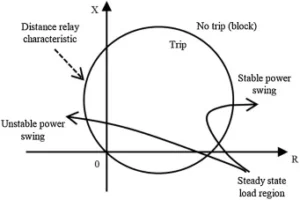
Some faults are transient, and the distance relays or trip circuit breakers do not serve an essential function. These transients are categorized as power swing, as shown in the figure.

Some conditions should be verified to spot power swings that are itemized below:
- No earth fault revealing (absence of zero sequence current)
- No phase-phase fault (absence of negative sequence current)
- Change in ohmic resistance (Impedance) with time is three-phase and fewer than some setting values (ΔR and ΔX).
Overview of Power Swing
Power swing, a fascinating phenomenon in electrical systems, involves the dynamic oscillation of power flows and voltages in interconnected networks. Understanding and deciphering power swing’s mysteries is crucial for ensuring grid stability and preventing potential disruptions.
By delving into the fundamentals, it becomes clear that power swings are often triggered by system disturbances or sudden changes in load conditions. Detecting and monitoring power swing events requires sophisticated techniques, such as protective relays and synchrophasors, which provide real-time data and measurement accuracy. Analyzing power swing phenomena involves employing mathematical models and dynamic simulations to assess system stability. Effective mitigation and control strategies, such as reactive power compensation and emergency control schemes, are vital in minimizing the risks associated with power swings.
Studying case studies and real-world examples and identifying successful strategies to mitigate power swing challenges can teach us valuable lessons. Looking to the future, emerging technologies like artificial intelligence and machine learning hold promise for improving power swing detection and control algorithms. With a comprehensive understanding of power swing and continuous advancements in analysis techniques, we can navigate its mysteries and ensure the reliability and stability of electrical systems.
Importance of Power Swing Dynamics
Power swing dynamics are crucial in electrical systems as they can cause voltage instability and potential equipment damage, necessitating effective protection schemes. Understanding and analyzing power swing dynamics allows for developing reliable strategies to maintain grid stability and prevent disruptions.
Grid Stability
Power swing dynamics directly impact the stability of the power grid. Power swings can cause transient disturbances that affect the balance between generation and demand, potentially leading to voltage and frequency fluctuations. By comprehending power swing dynamics, system operators and engineers can implement appropriate measures to maintain grid stability and prevent cascading failures that could result in blackouts or widespread outages.
Protective Relay Operation
Protective relays are crucial in detecting and responding to abnormal conditions in the power system. Understanding power swing dynamics is essential for designing and configuring protective relays to accurately distinguish between genuine faults and transient power swing events. Proper coordination and adjustment settings ensure the selective and reliable operation of protective relays, minimizing unnecessary trips and ensuring optimal system performance.
Grid Planning and Expansion
Power swing dynamics must be considered during grid planning and expansion efforts. By analyzing historical power swing data and studying the behavior of the existing network, engineers can identify potential challenges and design robust transmission systems that can accommodate power swings without compromising stability. An accurate understanding of power swing dynamics aids in selecting appropriate equipment and implementing necessary control measures to handle future load variations and system disturbances.
System Protection and Resilience
Power swing dynamics can significantly impact the protection schemes deployed within the power system. It is vital to comprehend the behavior and characteristics of power swings to ensure the reliable operation of protection equipment. Failure to account for power swing dynamics can result in inadequate protection coordination, false tripping of relays, and compromised system resilience. By understanding power swing dynamics, engineers can develop protection strategies that effectively respond to power swing events, safeguarding the system against faults and ensuring efficient fault clearing.
System Optimization and Efficiency
Power swing dynamics can affect the overall efficiency of the power system. By understanding the causes and behavior of power swings, engineers can identify areas for improvement and implement optimization measures. These may include implementing advanced control algorithms, utilizing reactive power compensation techniques, or upgrading system components to minimize the impact of power swings and enhance system efficiency.
Understanding power swing dynamics is crucial for grid stability, protective relay operation, grid planning, system protection, and overall system optimization. By comprehending the intricacies of power swing dynamics, engineers and system operators can make informed decisions, implement appropriate measures, and ensure electrical systems’ reliable and efficient operation.
Causes and Triggers of Power Swing
Exploring the causes and triggers of power swings is crucial for understanding the dynamics and behavior of this phenomenon in electrical systems. Various factors can initiate power swings, and comprehending their causes is essential for effective analysis and mitigation strategies. Here are some common causes and triggers of power swings:
System Imbalance
Power swings can occur when there is an imbalance between generation and load in the power system. This imbalance can arise due to sudden changes in load demand, tripping of generators or transmission lines, or insufficient reactive power support. As a result, the power system experiences oscillations as it tries to restore equilibrium between generation and load.
Faults and Clearing Mechanisms
Defects in the power system can also trigger power swings. For example, when a fault occurs on a transmission line or a generator, protective devices such as circuit breakers operate to clear the spot. The sudden change in system configuration and the subsequent restoration of the faulted element can induce power swings as the system adjusts to the new operating conditions.
Network Configuration Changes
Power swings can be initiated by network configuration changes, such as switching operations or the addition/removal of significant load or generation. These changes alter the system’s power flow, causing temporary imbalances and power swing events.
Network Faults or Instabilities
Certain network faults or instabilities, such as voltage collapse or system resonance, can lead to power swings. These conditions can cause rapid voltage and current magnitude changes, leading to oscillatory behavior in the power system.
Loss of Synchronization
Power swings can occur due to the system’s loss of synchronization between generators. This can happen when a generator loses its connection to the grid or synchronization signals are disrupted. The resulting imbalance between generator outputs and system demand can initiate power swings.
Understanding the causes and triggers of power swings is crucial for designing effective protection and control schemes. It enables engineers to develop strategies for detecting and mitigating power swing events, optimizing system stability, and ensuring the reliable operation of electrical systems. By analyzing these causes, engineers can identify vulnerabilities, implement appropriate control measures, and enhance the power grid’s resilience to power swing events.
Characteristics and Behavior of Power Swing
Understanding the characteristics and behavior of power swings is essential for effectively analyzing and managing this dynamic phenomenon in electrical systems. Engineers can develop strategies to ensure system stability and reliability by examining its distinctive features and behavior. Here are key aspects to consider:
Oscillatory Nature
The oscillatory behavior of power flows, voltages, and currents within the power system characterizes power swing. During a power swing, these quantities fluctuate back and forth as the system attempts to restore equilibrium. The oscillations can vary in frequency, magnitude, and duration depending on the specific conditions that trigger the power swing.
Swing Angle and Swing Curve
The swing angle represents the phase difference between the generator rotor angles during a power swing. It is a crucial parameter for understanding power swing behavior. The swing curve is a graphical representation of the relationship between the swing angle and time. Analyzing swing curves helps assess the severity and duration of power swings, enabling operators to make informed decisions and take appropriate actions.
Frequency and Damping
Power swings can exhibit different frequencies depending on the system dynamics. The swing frequency relates to the rate at which the power system oscillates. Damping refers to the gradual reduction in the amplitude of the power swing over time. Understanding the frequency and damping characteristics helps engineers design control strategies to mitigate the impact of power swings and prevent system instability.
Critical Clearing Time
Critical clearing time (CCT) is a crucial parameter in power swing analysis. It represents the time to clear a fault and restore system stability before the power swing becomes unstable. By accurately determining the CCT, engineers can design protective relays and control systems to facilitate timely fault clearance and prevent instability during power swing events.
Interaction with Protection Systems
Power swings can impact the performance of protective relays and associated systems. Understanding the interaction between power swings and protection systems is crucial to prevent unnecessary tripping or delayed operation of protective devices. This includes coordinating relay settings, implementing adaptive protection schemes, and using wide-area monitoring and control systems.
By comprehending the characteristics and behavior of power swing, engineers can develop effective strategies to detect, analyze, and mitigate its impact on the power system. This understanding aids in designing protective relays, control algorithms, and stability enhancement measures to ensure electrical systems’ reliable and stable operation during power swing events.
Technologies and Advancements in Power Swing Analysis
Emerging technologies and advancements in power swing analysis are revolutionizing how power systems are monitored, analyzed, and protected. These innovative approaches provide enhanced capabilities for detecting, analyzing, and mitigating power swing events, ensuring the stability and reliability of electrical grids. Here are some notable advancements in power swing analysis:
Synchrophasor Technology
Synchrophasor technology has emerged as a game-changer in power swing analysis. It involves high-precision time-synchronized measurements from phasor measurement units (PMUs) placed strategically across the grid. These measurements provide real-time data on voltage, current, and frequency with high accuracy and time resolution, enabling precise analysis of power swing dynamics. Synchrophasors facilitate wide-area monitoring and control systems, allowing operators to quickly identify and respond to power swing events.
Wide-Area Monitoring Systems
Wide-area monitoring systems utilize synchrophasor data and advanced analytics to view the power system’s dynamic behavior comprehensively. These systems analyze data from multiple locations to detect power swings, assess their characteristics, and evaluate the impact on system stability. By utilizing wide-area monitoring, operators gain valuable insights into power swing patterns, enabling them to make informed decisions and take appropriate control actions to maintain grid stability.
Machine Learning and Artificial Intelligence
Two commonly used terms in technology are machine learning and artificial intelligence (AI). Techniques are increasingly being utilized in power swing analysis. These technologies enable the development of advanced algorithms that automatically detect, classify, and predict power swing events based on historical data and real-time measurements. Machine learning algorithms can learn patterns and anomalies associated with power swings, enhancing the accuracy and speed of power swing detection and analysis.
Advanced Protection and Control Schemes
With advancements in power swing analysis, protection and control schemes have become more sophisticated. New protection relays and algorithms incorporate improved logic and adaptive settings that accurately discriminate between power swings and genuine faults. These advancements minimize unnecessary relay operations, reduce tripping times, and enhance the overall reliability of protective systems.
Grid Digitalization and IoT Integration
Digitalizing the power grid and integrating the Internet of Things (IoT) enables better monitoring and analyzing power swing events. Smart grid technologies and advanced sensors and communication systems provide real-time data on power system conditions. This wealth of information enhances power swing analysis, allowing for timely detection, precise characterization, and effective control of power swing events.
These emerging technologies and advancements transform power swing analysis, empowering operators and engineers with comprehensive insights and enabling faster and more accurate decision-making. By leveraging these advancements, power systems can proactively manage power swing events, ensure grid stability, and optimize the reliable operation of electrical networks.
Conclusion
In conclusion, emerging technologies and advancements in power swing analysis, such as synchrophasor technology, wide-area monitoring systems, and machine learning, are transforming electrical system monitoring and protection. These innovations provide real-time data, advanced analytics, and accurate information for detecting and mitigating power swing events, ensuring grid stability and improved system performance. Ongoing research and development in these technologies will enhance our ability to manage and mitigate the impacts of power swings, ensuring resilient and reliable power systems.