Power of Plugging and Regenerative Braking in DC Motors
In the realm of motor control and energy efficiency, the concepts of plugging and regenerative braking have emerged as game-changers, breathing new life into the performance of DC motors. These innovative techniques not only enhance the overall efficiency of the motors but also pave the way for significant energy savings and reduced environmental impact. DC motors can reclaim previously lost energy by harnessing plugging and regenerative braking, unlocking a new level of sustainability and power management.
Understanding DC Motors
Before delving into plugging and regenerative braking, let’s briefly understand how DC motors operate. A DC (Direct Current) motor converts electrical energy into mechanical energy. It consists of two main components: the stator (the stationary part) and the rotor (the rotating part). When a DC voltage is applied to the motor’s terminals, it generates a magnetic field in the stator, which interacts with the rotor’s magnetic field. This interaction creates rotational motion, making DC motors widely used in various applications.
Plugging
The Fig below shows the plugging of a DC Shunt Motor. In this technique, the motor inclines to rotate in opposite directions by reversing the armature connection, giving the essential breaking effect. If the engine comes to the initial position, the supply connection should be disconnected; otherwise, it will continuously rotate in the opposite direction.

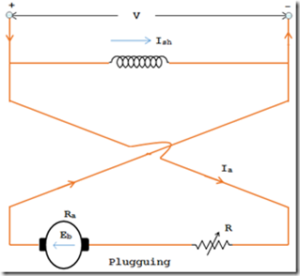
Though the armature connections are reversed, the links in the field windings are retained the same. Therefore, the armature current reverses. The back EMF opposes the applied voltage when the motor runs normally. When the armature connection is reversed, the back EMF and the used voltage act in a similar direction all over the circuit. Thus, a voltage across the armature circuit equal to V+Eb is impressed. Since Eb equals Source voltage, the voltage applied across the armature is 2V. An adjustable resistor R is placed in the circuit when changing the connections of the armature to limit the current to a safe value.
Now, we will see how braking torque depends on the motor speed.
From the above Fig (plugging)
Armature Current Ia = (V+Eb) / (R=Ra)
For a DC Shunt Motor, Φ is constant.
Thus Braking torque ∴ TB = K5 + K6N
Therefore, braking torque reduces as the motor speed slows down. Even when the motor speed is reduced to zero, there will be certain braking torque (TB = K5)
Benefits of Plugging
- Quick Braking: Plugging provides rapid braking, which is crucial for safety in many industrial settings. It can bring a motor to a halt within milliseconds, preventing accidents and minimizing damage to equipment.
- Direction Reversal: Plugging allows for instant reversal of the motor’s direction, making it ideal for applications requiring frequent changes in movement.
- Energy Dissipation: Plugging dissipates excess energy as heat in the motor’s windings, which can be advantageous in scenarios where energy regeneration is not a primary concern.
Regenerative Braking
Benefits of Regenerative Braking
- Energy Recovery: Regenerative braking captures the kinetic energy of the moving motor and converts it back into electrical power, which can be stored in batteries or reused in the system. This contributes to energy efficiency and reduces operating costs.
- Extended Lifespan: By dissipating less energy as heat, regenerative braking can extend the lifespan of DC motors, reducing maintenance and replacement costs.
- Environmental Impact: Regenerative braking’s energy conservation capability reduces the overall environmental impact of energy-intensive applications, making it a green technology choice.
Applications of Plugging and Regenerative Braking
Both plugging and regenerative braking find applications in various industries:
- Automotive: Regenerative braking is a key feature in electric and hybrid vehicles, improving fuel efficiency and range.
- Industrial Automation: Plugging is used for precise control in conveyor belts, robotic arms, and CNC machines.
- Elevators and Escalators: Plugging ensures smooth and controlled movement in vertical transportation systems.
- Material Handling: Both techniques are essential in forklifts and cranes, providing operational safety and control.
Armature Reaction in DC Motor
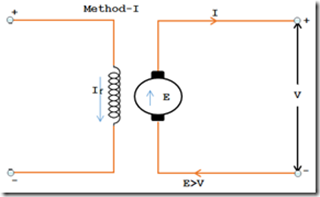
In the first method, the field windings are cut off from the source, and the field current is raised by exciting it from a separate source. Therefore, the induced EMF exceeds the source voltage, and the machine feeds energy into the head. Hence, the braking torque is applied up to the speed of the motor till the induced EMF and the supply voltage become equal. Once the Machine speed drops, it is impossible to maintain the induced EMF at a higher value than the supply voltage. Hence, this technique is used only for a limited range of speed.
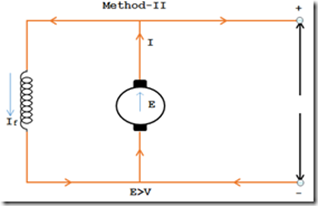
In another technique, Instead of changing the field excitation, the load causes the motor to run beyond the rated speed (I.e., reducing the burden on a hoist). As an outcome, the induced EMF is increased higher than the source voltage. Therefore, the current in the armature reverses, and the wind in the shunt field remains unaltered. Thus, the torque is changed, and the motor speed slows until the induced EMF becomes less than the supply voltage.
Conclusion
In conclusion, the power of plugging and regenerative braking in DC motors is a remarkable advancement that revolutionizes energy efficiency and control in various applications. Shooting, a technique of reversing the armature voltage, enables rapid stopping and changing, enhancing safety and maneuverability in industrial settings. On the other hand, regenerative braking recaptures kinetic energy during deceleration, converting it back into electrical energy, reducing waste, and increasing overall efficiency. By harnessing these capabilities, industries can significantly reduce energy consumption and operating costs, contributing to a greener and more sustainable future. Embracing these technologies unlocks a new era of intelligent motor control, benefiting businesses and the environment.