Overcurrent Protection Relay: Function, Types, and Applications
Types of Over-Current Relays
Over-current protection uses magnitude relays since it picks up once the current magnitude exceeds some setting values. There are four forms of over-current relays.
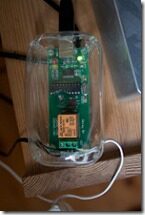
1. Instantaneous Over-Current Relay
2. Definite Time Over-Current Relay
3. Inverse Time Over-Current Relay
4. Direction Over -Current Relay
Instantaneous Over-Current Relay
An Instantaneous Over-Current Relay is a type of over-current protection device that operates without any intentional time delay. It is designed to immediately trip or activate its protective action when the current magnitude exceeds a predetermined setpoint value.
The main characteristic of an Instantaneous Over-Current Relay is its quick response to over-current conditions. When the current exceeds the setpoint value, the relay detects this fault and sends a trip signal to the associated circuit breaker or protective device. This immediate response helps to rapidly isolate the faulty section of the electrical system, minimizing the potential damage to equipment and reducing the duration of the fault.
Instantaneous over-Current Relays operation criteria are current magnitude (without time delay). This sort is applied to the outgoing feeders from the substation. The association diagram of the fast over-current relay is shown above.
Instantaneous Over-Current Relays are typically used when a fast and decisive response to over-current events is required. They are commonly employed in electrical distribution systems’ short-circuit protection, motor overload protection, and feeder protection. These relays are particularly useful in critical systems where even a short duration of excessive current can have severe consequences.
One key advantage of the Instantaneous Over-Current Relay is its simplicity. It operates based on a simple comparison between the current magnitude and the predetermined setpoint value. The relay is triggered when the current exceeds the setpoint, initiating the protective action. This straightforward operation makes the relay reliable, robust, and suitable for various electrical systems.
Definite Time over Current Relay
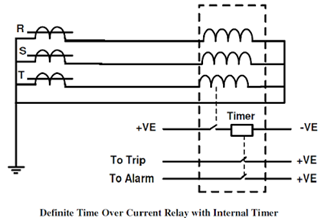
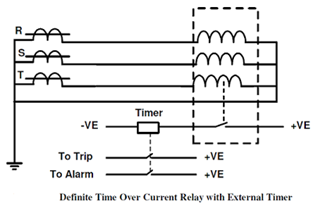
Definite time over current relay is the most applied form of Overcurrent. It’s used as:
Backup protection of distance relay of cable with time delay capable fourth stage of distance relay that is 2.5 seconds in 220 KV lines, and 1.5 seconds in 66 KV lines.
Backup protection to the differential relay of the Power Transformer with a time delay of 2.0 seconds in 220/66 KV transformers and 1.1 seconds within the 66/11 KV transformers.
Main fortification to outgoing feeders and bus couplers with regulating time delay setting.
Inverse Time over Current Relay
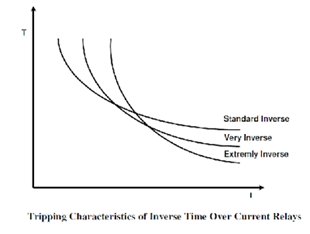
Normal Inverse
The Normal Inverse characteristic is the most basic form of inverse time curve used in over-current relays. It follows a curved shape where the time delay decreases gradually as the current magnitude increases. The relatively smooth curve exhibits a proportional relationship between current and time. The Normal Inverse characteristic is suitable for general applications requiring moderate coordination and selectivity.
Very Inverse
The Very Inverse characteristic offers a more pronounced inverse relationship between current and time than the Normal Inverse feature. The curve has a steeper slope at lower current levels, indicating faster tripping for higher fault currents. This distinct type is useful for applications where a faster response is desired for higher fault currents while still providing coordination for lower-magnitude faults.
Extremely Inverse
The Extremely Inverse characteristic represents a more aggressive response to over-current conditions. The curve exhibits a rapid decrease in time delay with increasing current magnitude. It offers a highly selective reaction, tripping quickly for even moderate fault currents. The Extremely Inverse characteristic is suitable for systems that require a high level of discrimination and rapid fault clearance.
Direction over Current Relay
A Direction Over-Current Relay is a specialized over-current protection device that monitors the current’s magnitude and direction in the electrical power system. It is primarily used in applications where detecting the direction of current flow is critical for proper operation and protection.
The main function of a Direction Over-Current Relay is to identify fault conditions that occur in a specific direction of current flow, such as in the case of a feeder or transmission line with multiple sources or feeders. Considering the current trend, the relay can selectively trip or initiate protective actions only for faults occurring in the desired order while ignoring flaws in other laws.
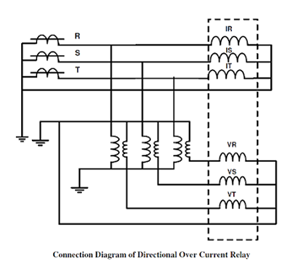
The directional over current relay is associated with the current relay operating in the direction of current flow and blocks within the other way. Three conditions should be gratified for operation. The previous two conditions, current magnitude and time delay, should be considered; therefore, radial asymmetry is the twenty-third additional condition during this sort. The radial asymmetry of current flow is known as mistreatment voltage as a reference of direction. The association diagram of the current and voltage circuits of directional over-current Relays. Almost this sort is put in on the low aspect of the power transformer.
FAQs
What is an overcurrent protection relay?
An overcurrent protection relay is a device used in electrical systems to detect excessive current flow and protect equipment from damage. When the current exceeds a set limit, the relay sends a signal to disconnect the power supply, preventing overheating, equipment failure, or fire hazards.
Key Function:
- Detects overcurrent conditions.
- Protects equipment by disconnecting power during faults.
What are the types of overcurrent protection relays?
Common types of overcurrent protection relays include:
- Instantaneous Overcurrent Relay (IOC): Operates immediately when the current exceeds a preset level, with no intentional delay.
- Time-Delayed Overcurrent Relay: Provides a delay before tripping, allowing the system to recover from temporary faults.
- Inverse Time Overcurrent Relay: The tripping time decreases as the current increases, providing graded protection.
Types:
- Instantaneous (IOC).
- Time-delayed.
- Inverse time.
Where are overcurrent protection relays used?
Overcurrent protection relays are used in a variety of settings, including:
- Power Distribution Systems: To prevent damage from short circuits and overloads.
- Industrial Equipment: Protects motors and machinery from overcurrent conditions.
- Transmission Lines: Ensures the safe operation of high-voltage lines by detecting faults.
Applications:
- Power distribution.
- Industrial machinery protection.
- High-voltage transmission lines.