

Moving Iron Instrument – Principles, Types, and Applications
Moving iron Instruments might be fascinating, especially considering their role in accurately measuring current and voltage without external power sources. These devices rely on the interaction of magnetic forces within a stationary coil and a movable iron vane. Their simple construction and high torque-to-weight ratio make them reliable and efficient for various applications. However, the real intrigue lies in understanding the specific types of Moving Iron Instruments and how they generate deflecting torque. Are you curious about how these elements come together to guarantee precise measurement? Let’s Let’s explore further.
Key Takeaways
- Measures both AC and DC or voltage using soft iron components.
- It consists of an iron vane that moves within the magnetic field of a stationary coil.
- Attraction Type and Repulsion Type, each with specific mechanisms for measurement.
- Offers advantages like measurement versatility, simple construction, and a high torque-to-weight ht ratio.
- They are commonly used circuits for reliable voltage and current measurements with adjustable ranges.
What Is a Moving Iron Instrument
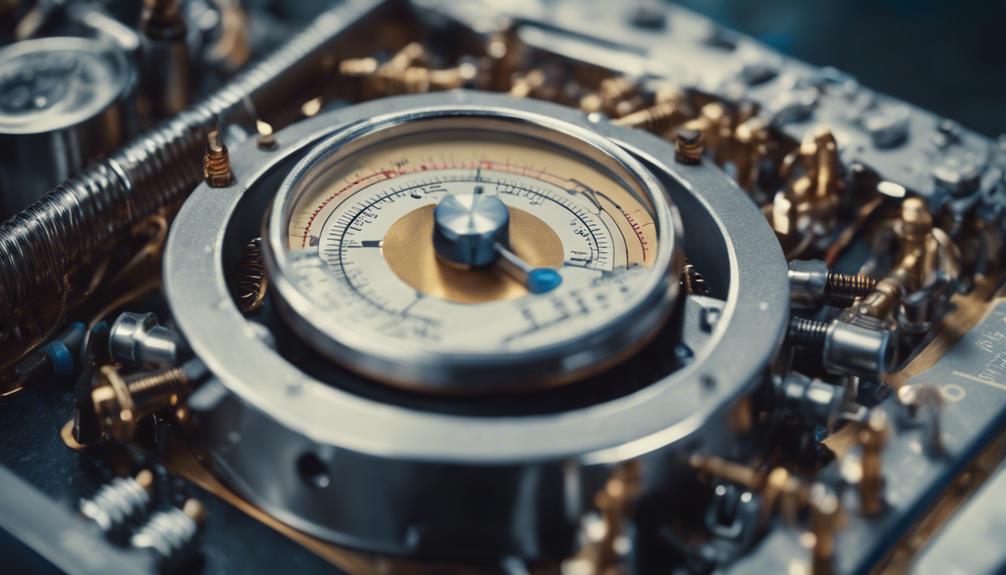
A moving iron instrument measures current or voltage using soft iron ponents responding to magnetic field changes. When you apply an electric current or voltage to these instruments, the resulting magnetic force makes the iron piece move. This movement is then translated into a pointer deflection, providing precise giving.
These instruments are versatile because they work seamlessly with AC and DC circuits, eliminating the need for external power sources. The soft iron components inside the device react to the magnetic field generated by the current or voltage, prompting the pointer to move along a calibrated scale. This allows you to measure electrical parameters accurately.
Moving iron instruments aren’t only costly instruments that aren’t robust, making them suitable for a wide range of applications. Their design guarantees linear scale readings, which means the deflection of the pointer is proportional to the current or voltage applied. This linearity, combined with minimal friction errors, enhances the accuracy of the measurement of the measurement.
Construction of Moving Iron Instrument
To understand the construction of a moving iron instrument, you need to focus on two main areas:
basBasicructural components and the assembly mechanism.
The instrument consists of a soft iron vane that moves within the magnetic field created by a stationary coil.
When current flows through the coil, the interaction with the magnetic field allows for precise measurement.
Basic Structural Components
Moving iron instruments contain a soft iron plate or vane that moves freely within the magnetic field generated by a stationary coil. The iron vane is the key movable component in these instruments, responding to variations in the field strength created by the stationary coil. This stationary coil acts as an electromagnet, its magnetic field fluctuating based on the current passing through it.
As the current varies, so does the magnetic field, causing the iron vane to move accordingly.
The interaction between the iron vane and the oil’s magnetic field is essential for accurately measuring electrical parameters. When current flows through the coil, it generates a magnetic field, attracting or repelling the iron vane depending on the field strength. The movement of this iron component is directly correlated to the magnitude of the measured electrical parameter, allowing for precise readings.
In essence, the basic structural components of moving iron instruments—comprising the stationary coil and the iron vane—work together seamlessly to measure electrical parameters accurately. By understanding these components, you can appreciate the functionality and reliability of moving iron instruments in various electrical measurement applications.
Assembly and Mechanism
Understanding how these components fit together, let’s explore the assembly and mechanism of a moving iron instrument. The basic construction revolves around a soft iron plate or vane that moves freely within the magnetic field generated by a stationary coil.
The stationary coil, acting as an electromagnet, varies its magnetic field strength depending on the current magnitude passing through it. This interaction forms the core principle of moving iron instruments, exploiting the concepts of attraction and repulHere’sHere’s a clear breakdown:
- Iron Vane: A soft iron vane moves in response to the magnetic field, indicating electrical changes.
- Stationary Coil: The coil generates a magnetic field whose strength changes with current variations.
- Control Mechanism: While older models used gravity control, modern moving iron instruments used spring control for accuracy.
- Damping Method: Air friction, achieved through a moving piston in an air syringe, guarantees smooth needle movement.
The working principle of moving iron instruments has advantages, like simplicity and robustness, and disadvantages, like non-linear scales. Understanding the assembly and mechanism provides a solid foundation for appreciating how these instruments measure electrical parameters.
Working Principle
Harnessing the magnetic effects of electric current, moving iron instruments measure electrical quantities through the interaction between a movable iron component and a stationary coil.
When current flows through the stationary coil in moving iron meters, it generates a magnetic field. This field exerts a force on the movable iron pieces inside the coil. The force of attraction between the magnetic field and the iron pieces is proportional to the square of the current passing through the coil.
The magnetic field strength increases as the current increases, causing a greater force to act on the movable iron. This force induces a torque that moves the iron piece. The displacement of the iron piece is then mechanically linked to a pointer, which deflects on a calibrated scale, providing a visual indication of the measured electrical quantity, such as voltage or current.
This principle guarantees that the instrument’s response is proportional to the current, enabling accurate measurements. The straightforward yet effective design of moving iron instruments makes them reliable tools for various electrical measurements. By converting the magnetic effects of current into mechanical movement, these instruments offer a clear and precise way to gauge electrical parameters.
Types of Moving Iron Instruments
When you explore the types of moving iron instruments, you’ll find they fall into two main categories: attraction and repulsion.
Attraction-type instruments use a thin disc of soft iron that moves towards stronger magnetic fields, while repulsion-type instruments rely on the force between fixed and movable iron vanes.
Knowing these differences can help you choose the instrument for your measurement needs.
Attraction Type Instruments
Attraction-type moving iron instruments draw a single iron disc towards areas with stronger magnetic fields, guaranteeing accurate measurements through spring mechanisms and careful balance adjustments. These instruments use a basic principle where iron discs or plates move towards high magnetic flux density regions. Instead of relying on gravity, modern designs incorporate spring mechanisms for enhanced accuracy and reliability.
Air friction is significant in these instruments, providing damping torque to stabilize the pointer. Without adequate damping, the pointer might oscillate, causing reading errors. Balance weight adjustments are vital to achieving precise measurements. These adjustments ensure the pointer’s equilibrium, allowing you to obtain accurate readings every time.
Here are some key features:
- Iron Disc Movement: The iron disc is attracted to stronger magnetic fields, enabling the measurement.
- Spring Mechanisms: Springs replace gravity for more accurate and consistent performance.
- Air Friction Damping: Air friction provides damping torque and stabilizes the pointer.
- Balance Weight Adjustments: These adjustments are essential for the precise positioning of the pointer.
Repulsion Type Instruments
Have you ever wondered how repulsion-type moving iron instruments achieve accurate measurements without relying on polarity? These instruments use the principle of repulsion between two iron vanes—one fixed and one movable. When current flows through the coil, a high magnetic field strength is generated, causing the two vanes to repel each other. This repulsion results in the deflection of the movable vane, giving a measurement that’s not dependent on the polarity of the current.
Repulsion-type instruments are versatile and work equally well with AC and DC measurements. The torque regulation is managed by a spring control mechanism, ensuring that the deflection is proportional to the strength of the current. This makes these instruments simple yet effective for a variety of electrical measurements. Here’s a comparison to highlight their unique features:
| Feature | Repulsion Type Instruments |
|---|---|
| Polarity Dependency | None |
| Use with AC/DC | Both |
| Torque Regulation | Spring Control |
| Measurement Principle | Repulsion Force |
| Magnetic Field Impact | High Strength |
Deflecting Torque

Deflecting torque kicks in as soon as current flows through the coil in a moving iron instrument, providing a proportional response based on the current’s resistance square.
As the current passes through the coil, the moving iron instrument generates deflecting torque, which is important for accurate readings. This deflecting torque is derived from energy considerations and is directly proportional to the square of the current.
In a steady-state condition, the deflecting torque determines the pointer’s position on the scale, directly indicating the current magnitude.
The torque causing deflection is unidirectional and independent of the current’s polarity, ensuring consistent readings. This feature is essential for maintaining the instrument’s steady-state condition.
Controlled torque adjustments are important to ensure you get precise measurement readings. They help in balancing the deflecting torque and maintaining the accuracy of the instruHere’sHere’s a quick rundown to remember:
- Proportional Response: Deflecting torque is proportional to the square of the current.
- Unidirectional Torque: The torque is independent of current polarity.
- Steady-State Condition: Ensuring accurate pointer positioning.
- Controlled Adjustments: Important for maintaining measurement accuracy.
Advantages
One of the key advantages of moving iron instruments is their ability to measure AC and DC currents without any modifications. This versatility makes them a valuable tool in various types of electrical applications, where instruments where current types are not needed, and savings are not required. Both time and moving iron instruments are also known for their simple construction. This simplicity translates to robustness and durability, ensuring the device can withstand harsh conditions and regular use. Because of their uncomplicated design, these instruments are cost-effective, making them an excellent choice for both industrial and educational settings.
Another significant benefit is their high torque-to-weight ratio. This feature minimizes friction errors, enabling more accurate readings. You can rely on these instruments to perform consistently in demanding environments consistently. The lack of an external power source also enhances their efficiency and practicality, making them easier to use in various situations.
Disadvantages

While versatile, moving iron instruments have disadvantages that can impact their overall performance and accuracy. Understanding these drawbacks will help you make informed decisions when using them in various applications.
- Non-linear Scale:
One of the key disadvantages of moving iron instruments is their non-linear scale. This can make it difficult to take precise readings, especially in the lower and upper ranges of the scale.
- Calibration Challenges:
The deflection torque in these instruments isn’t directly proportional to the square of the current, leading to significant calibration challenges. This is especially true when switching between AC and DC measurements, as each requires different calibrations.
- Hysteresis:
Errors in moving iron instruments can also arise from hysteresis. This means the instrument’s reading may lag behind changes, affecting accuracy.
- AC-specific Errors and Stray Magnetic Fields:
Moving iron instruments are susceptible to AC-specific errors due to frequency variations. Additionally, stray magnetic fields can introduce errors in the readings, complicating their use in environments with high electromagnetic interference.
Applications in Voltmeter and Ammeter
Moving iron instruments are widely used in electrical circuits as voltmeters and ammeters due to their versatility in measuring AC and DC currents. Thanks to their unique design features, these instruments excel in measuring electric voltage and current.
A moving iron instrument is used as a voltmeter that connects in parallel with the circuit, ensuring accurate voltage measurement due to its high resistance. As an ammeter, it connects in series, minimizing voltage drop because of its low resistance.
Moving iron instruments used in these applications rely on the principle of the strength of the magnetic field. The deflection of the iron piece is proportional to the square of the current or voltage, making these instruments highly effective for both types of measurements. The Attraction Type Moving Iron design is notable for its reliability and accuracy.
You can adjust the range of an ammeter using a shunt coil, whose range is adjusted with additional resistance. This flexibility adds to their appeal in various electrical applications.
Therefore, the applications in voltmeter and ammeter settings showcase the adaptability and precision of moving iron instruments in electrical measurements.
Common Uses in Electrical Circuit
You’ll find that moving iron instruments are integral in various electrical circuits for their reliability and accuracy beyond their role as voltmeters and ammeters. These devices are essential for several reasons:
- Versatile Measurement: Moving iron instruments can measure AC and DC, making them highly versatile. Their unique construction lets them handle varying magnetic field strength and current flowing through the circuit.
- Durability: The robust construction of the moving iron instruments guarantees they’re less susceptible to damage from external magnetic fields, a common issue in electrical environments.
- Adjustable Ranges: You can easily adjust the measurement range using shunt coils for ammeters and additional resistances for voltmeters. This makes these instruments adaptable to different circuit requirements.
- Consistent Accuracy: They provide accurate readings due to their design, which includes a Magnet Moving Coil and controlling torque mechanism. This ensures that the instrument remains reliable over time.
Conclusion
To conclude, moving iron instruments are invaluable tools for measuring current and voltage in electrical circuits. Their simple construction, high torque-to-weight ratio, and consistent performance make them reliable and versatile.
Whether dealing with voltmeters or ammeters, these instruments excel in various applications. Despite a few disadvantages, their benefits far outweigh the drawbacks, making moving iron instruments a go-to choice for accurate electrical measurements. You’ll find them indispensable in many electrical circuit setups.
FAQs
What is a moving iron instrument?
A moving iron instrument is an electrical measuring device that measures AC and DC currents and voltages. It operates based on the principle that a piece of soft iron moves in response to the magnetic field produced by the current flowing through a coil.
How does a moving iron instrument work?
A moving iron instrument works on the principle of electromagnetic inducHere’sHere’s how it works:
- Coil and Magnetic Field: The instrument consists of a coil through which the current to be measured flows. This current generates a magnetic field.
- Iron Piece MovemeThe magnetic field attracts A piece of soft iron placed within the field. The force of attraction is proportional to the strength of the magnetic field and, thus, to the current flowing through the coil.
- Pointer Deflection: The movement of the iron piece causes a pointer to move over a calibrated scale, indicating a current or voltage value tag.
What are the types of moving iron instruments?
There are two main types of moving iron instruments:
- Attraction Type: In this type, a piece of soft iron is attracted towards a fixed coil carrying the current. The deflection of the pointer is proportional to the strength of the magnetic field.
- Repulsion Type: This type uses two iron vanes, one fixed and one movable. When current flows through the coil, both iron vanes become magnetized and repel each other. The movement of the movable vane causes the pointer to deflect, indicating the measurement.
What are the applications of moving iron instruments?
Moving iron instruments are used in various applications, including:
- Measuring AC and DC Currents and Voltages: Suitable for alternating and direct current measurements.
- Power Distribution SysteThese are used on switchboards and control panels to monitor electrical parameters.
- Laboratory Testing: Employed in lotto testing, remeasuring electrical quantities in experiments and circuit designs.
- Industrial Equipment: Used in industrial settings to monitor and control electrical machinery and systems.
What are the advantages of moving iron instruments?
The advantages of moving iron instruments include the following:
- Versatility: Can measure both AC and DC quantities.
- Robustness: Durable and can withstand mechanical shocks and vibrations.
- Simplicity: Simple construction and easy to use.
- Cost-Effective: Generally less expensive compared to other types of measuring instruments.
What are the limitations of moving iron instruments?
The limitations of moving iron instruments include:
- Non-Linearity: The scale is non-linear, especially at lower ranges, making it less accurate than other instruments.
- Hysteresis and Eddy CurrenHysteresisesis and eddy currents can affect accuracy.
- Frequency Response: Performance can be affected by changes in frequency, making them less suitable for high-frequency measurements.
- Parallax Error: Potential for parallax error if the pointer is not viewed directly from the front.
How can I ensure accurate readings with a moving iron instrument?
To ensure accurate readings with a moving iron instrument:
- Proper Calibration: Regularly calibrate the instrument to maintain accuracy.
- Correct Viewing Angle: View the pointer directly from the front to avoid parallax error.
- Stable Environment: Use the instrument in a stable environment free from mechanical shocks and vibrations.
- Avoid Overloading: Do not exceed the maximum rated capacity of the instrument to prevent damage and inaccurate readings.
Understanding moving iron instruments’ principles, types, and applications can help inhale and create a device for measuring electrical quantities and ensuring accurate and reliable readings.
