Discovering the Open Circuit Characteristic of D.C Generators
D.C. generators have been crucial in powering various electrical systems for decades. Understanding the behavior and characteristics of these generators is fundamental for engineers and researchers in electrical engineering. Among the important features to explore is the open circuit characteristic, which provides invaluable insights into the generator’s voltage output under no-load conditions. By delving into the open circuit characteristic, we can unravel the intricacies of D.C. generators, their performance, and the factors that influence their operation. In this article, we embark on a journey to discover the open circuit characteristic of D.C. generators, shedding light on their significance and the methods employed to analyze and interpret this important phenomenon.
Defining the Open Circuit Characteristic
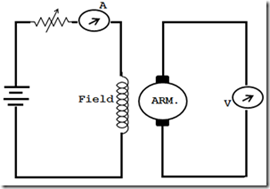
-
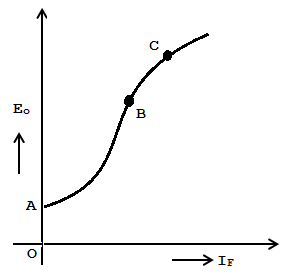
When the field current is zero, there’s some generated e.m.f. O.A. This is often owing to the residual magnetism within the field poles.
-
The curve is linear over a reasonably wide selection of field current (up to point B within the curve). As a result of this varies, the reluctance of iron is insignificant compared to the air gap. The air gap reluctance is a constant and, therefore, linear relationship.
-
After the curve reaches point B, the reluctance of iron additionally comes into the picture. It results from higher flux densities, µr for iron reduces, and the unwillingness of iron is no longer tiny. Accordingly, the curve moves away from the linear relationship.
-
After point C on the curve, the magnetic saturation of poles begins, and E0 tends to level.
Factors Influencing the Open Circuit Characteristic
The following factors influenced the open circuit characteristic of a dc. Generator
Field Excitation Current
The field excitation current of a D.C. generator plays a significant role in determining its open circuit voltage. By adjusting the field excitation current, engineers can control the strength of the magnetic field within the generator, which directly affects the generator’s output voltage. Experimenting with different levels of field excitation current allows for a comprehensive analysis of the generator’s behavior and performance.
Speed and Armature Reaction
The speed at which a D.C. generator operates and the effect of armature reaction also impact its open circuit characteristic. Rate changes can lead to variations in the generator’s voltage output. Additionally, the armature reaction, caused by the magnetic field produced by the armature windings, can further influence the open circuit voltage. Understanding and accounting for these factors are crucial in accurately predicting the generator’s behavior.
Experimental Setup
- Connect the DC generator to a power supply, ensuring all connections are secure and proper safety measures are in place.
- Attach the ammeter in series with the field winding to measure the field current (If the generator is separately excited, the field winding must have a separate DC power supply).
- Connect the voltmeter across the output terminals of the generator to measure the generated voltage (EMF).
- Use a rheostat in series with the field winding to vary the field current manually.

Procedure
- Begin with all the switches open and no load connected to the generator.
- Gradually increase the field current by adjusting the rheostat while recording the corresponding generated voltage values from the voltmeter.
- Increase the field current in small increments, and for each increment, wait for the voltmeter reading to stabilize before recording the value.
- Increasing the field current until a suitable range of data points is obtained to cover the entire OCC.
- After reaching the maximum field current, decrease the field current in the same manner, recording voltage values at different intervals.
- Repeat the experiment a few times to ensure the consistency of the results.
Data Analysis
- Plot a graph with the generated voltage (EMF) on the vertical (y) axis and the field current on the horizontal (x) axis.
- The resulting graph represents the Open Circuit Characteristic of the DC generator.
Interpretation
- The Open Circuit Characteristic is generally a curve with a characteristic shape. It typically exhibits a slight increase in voltage with the field current, reaching a peak value, after which it starts to decrease.
- The peak voltage obtained is the maximum EMF the DC generator generates under no-load conditions.
- At any point, the slope of the OCC curve represents the generator’s internal resistance at that particular field current.
Conclusion
The open circuit characteristic of D.C. generators is crucial in understanding their behavior and performance. By studying this characteristic, engineers and researchers gain valuable insights into the generator’s voltage output under no-load conditions, enabling them to optimize its design and performance for various electrical applications. The open circuit characteristic curve becomes a powerful tool for analysis and interpretation, facilitating informed decisions and ensuring D.C. generators’ efficient and reliable operation.