3 Phase Induction Motor: Working Principle and Key Features
When you explore the working principle of a 3 phase induction motor, you’ll discover how it harnesses the power of a rotating magnetic field within the stator. This rotating field, interacting with the rotor, induces currents that generate the torque necessary for motor operation. But what exactly causes this magnetic field to rotate, and how does the rotor respond to these induced currents to maintain continuous torque production? Understanding these aspects is essential for appreciating why 3-phase induction motors are the backbone of industrial applications. Let’s take a closer look at the mechanics behind this fascinating process.
Key Takeaways
- Stator windings create a rotating magnetic field that induces currents in the rotor.
- The rotor turns due to the interaction between its induced currents and the stator’s rotating magnetic field.
- The speed difference between the rotor and magnetic field is essential for continuous torque production.
- Torque is generated by the interaction of the rotor’s induced currents with the stator’s magnetic field.
- Three-phase sinusoidal voltages ensure efficient, smooth power delivery and reduced voltage fluctuations.
3 Phase Power Basics
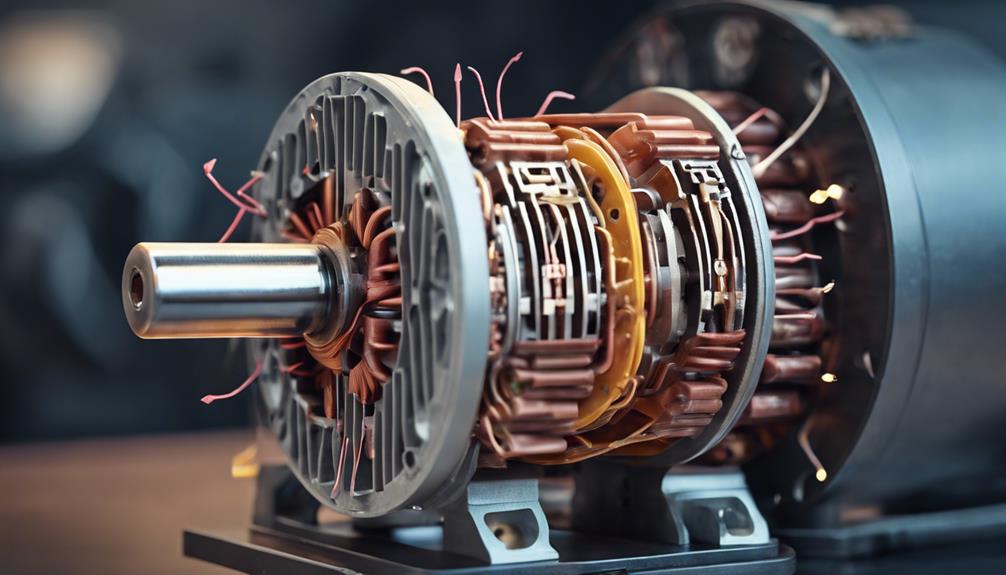
Three-phase power utilizes three sinusoidal voltages, each shifted by 120° to guarantee efficient and smooth power delivery. This system is widely adopted in industrial applications because it can deliver three times as much power as a single-phase system while using only 1.5 times the wire.
The significant nature of three-phase power ensures reduced voltage fluctuations, making it ideal for high-power equipment like induction motors and large machinery.
Three-phase power plays a vital role in an induction motor. It creates a stator field, the magnetic field generated by the stationary part of the motor. When the three-phase currents flow through the stator windings, they produce a rotating magnetic field (RMF). This RMF is essential because it induces a current in the rotor, the rotating part of the motor.
As a result, the rotor turns, converting electrical energy into mechanical energy. The continuous and smooth rotation of the RMF ensures that the motor operates efficiently and reliably.
Therefore, three-phase power isn’t just about delivering power; it also facilitates the fundamental operation of induction motors by creating the necessary magnetic conditions for converting electrical energy into mechanical motion.
Magnetic Field Production
The stator windings, positioned 120 degrees apart, generate a rotating magnetic field essential for operating a 3-phase induction motor. When a 3-phase AC supply is connected to these windings, the currents in the stator create a magnetic field within the motor. This magnetic field rotates synchronously, governed by the formula (120 x supply frequency) / Number of poles.
The rotating magnetic field (Is vital because it induces currents in the rotor conductors. These induced currents interact with the RMF to create torque, driving the rotor. The direction of the motor’s rotation hinges on the stator windings’ phase sequence and connection order.
Understanding the RMF’s role in phase induction motors involves several key points:
- Stator windings: Offset by 120 degrees to produce the RMF.
- Synchronous speed: Determined by supply frequency and Number of poles.
- Torque generation: Resulting Interaction between the RMF and induced rotor currents.
- Slip: Necessary for torque, the speed difference between the stator field and rotor.
Stator and Rotor Interaction
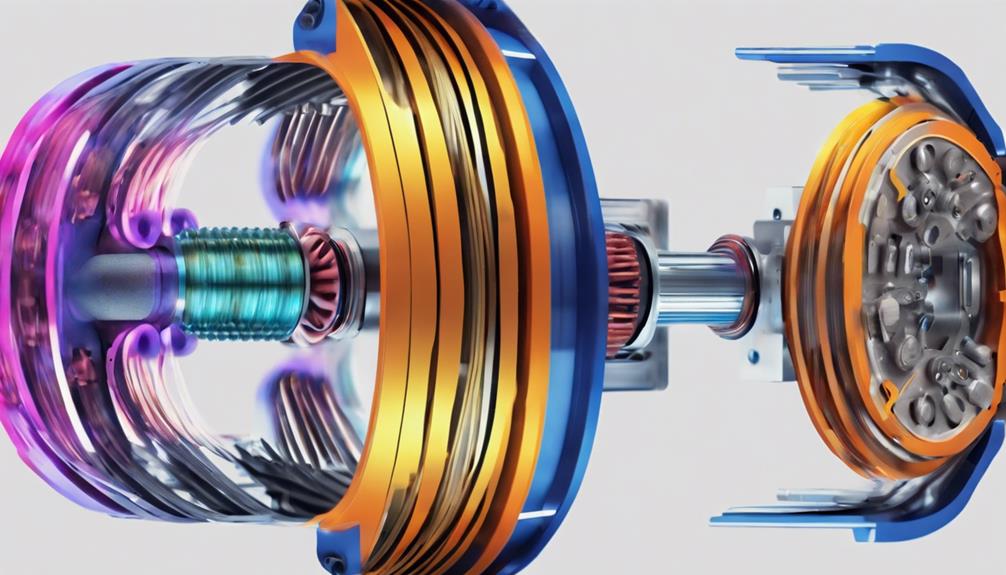
In a 3-phase induction motor, when the stator’s rotating magnetic field induces currents in the rotor, it produces torque that drives the motor. The stator achieves this rotating magnetic field by utilizing three windings, each offset by 120 degrees. A rotating magnetic field is generated as the 3-phase power supply energizes the stator windings. The rotating magnetic field interacts with the rotor, causing induced currents to flow within the rotor bars. These induced currents then create their magnetic fields. The interaction between the stator’s rotating magnetic field and the rotor’s induced magnetic fields leads to torque production, which causes the rotor to turn.
You’ll notice that the rotor never quite catches up to the stator’s rotating magnetic field. This difference in speed, known as slip, is essential for continuous torque production. The rotor’s speed is always slightly less than the synchronous speed of the rotating magnetic field.
One key benefit of this setup is the robust design of the induction motor. The motor is more maintenance-friendly and durable, with no electrical connections to the rotor. This strong design guarantees longevity and reliability in various industrial applications.
Slip and Synchronous Speed
Understanding slip and synchronous speed is essential for optimizing the performance and efficiency of your 3-phase induction motor. Slip is the difference between the synchronous speed and the actual rotor speed. This discrepancy allows the rotor to generate the torque required for mechanical work.
The slip percentage is important for determining how effectively your motor converts electrical energy into mechanical energy and can be calculated using the formula:
[ ext{Slip Percentage} = rac{ext{Synchronous Speed} – ext{Rotor Speed}}{ext{Synchronous Speed}} imes 100% ]
To ensure your 3-phase induction motor operates efficiently across various applications, it’s important to maintain an ideal slip. Here are key points to consider:
- Rotor Speed: The actual speed at which the rotor turns is always slightly less than the synchronous speed.
- Torque: Slip enables the rotor to produce torque, which is essential for the motor’s mechanical work.
- Slip Percentage: Monitoring and adjusting this value can help in optimizing performance.
- Applications: Different applications may require different slip percentages for ideal efficiency and performance.
Rotor Current Induction
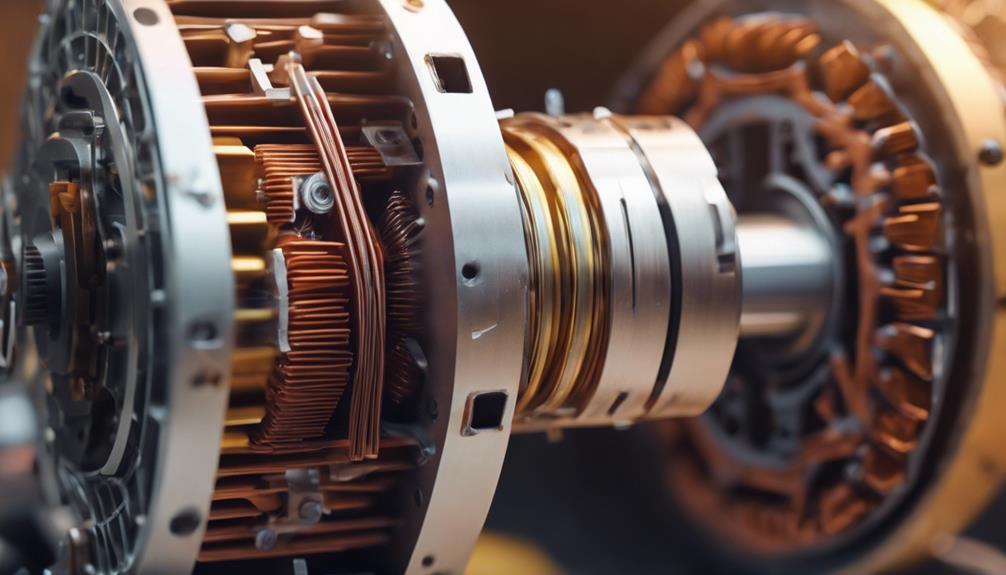
When you explore rotor current induction, you’ll see how the stator’s rotating magnetic field generates currents in the rotor.
These induced currents interact with the stator field, causing the rotor to turn.
The difference in speed, or slip, between the stator field and the rotor is essential for producing the necessary torque.
Electromagnetic Field Interaction
The rotating magnetic field created by the stator windings induces current in the rotor, setting the stage for torque production. When this rotating magnetic field intersects with the rotor’s conductors, an induced electromotive force (emf) within them is induced. This induced emf generates rotor current, interacting with the stator’s magnetic field.
This electromagnetic field interaction is vital because it produces a torque that causes the rotor to spin. The rotor current creates its magnetic field, which opposes the stator’s magnetic field, converting electrical energy into mechanical energy.
Key aspects worth noting include:
- Rotor Current: Generated by the induced EMF from the rotating magnetic field.
- Electromagnetic Field Interaction: The rotor’s magnetic field opposes the stator’s.
- Slip: The speed difference between the rotor and the rotating magnetic field is essential for torque production.
- Torque: The force that causes the rotor to turn, generated by the interaction of rotor current with the stator field.
As the rotor starts to spin, the slip decreases but never reaches zero, ensuring continuous torque production.
This interaction is fundamental to operating a 3-phase induction motor, making it efficient and reliable.
Slip and Rotor Speed
Slip, the difference between synchronous and rotor speeds is important for torque generation in a 3-phase induction motor. Without slip, the rotor wouldn’t induce any current so that no torque would be generated.
The presence of slip guarantees that the rotor can interact with the rotating magnetic field produced by the stator. This interaction induces a rotor current, which is essential for generating torque.
In an induction motor, the rotor speed is always slightly slower than the synchronous speed due to slip. This difference allows the rotor to ‘chase’ the rotating magnetic field but never quite catch up.
The level of slip directly impacts the amount of torque produced. A higher slip means a higher rotor current, generating more torque. Conversely, lower slip results in less rotor current and reduced torque.
Understanding slip is important for optimizing the performance of an induction motor. By managing slip, you can control the motor’s torque output and efficiency.
Slip isn’t just a byproduct of the motor’s operation; it’s an essential aspect that allows the induction motor to function effectively and efficiently.
Torque Generation
The torque generation in a 3-phase induction motor hinges on the interaction between the stator’s rotating magnetic field and the rotor’s induced currents.
This interaction creates a rotor magnetic field that opposes the stator field, generating the necessary torque to drive the motor.
The slip, which is the difference in speed between the stator field and the rotor, is essential for this process.
Electromagnetic Force Interaction
Understanding how torque is generated in a three-phase induction motor hinges on the interaction between the stator’s rotating magnetic field and the rotor’s induced currents. When the stator creates a magnetic field that rotates, it induces currents in the rotor. The rotor never quite catches up with the rotating magnetic field due to a phenomenon called ‘slip.’
This slip is essential for torque generation because it maintains the necessary relative positions between the magnetic field and the rotor currents.
Here’s a quick breakdown of the key points:
- The rotating magnetic field in the stator induces currents in the rotor.
- The rotor never matches the speed of the rotating magnetic field, resulting in slip.
- The induced current in the rotor interacts with the rotating magnetic field to produce torque.
- Torque generation relies on the relative positions of the magnetic field and the rotor currents.
As the rotor attempts to align with the rotating magnetic field, a force is exerted, creating rotational torque. This torque drives the mechanical motion of the motor shaft, converting electrical energy into mechanical work efficiently.
Understanding these interactions is vital for grasping how three-phase induction motors operate and deliver power to various mechanical systems.
Rotor Magnetic Field
The rotor’s magnetic field is often crucial for generating the torque that powers three-phase induction motors. When the stator’s rotating magnetic field interacts with the rotor, it induces a current in the rotor. This rotor current creates a magnetic field that opposes the stator field, leading to electromagnetic torque. The torque production results from the speed difference, or slip, between the rotating stator field and the rotor.
| Concept | Description | Result |
|---|---|---|
| Rotor Magnetic Field | Generated by induced rotor current | Opposes stator field |
| Rotor Current | Induced by the stator’s rotating magnetic field | Opposes stator’s magnetic field |
| Electromagnetic Torque | Produced due to the interaction of rotor and stator fields | Causes motor rotation |
| Speed Difference | Slip between stator field speed and rotor speed | Essential for torque generation |
| Torque Production | Conversion of electrical energy into mechanical motion | Powers the motor |
The interaction between the rotor’s magnetic and stator fields is critical. The opposing nature of these fields causes the rotor to experience a force, resulting in the rotor’s rotation. This rotation produces the mechanical power you need for various applications. The speed difference between the stator field and the rotor ensures continuous torque production, maintaining the motor’s operation.
Slip and Torque Relationship
The torque generated in a three-phase induction motor hinges on the slip between the rotor and the stator’s rotating magnetic field. This slip is the speed difference between the rotating magnetic field and the rotor. When you grasp this relationship, you can see how crucial it is for achieving the desired mechanical work.
The torque in an induction motor is directly proportional to the slip. As the slip increases, the torque produced by the motor also increases. This happens because a higher slip means a greater relative motion between the rotor and the magnetic field, which generates more force to be converted into mechanical work. However, it’s important to balance the slip, as excessive slip can lead to inefficiencies and overheating.
Here are some key points to take into account about the slip-torque relationship:
- Slip Definition: Slip is the speed difference between the rotor and the rotating magnetic field.
- Torque Generation: Higher slip values result in increased torque production.
- Mechanical Work: Effective torque generation is crucial for performing mechanical work.
- Optimization: Understanding the slip-torque relationship helps optimize induction motor performance.
Motor Efficiency
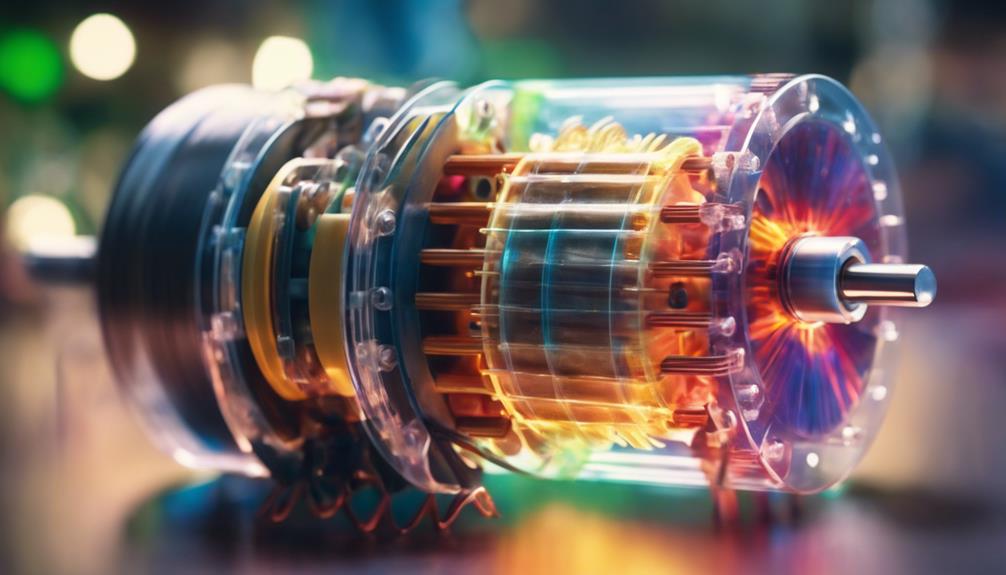
Maximizing the energy efficiency of your 3-phase induction motor can greatly reduce operating costs and environmental impact. By focusing on motors’ magnetic properties, you can achieve higher efficiency and substantial energy savings. Efficient motors are designed to minimize losses, influeced by magnetic losses, operating conditions, and regular maintenance.
Key Factors | Description | Impact
— | — | —
Magnetic Losses | Losses due to magnetic hysteresis and eddy currents | Reducing these losses improves overall efficiency.
Operating Conditions | Temperature, load, and voltage variations | Ideal conditions ensure peak performance.
Maintenance | Regular inspections and timely repairs | Extends motor lifespan and maintains efficiency.
Select motors with high-efficiency ratings to enhance your motor’s efficiency and ensure they’re suitable for your specific operating conditions. High-efficiency motors use superior materials and design techniques to minimize losses, delivering better performance with less energy consumption. Regular maintenance, including checking for wear and tear, lubrication, and cleaning, is essential for keeping your motor in top shape.
Self-Starting Capability
Thanks to their unique rotor design, squirrel cage induction motors excel at self-starting. The rotor in these motors resembles a hamster wheel, which is essential in enabling this capability. This feature eliminates the need for external starting mechanisms, making the motor simpler and more efficient.
The rotor bars in a squirrel cage motor are designed to induce currents when the engine is powered on. These induced currents generate a magnetic field that interacts with the stator’s magnetic field, causing the rotor to turn and the engine to start automatically. This self-starting capability is a significant advantage in various settings.
You’ll find squirrel cage induction motors used widely due to their self-starting nature:
- Industrial applications: Factories and plants benefit from the reliability and efficiency of these motors.
- Domestic applications: Household appliances like washing machines and air conditioners often utilize these motors.
- Pumps and fans: These essential pieces of equipment rely on self-starting motors to operate smoothly.
- HVAC systems: Heating, ventilation, and air conditioning systems depend on the self-starting capability for consistent performance.
Reliability and Robustness
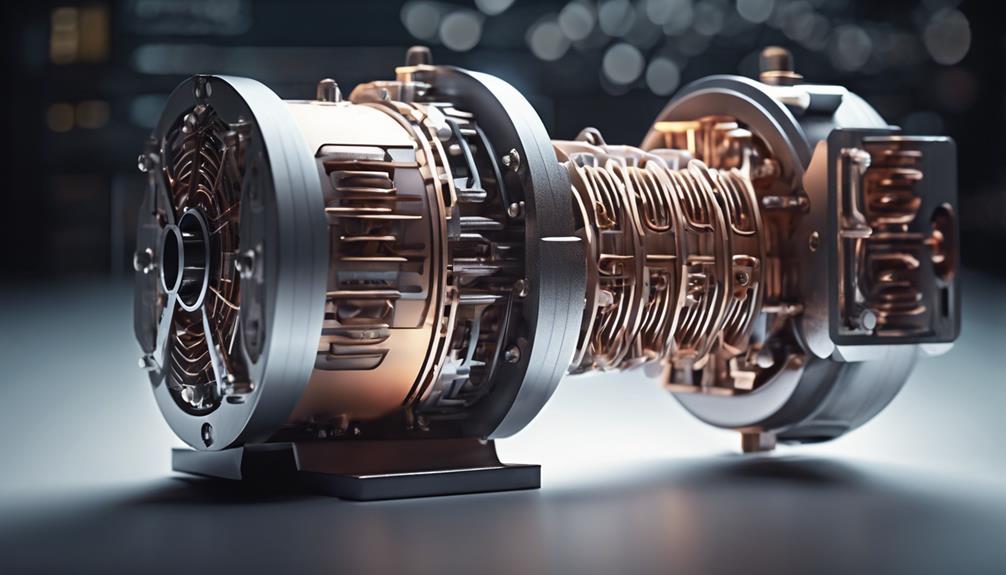
Induction motors stand out due to their exceptional reliability and robust construction. Thanks to their simple design and the absence of slip rings, these motors have fewer parts prone to wear and tear. This simplicity not only enhances their robustness but also greatly reduces maintenance requirements. You don’t have to worry about frequent repairs, making them highly reliable.
Induction motors’ self-starting feature further boosts their reliability. You won’t need any external mechanisms to get them running, ensuring they perform consistently. Their robust design makes them suitable for harsh conditions, such as extreme temperatures, dust, or moisture.
Additionally, induction motors are incredibly cost-effective. The initial investment might be comparable to other motors, but the long-term savings on maintenance and repairs are substantial. Let’s summarize these points:
| Feature | Benefit |
|---|---|
| Absence of Slip Rings | Reduced maintenance |
| Self-Starting Feature | Consistent performance |
| Robust Construction | Suitable for harsh conditions |
Considering all these aspects, you’ll see why induction motors are preferred in various applications. Their reliability and robustness make them an excellent investment for industrial and domestic uses.
Industrial Applications
Due to their efficiency and reliability, three-phase induction motors are essential to a wide range of industrial applications. Leveraging the principles of AC power and Faraday’s law of electromagnetic induction, these motors drive countless types of machinery and equipment.
Utilizing a three-phase system guarantees a constant power supply, which is vital for maintaining synchronous speed and rotor performance.
In the domain of electrical engineering, three-phase induction motors are indispensable. Here are some key industrial applications:
- Machinery and Equipment: These motors power various types of heavy machinery, including conveyors and crushers, ensuring smooth operation in manufacturing plants.
- Pumps and Compressors are essential for fluid movement and gas compression, and they’re widely used in water treatment plants, oil refineries, and chemical processing units.
- HVAC Systems: They play a critical role in heating, ventilation, air conditioning systems, driving fans, and blowers to maintain ideal environmental conditions.
- Electric Vehicles: Induction motors, known for their efficiency and performance, are increasingly used in the propulsion systems of industrial electric vehicles.
Conclusion
In understanding the 3 phase induction motor, you’ve seen how the rotating magnetic field in the stator induces currents in the rotor, generating essential torque.
The slip between synchronous and rotor speeds guarantees continuous torque production, making these motors highly efficient.
Their self-starting capability, reliability, and robustness make them indispensable in various industrial applications.
Embrace the efficiency and dependability of 3-phase induction motors for your industrial needs!
FAQs
What is the working principle of a 3-phase induction motor?
A 3-phase induction motor operates on the principle of electromagnetic induction. When a 3-phase alternating current (AC) is supplied to the stator windings, it creates a rotating magnetic field. This rotating magnetic field induces a current in the rotor conductors, which, in turn, generates another magnetic field that opposes the stator’s magnetic field. This interaction between the rotor’s induced current and the stator’s magnetic field produces a torque, causing the rotor to rotate.
The rotor follows the rotating magnetic field but lags slightly behind in speed, a phenomenon known as slip. The difference in speed between the stator’s magnetic field and the rotor drives the motor.
Key Principles:
- Electromagnetic Induction: AC in the stator generates a rotating magnetic field.
- Induced Current: The magnetic field induces current in the rotor, creating torque.
- Slip: The rotor always rotates slightly slower than the stator field.
How does the rotating magnetic field in a 3-phase induction motor work?
In a 3-phase induction motor, the stator is supplied with 3-phase alternating current, offset by 120 degrees for each phase. This arrangement produces a magnetic field that rotates continuously in space. The magnetic field rotates at a synchronous speed, which is determined by the frequency of the AC supply and the Number of numbers in the motor. The rotor, subject to this rotating magnetic field, experiences an induced current due to Faraday’s Law of Electromagnetic Induction, and the resulting interaction causes the rotor to follow the rotating field.
Rotating Magnetic Field:
- Three Phases: A 3-phase AC supply creates a rotating magnetic field.
- Synchronous Speed: The speed at which the magnetic field rotates, dependent on frequency and the Number Number
- Faraday’s Law: Induces current in the rotor, generating motion.
What are the components of a 3-phase induction motor?
A 3-phase induction motor has two main components:
- Stator: The motor’s stationary part consists of windings connected to the 3-phase AC supply. The stator generates the rotating magnetic field.
- Rotor: The rotating part of the motor. There are two types of rotors:
- Squirrel Cage Rotor: The most common type, consisting of aluminum or copper bars connected by end rings. It is durable and requires less maintenance.
- Wound Rotor: Contains windings and is connected to external resistors to control starting torque.
Key Components:
- Stator: Creates the rotating magnetic field.
- Rotor: Rotates under the influence of the magnetic field and can be squirrel cage or wound type.
What is slip in a 3-phase induction motor?
Slip refers to the difference between the synchronous speed of the stator’s magnetic field and the actual speed of the rotor. It is expressed as a percentage and occurs because the rotor cannot catch up completely with the stator’s rotating field. Slip is necessary for generating torque in the motor, as it allows for the continuous induction of current in the rotor.
The slip is calculated using the formula:
Slip (S)=(Ns−Nr)Ns×100text{Slip (S)} = frac{(N_s – N_r)}{N_s} times 100
Where:
- NsN_s is the synchronous speed (speed of the rotating magnetic field),
- NrN_r is the rotor speed.
Slip Characteristics:
- Definition: Difference between synchronous speed and rotor speed.
- Necessity: Slip is required to produce torque.
- Formula: Slip = (Ns−Nr)Ns×100frac{(N_s – N_r)}{N_s} times 100.
What are the applications of a 3-phase induction motor?
3-phase induction motors are widely used in industrial and commercial applications due to their simplicity, reliability, and efficiency. Some key applications include:
- Manufacturing Plants: Powering conveyor belts, pumps, compressors, and other machinery.
- HVAC Systems: Used in fans, blowers, and cooling systems.
- Electric Vehicles: Some electric vehicles use 3-phase induction motors for propulsion.
- Cranes and Hoists: Providing the required torque to lift heavy loads.
Applications:
- Industrial Machinery: Used in factories and processing plants.
- HVAC Systems: Essential in heating, ventilation, and air conditioning.
- Electric Vehicles: Driving the propulsion systems in some EVs.
- Cranes and Hoists: Provides the torque needed for lifting.