Diode Resistance: A Guide to Optimizing Circuit Performance
When you explore the concept of diode resistance, you’ll find that it isn’t just a static value but a dynamic characteristic influenced by several factors, including the type of diode and the conditions under which it operates. Particularly, the variation in resistance between forward and reverse bias conditions reveals much about a diode’s efficiency and its role in different electronic applications. Understanding these variations can help you optimize your circuit designs, particularly in power-sensitive setups. What might you uncover about the subtle interplays at work, and how could this knowledge shape your approach to using diodes in future projects?
Key Takeaways
- Diode resistance varies with the applied voltage and changes depending on whether the diode is in forward or reverse bias.
- Material used in diodes, such as silicon or germanium, significantly impacts their resistance and efficiency in circuits.
- Diodes exhibit high resistance in reverse bias, limiting current flow and minimizing leakage current.
- Measurement of diode resistance is crucial and typically done using a multimeter in diode mode to assess forward voltage drop.
- Temperature changes affect diode resistance, impacting circuit performance, stability, and reliability.
Understanding Diode Resistance

To grasp diode resistance, it’s important to understand that its resistance varies with the voltage applied across it. This variability is vital because it affects how the diode performs in different circuits. Diode materials play a significant role in this behavior. Different materials, such as silicon, germanium, or gallium arsenide, have unique properties influencing how the diode responds to electrical current.
When a diode is in reverse bias – meaning the voltage is applied in a direction that effectively blocks the current flow – the resistance is typically very high. This high resistance state prevents current from flowing through the diode, except for a very small leakage current. The specific characteristics of the diode materials impact the magnitude of this leakage current and the precise level of resistance offered in reverse bias.
Understanding these nuances is key to selecting the right diode for your needs. The choice of material can determine the diode’s efficiency, response time, and suitability for various applications. Remember, the behavior of diodes under reverse bias isn’t just an essential detail; it’s vital for ensuring your circuit functions as intended, protecting other components from potential damage due to incorrect voltage levels.
Types of Diodes Explained
Now that you understand how diode resistance varies with material and bias, let’s explore the different types of diodes available. Diode manufacturing has evolved, enabling a variety of diodes to be created for specific applications.
First, the standard rectifier diode is commonly used to convert alternating current (AC) to direct current (DC). It’s essential in power supplies and radio signal demodulation.
Next, you’ve got zener diodes. These are great for voltage regulation, as they allow current to flow backward once a certain voltage threshold is reached.
Then, there are LEDs or light-emitting diodes. Unlike other diodes, LEDs convert electrical energy directly into light. They’re used in everything from indicator lights to screens on your gadgets.
Schottky diodes have a low forward voltage drop and are key in high-speed switching applications. They’re faster than rectifier diodes, making them ideal in radio frequency applications.
Avalanche diodes are used in high-voltage environments. They can handle large voltage spikes, protecting circuits from electrical surges. Each type of diode serves distinct functions, making them indispensable in modern electronics. As you explore electronics further, you’ll see just how vital these components are in designing efficient systems.
Measuring Diode Resistance

Understanding how to measure diode resistance is vital for evaluating its performance in various applications. However, measuring this resistance isn’t as straightforward as measuring resistance in resistors due to the diode’s nonlinear behavior and dependence on several factors, including temperature.
To start, you’ll need a multimeter set to the diode mode. First, ensure the diode is disconnected from any power source and circuit. Connect the multimeter’s red probe to the anode and the black probe to the cathode. The value displayed isn’t the resistance itself but indicates the forward voltage drop, which is important for understanding the diode’s behavior under forward bias conditions.
Remember the resistance variability, which can be significant between different diodes, even of the same type. This variability often stems from differences in manufacturing processes and materials used.
Additionally, temperature plays a critical role in diode resistance. As temperature increases, the diode’s forward voltage typically decreases, suggesting a decrease in resistance. This temperature dependence means you must consider environmental conditions when measuring diode resistance to ensure accuracy and repeatability in your readings.
Impact on Circuit Performance
Diode resistance greatly influences how well your circuit performs, affecting everything from power efficiency to signal integrity. As the resistance changes, so does the behavior of the entire system. You’ll notice that as temperature increases—a common phenomenon known as thermal effects—the diode’s resistance can either increase or decrease, depending on the type of diode. This variability can lead to power losses and can affect how components respond to the intended signals.
Here’s a quick look at how diode resistance impacts specific aspects of circuit performance:
| Aspect | Impact of Diode Resistance |
|---|---|
| Power Efficiency | Increased resistance leads to higher power dissipation, reducing overall efficiency. |
| Signal Integrity | Variability in resistance can cause signal distortion, altering the intended signal path and quality. |
| Stability | Fluctuations in resistance due to thermal effects can make the circuit less stable and reliable. |
You must monitor these factors because they directly influence how your circuit handles real-world conditions. Signal distortion, for instance, can seriously degrade the quality of audio or data transmission, leading to errors and inefficiencies. By understanding these impacts, you can better anticipate and mitigate potential issues in your circuit designs.
Optimizing Diode Use in Designs
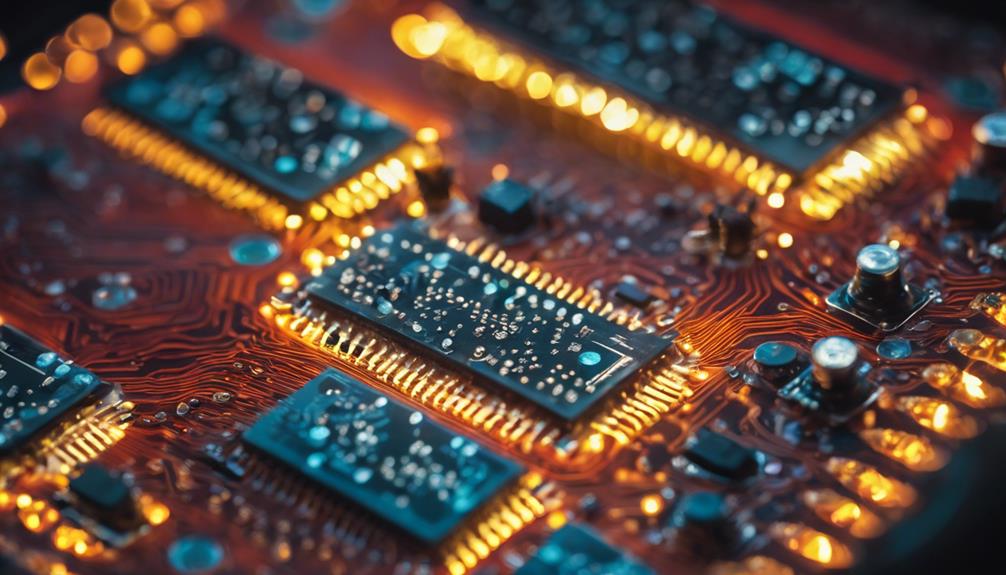
To optimize your circuit designs, consider how you integrate and position diodes to minimize resistance-related issues. Important diode placement strategies aren’t just about where you place each component; they’re about understanding the flow of current and the potential for heat accumulation. You’ll need to think about the entire layout of your circuit board.
Regarding thermal management considerations, remember that diodes can generate significant heat when current passes through them. This is especially true in power applications where high currents are involved. To prevent performance loss or damage, you must make sure there’s sufficient spacing between components to allow for adequate airflow. Additionally, consider using heat sinks or cooling fans if your design involves high-power diodes or operates within a confined space.
It’s also important to select the right type of diode for each application. For instance, Schottky diodes might be ideal for applications requiring fast switching and low forward voltage drop. Meanwhile, a TVS (Transient Voltage Suppression) diode might be more suitable for high voltage applications to protect your circuit from voltage spikes.
Conclusion
You’ve seen how important diode resistance is to your circuits. Whether you’re working with silicon, germanium, or gallium arsenide, selecting the right diode and understanding its resistance properties can greatly impact power efficiency and signal integrity.
Measure resistance accurately and consider temperature effects to guarantee peak performance. By integrating the best-fit diode into your designs, you’ll enhance stability and efficiency, tailoring your projects to effectively meet specific needs and challenges.