Advantages and Limitations of the DC Motor Voltage Equation
When you explore the DC motor voltage equation, you’ll find it’s a powerful tool for predicting and controlling motor performance. It lets you balance electrical parameters like input voltage, back EMF, and armature resistance to estimate speed, torque, and efficiency accurately. However, real-world factors such as mechanical losses and temperature variations can impact its accuracy. So, how do you navigate these limitations while leveraging the equation’s strengths? Let’s break down the intricacies and practical challenges you might face.
Key Takeaways
- Predictive Capability: The equation helps predict motor speed, torque, and power consumption accurately under ideal conditions.
- Efficiency Analysis: It aids in assessing and optimizing motor efficiency by understanding the electrical parameters and their relationships.
- Simplification: Provides a simplified model for analyzing DC motor performance without complex real-world variables.
- Limited Real-World Accuracy: Practical factors like brush drop voltage and mechanical losses can cause deviations from the ideal equation.
- Temperature Sensitivity: The equation does not account for changes in resistance and efficiency due to temperature variations.
Understanding the Voltage Equation
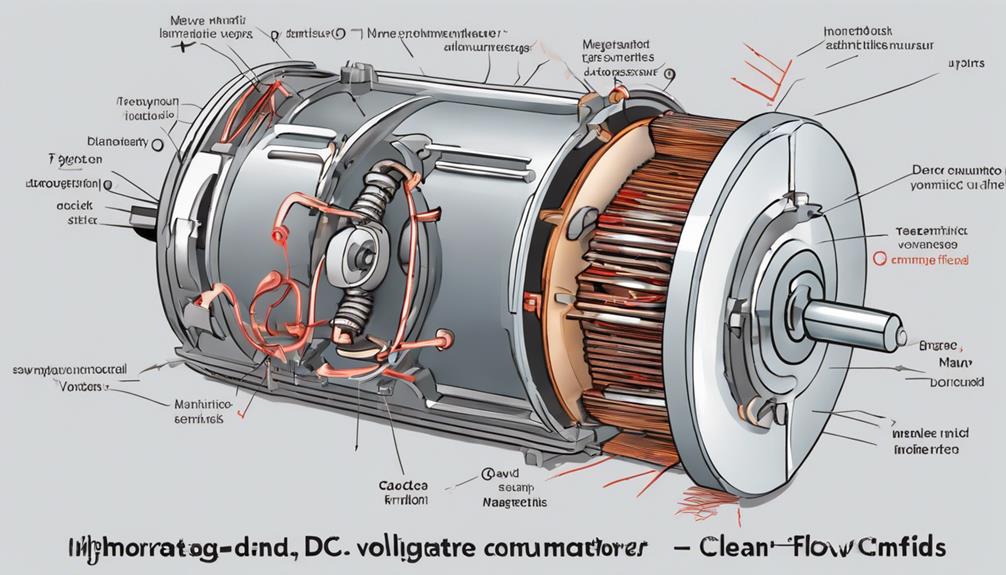
Understanding the voltage equation is essential when working with DC motors. The theory behind this equation involves balancing various electrical parameters to ensure the best motor performance. At its core, the equation relates the input voltage to the back electromotive force (EMF), armature resistance, and armature current. By grasping these relationships, you’ll gain insights into the motor’s operating principles and how it responds to different loads.
The armature windings play a pivotal role in a DC motor. When current flows through these windings, it generates a magnetic field, creating torque that drives the motor.
The voltage equation helps you understand how input voltage is divided among back EMF and the voltage drop across the armature resistance. This understanding is crucial for predicting the motor’s speed and torque characteristics under varying load conditions.
Analyzing the voltage equation allows you to assess power consumption and efficiency. You can manipulate the equation to optimize performance for specific applications, such as minimizing voltage drop and preventing overheating.
Key Components of the Equation
When delving into the key components of the DC motor voltage equation, it’s important to focus on the three primary elements: back electromotive force (EMF), armature resistance, and armature reactance. Each plays a pivotal role in determining the performance and efficiency of DC motors.
- Back Electromotive Force (EMF): This counteracts the applied voltage, effectively reducing the actual voltage across the armature. The motor itself generates the back EMFs proportional to the motor speed. It essentially acts as a natural feedback mechanism in the system.
- Armature Resistance: This element limits the current flow through the armature, causing a voltage drop in the circuit. By understanding the armature resistance, you can control the heat generated and ensure the motor operates within safe parameters.
- Armature Reactance: This accounts for the inductive effects in the armature windings. The inductance causes additional voltage drops, which must be considered to predict motor performance accurately.
Calculating Motor Speed

When calculating motor speed, you’ll need to understand the voltage-speed relationship and the speed calculation formula derived from the DC motor voltage equation.
Voltage-Speed Relationship
Grasping the voltage-speed relationship in DC motors is pivotal for anyone looking to predict and control motor performance effectively. This relationship is fundamental because it connects the applied voltage to the motor’s rotational speed, allowing you to foresee how changes in voltage will impact motor performance. By understanding the voltage-speed relationship, you can make informed decisions about motor operation and adjustments.
The DC motor voltage equation ties together voltage, speed, and back electromotive force (EMF), which are vital components in motor operation. Here’s how you can leverage this relationship:
- Predict Motor Speed: You can calculate motor speed based on the applied voltage and intrinsic motor constants by manipulating the voltage equation.
- Assess Voltage Impact: The voltage-speed relationship helps you understand how increasing or decreasing the voltage will affect the rotational speed.
- Optimize Performance: The voltage equation provides insights into optimizing motor performance under various voltage conditions, ensuring efficient and effective operation.
Speed Calculation Formula
Calculating the speed of a DC motor is straightforward once you’ve got a good handle on the speed calculation formula. The key formula you’ll use is:
Speed (rpm) = (Voltage – Back EMF) / (Armature Resistance) * (60 / Number of Poles).
This formula helps you determine the motor’s revolutions per minute (rpm), which is crucial for understanding its performance.
In this formula, Voltage refers to the applied voltage driving the motor. Back EMF, or back electromotive force, is the counter voltage generated by the motor’s rotation, acting against the applied voltage. This back EMF is essential because it reflects the motor’s speed and must be subtracted from the applied voltage to get an accurate measure of the effective voltage driving the motor.
Armature resistance accounts for the internal resistance within the motor’s windings. It’s a critical factor because it influences the current flow and, consequently, the motor’s speed.
Ultimately, the number of poles in the motor affects the speed calculation, with more poles generally resulting in a lower rpm for the same voltage.
Determining Required Torque
To ascertain the required torque for your DC motor application, you need to calculate torque requirements and analyze motor load. By understanding the relationship between voltage, current, and motor characteristics, you can guarantee your motor delivers the necessary performance.
This approach allows you to optimize voltage levels and achieve efficient power utilization for specific torque needs.
Calculating Torque Requirements
Understanding how to calculate the necessary torque is essential when you’re working with DC motors, as this ensures the motor can overcome resistance and move the load effectively. Calculating torque requirements involves determining the force needed to overcome factors like friction, inertia, and gravitational forces. To do this accurately, you’ll need to comprehend the relationship between the DC motor voltage equation and torque.
Using the DC motor voltage equation can help you calculate the required torque based on your motor’s operating voltage and characteristics. This equation integrates parameters like voltage, current, and motor constants, providing a clear picture of the torque output. Here’s how you can approach it:
- Identify Resistance Factors: Consider all elements that create resistance, such as friction, inertia, and gravity.
- Apply the Voltage Equation: Use the DC motor voltage equation to relate the operating voltage to current and torque.
- Verify Motor Specifications: Confirm the motor’s specifications match the calculated torque requirements to guarantee the best performance.
Motor Load Analysis
When performing motor load analysis, you must precisely determine the required torque to drive your load effectively. Factors such as load weight, friction, and acceleration all influence the torque needed from electric motors. By calculating these torque requirements accurately, you guarantee proper motor selection, which leads to efficient operation.
Understanding the load profile is essential because it helps in optimizing motor performance and longevity. You don’t want to overburden your motor, as it can lead to overheating and potential failure. Conversely, underutilizing the motor can result in inefficiency and wasted mechanical energy.
To get started, consider the following factors in your load analysis:
| Factor | Description |
|---|---|
| Load Weight | Heavier loads require more torque to move. |
| Friction | Higher friction increases the torque needed. |
| Acceleration | Faster acceleration requires additional torque. |
| Load Profile | Understanding the load variations over time. |
Efficiency Considerations
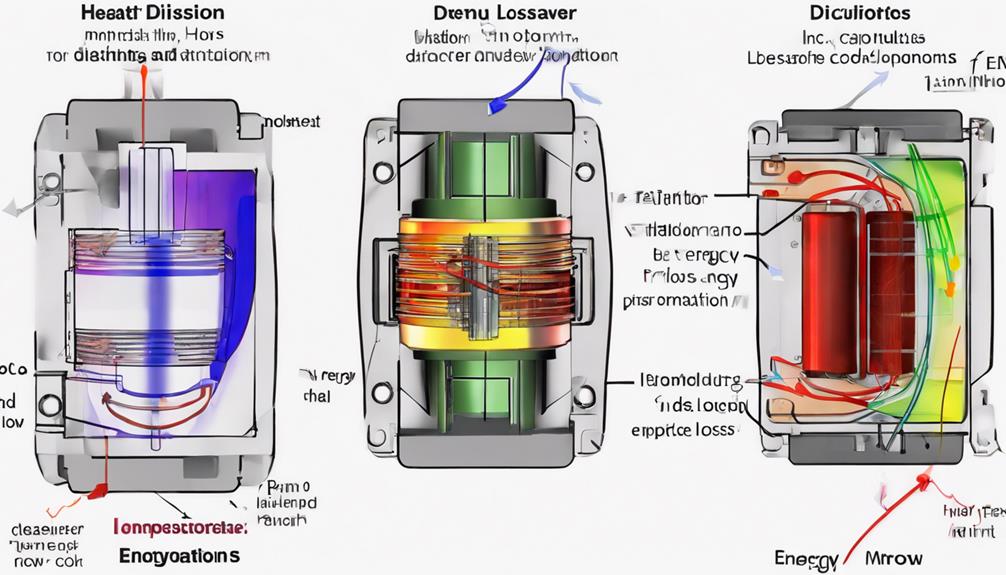
Efficiency considerations for DC motors revolve around the pivotal relationship outlined by the voltage equation, which links voltage, current, and resistance. By understanding this equation, you can greatly enhance the performance of your electric motor. Here’s why:
- Minimizing Losses: The voltage equation helps you identify and mitigate resistive losses within the motor. Lowering internal resistance and improving electrical conductivity are key strategies for achieving this. When you reduce these losses, you boost the motor’s overall efficiency, ensuring that more of the input power is converted into useful mechanical work rather than wasted as heat.
- Maximizing Power Output: Proper voltage utilization, as dictated by the voltage equation, optimizes the energy conversion process. This maximization means that your motor operates at peak efficiency, consuming less power and delivering more output.
- Optimizing Motor Performance: By applying efficiency considerations based on the voltage equation, you can finely tune your motor’s performance. This tuning ensures the engine runs efficiently across various loads and operating conditions, ultimately leading to energy savings and prolonged motor life.
In essence, leveraging the voltage equation for efficiency considerations allows you to achieve a more energy-efficient operation and better overall performance of your electric motor.
Ideal vs. Real Conditions
In the world of DC motors, the distinction between ideal and actual conditions significantly impacts performance. Ideally, the voltage equation simplifies to V = Eb + Ia(Ra), where V represents the supply voltage, Eb is the back electromotive force, Ia stands for the armature current, and Ra is the armature resistance. This ideal scenario assumes perfect field windings and an impeccable electromagnetic field without any losses.
However, real conditions are far more complex. Practical factors like brush drop voltage and additional losses come into play, which the ideal equation doesn’t account for. These elements can profoundly influence the motor’s efficiency and performance. Fleming’s left-hand rule helps you understand the interaction between the electromagnetic field and current but doesn’t cover these practical inefficiencies.
The real voltage equation includes these extra variables, making it more accurate for real-world applications. Deviations from ideal conditions can lead to limitations in the voltage calculations, affecting the motor’s operational efficiency.
Impact of Temperature Variations
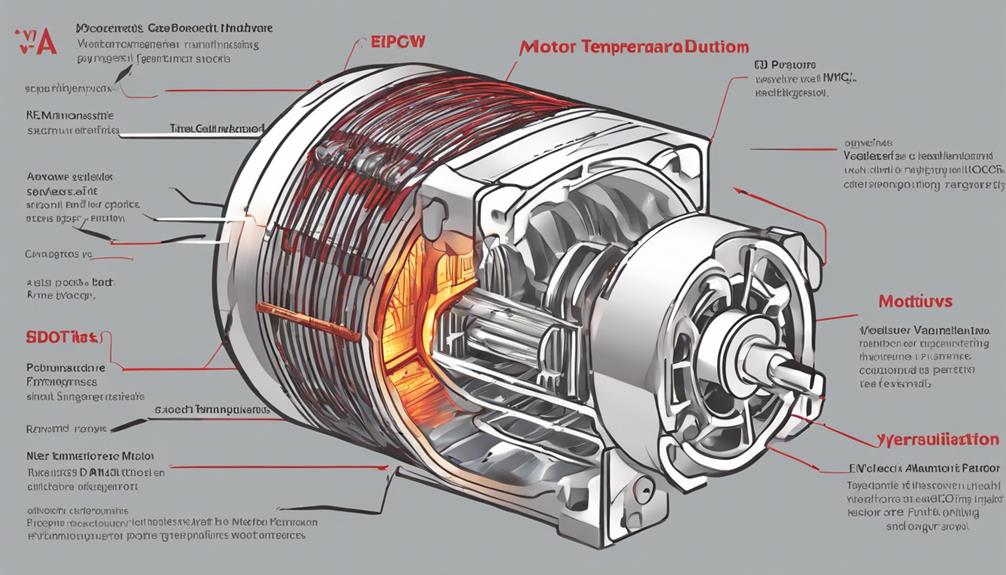
Temperature variations play a significant role in the performance and efficiency of DC motors. When the temperature changes, it can affect the resistance of the motor windings, which in turn alters the accuracy of the voltage equation. This means that if you’re trying to rely on the voltage equation for precise calculations, you’ll need to account for these adjustments.
Here are three key points to take into consideration:
- Increased Resistance: Higher temperatures lead to increased resistance in the motor windings. This rise affects the voltage drop across the windings and can result in less efficient motor operation.
- Fluctuating Speed and Torque: Temperature variations can cause fluctuations in motor speed and torque. This variability impacts the voltage equation’s ability to predict motor behavior accurately.
- Efficiency Impact: Changes in temperature impact the motor’s efficiency and performance. A motor operating in a hotter environment may not perform as well as one in cooler conditions, influencing the voltage equation’s applicability.
Understanding how temperature affects motor operation is essential. It helps you assess the voltage equation’s validity across different conditions, ensuring more reliable and effective motor performance. Keep these factors in mind to make better-informed decisions when working with DC motors.
Mechanical Losses
While temperature variations undeniably impact the performance of DC motors, mechanical losses are another vital factor to consider. These losses arise from energy dissipation due to friction, windage, and bearing losses. When a DC motor is operated, mechanical losses can markedly reduce its efficiency and overall performance.
As the speed and load on the motor increase, these losses become even more pronounced.
Minimizing mechanical losses is crucial to optimizing your motor’s efficiency. Understanding how these losses affect the relationship between the current and the magnetic field within the motor is important. By doing so, you can implement strategies to reduce friction and other forms of energy dissipation.
Regular maintenance, proper lubrication, and high-quality bearings can all help in reducing these mechanical losses.
Managing mechanical losses enhances the efficiency of DC motors and extends their longevity and reliability. By focusing on this aspect, you ensure that your motor operates more smoothly and with less wear and tear over time.
Addressing mechanical losses is a fundamental step in maximizing the performance and durability of DC motors.
Non-Linearities in Practice
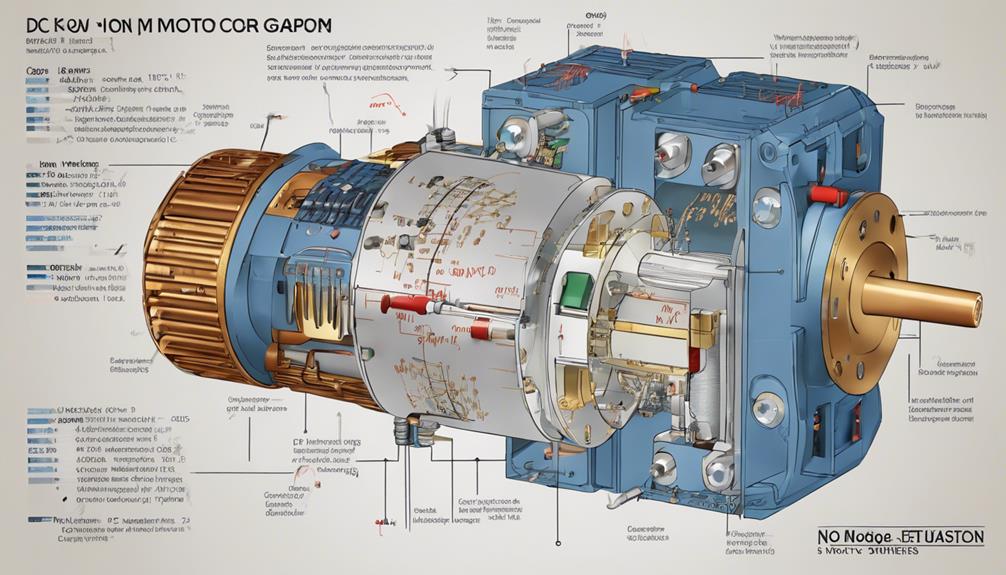
When dealing with DC motors, you’ll encounter non-linearities in the voltage equation, which can complicate motor control and efficiency. These non-linearities often arise from magnetic field saturation at high currents, causing the motor’s performance to deviate from theoretical predictions. Understanding these complexities is essential for achieving accurate control and best efficiency.
Several factors contribute to non-linearities in the voltage equation:
- Magnetic Field Saturation: As the current increases, the magnetic field within the motor can become saturated, leading to a non-linear relationship between current and voltage.
- Armature Resistance: Variations in the armature resistance, especially under different load conditions, can introduce non-linearities that affect motor performance.
- Internal Losses: Heat generated due to internal losses can change the resistance and magnetic properties of the motor’s components, further complicating the voltage equation.
Advanced control strategies like field weakening can mitigate these non-linear effects. Field weakening adjusts the magnetic field to compensate for saturation and other non-linear behaviors, allowing for more consistent motor performance. By understanding and compensating for these non-linearities, you can achieve more precise control and higher efficiency in DC motor applications.
Practical Applications
The DC motor voltage equation is essential for determining speed and torque characteristics in various practical applications. It’s especially valuable when working with servo motors, as it helps optimize performance by adjusting voltage levels tailored to specific tasks. Whether you’re involved in designing industrial equipment or managing power supplies, understanding this equation allows you to calculate the required voltage for a desired speed or torque output under different operating conditions.
For instance, precise control over motor speed and torque is vital for efficiency and productivity in industrial equipment. By applying the DC motor voltage equation, you can fine-tune your system to achieve the best performance, even accounting for voltage fluctuations and power supply variations. This guarantees that your equipment runs smoothly and reliably, minimizing downtime and maintenance costs.
When it comes to servo motors, the voltage equation plays a significant role in designing control systems that meet specific performance objectives. Engineers can develop more effective and responsive control strategies, ensuring that motors operate within their desired parameters.
Conclusion
Understanding the DC motor voltage equation helps you predict and control motor performance with precision. It’s great for estimating speed, torque, power consumption, and efficiency. However, don’t forget real-world factors like brush drop voltage, mechanical losses, and temperature changes, which can affect accuracy. While the equation is a powerful tool, always consider these limitations when optimizing your motor system for the best performance and reliability.
FAQs
What is the DC motor voltage equation?
The DC motor voltage equation relates the input voltage to the armature, current, resistance, and back EMF in a DC motor. It can be expressed as:
V=Eb+IaRaV = E_b + I_a R_a
Where:
- V = Applied voltage (Volts)
- E_b = Back electromotive force (Back EMF) (Volts)
- I_a = Armature current (Amperes)
- R_a = Armature resistance (Ohms)
This equation helps determine the motor’s behavior under various operating conditions, including speed, current, and torque.
Key Formula:
- Voltage = Back EMF + Armature current × Armature resistance
What are the advantages of the DC motor voltage equation?
The DC motor voltage equation provides several advantages for analyzing motor performance:
- Predicts Motor Behavior: It helps engineers and technicians understand how the motor will behave under varying loads by relating voltage, current, and resistance.
- Speed Control: The equation allows for precise speed control of the motor by manipulating the input voltage or back EMF, which is critical in many applications, such as electric vehicles or robotics.
- Performance Efficiency: The equation can help optimize the motor’s performance by allowing the user to adjust variables like resistance or input voltage to ensure efficient operation.
- Simple and Direct: The equation provides a straightforward way to calculate important parameters, making it easier to design, monitor, and troubleshoot DC motor systems.
Advantages:
- Predicts motor behavior under load.
- It helps control motor speed effectively.
- Enables performance optimization for efficiency.
- Simple calculation for practical applications.
What are the limitations of the DC motor voltage equation?
Despite its usefulness, the DC motor voltage equation has some limitations:
- Ideal Conditions Assumption: The equation assumes perfect conditions and does not account for non-ideal factors like temperature variations, losses due to friction, or magnetic saturation in the motor.
- Ignores Dynamic Effects: The equation primarily deals with steady-state operation and does not consider dynamic effects such as transient responses during start-up or speed changes.
- Limited Scope: It only provides a relationship between voltage, current, and back EMF but doesn’t address other important factors like mechanical losses, torque, or power output in more complex scenarios.
- No Direct Torque Information: While the equation can provide insights into electrical parameters, it does not give a direct indication of the motor’s torque, which is a critical performance metric.
Limitations:
- Assumes ideal conditions, ignoring real-world losses.
- Does not account for transient or dynamic behavior.
- It is limited to electrical parameters, not mechanical factors.
- There is no direct information about motor torque.
How can the DC motor voltage equation be improved?
To account for the limitations, the DC motor voltage equation can be extended or modified by incorporating additional factors:
- Add Friction and Windage Losses: These losses can be included in the equation to more accurately reflect the real operating environment.
- Dynamic Models: For more comprehensive analysis, dynamic models can be used alongside the voltage equation to account for transient responses during start-up or rapid speed changes.
- Power and Torque Relationships: By combining the voltage torque and power equations, a fuller picture of the motor’s performance, including torque production and efficiency, can be gained.
Improvements:
- Include friction and windage losses.
- Use dynamic models for transient analysis.
- Combine with torque and power equations for a complete understanding.