Oscillator Circuits – Types, Functions, and Key Applications
When you consider the backbone of modern electronics, oscillator circuits stand out as indispensable. You might think of them merely as waveform generators, but their role goes deeper. Oscillators are the beating heart of communication systems, ensuring signals are transmitted and received with precision. But how exactly do resistors, capacitors, and inductors combine to create such stable oscillations? What makes an RC oscillator different from an LC or voltage-controlled one? Understanding these nuances can be the key to mastering frequency control and achieving signal stability. Curious about what makes these circuits tick?
Key Takeaways
- RC oscillators use resistors and capacitors to generate stable waveforms for audio and signal processing.
- LC oscillators employ inductors and capacitors to create oscillations, with variants like Colpitts and Clapp providing tuning and stability.
- Crystal oscillators offer high-frequency stability, essential for precise timing in applications such as clocks and communication systems.
- Voltage-controlled oscillators adjust output frequency based on input voltage, which is crucial for RF communication and frequency modulation.
- Oscillator circuits are fundamental in industries like aerospace, telecommunications, and consumer electronics for signal generation and modulation.
Understanding Oscillator Circuits
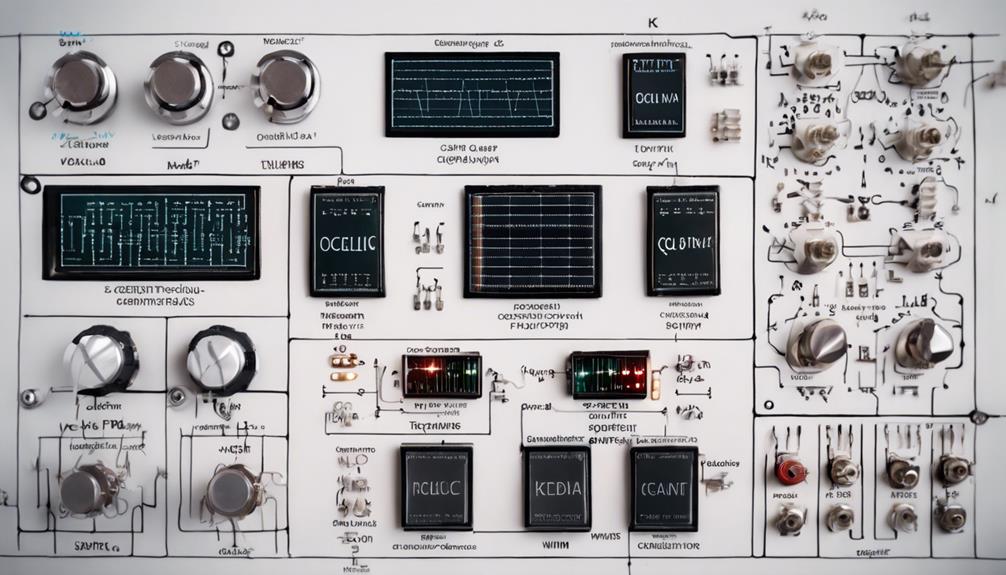
Oscillator circuits transform a direct current (DC) input into an alternating current (AC) output by generating continuous waveforms at specific frequencies. You must look at their core components and mechanisms to understand how these circuits work.
An oscillator circuit relies heavily on a feedback loop to sustain oscillations. This feedback loop takes a portion of the output signal and feeds it back into the input, guaranteeing a stable oscillation.
Key components like inductors and capacitors form what’s known as a resonant circuit. This resonant circuit is vital because it determines the frequency at which the oscillator will operate. By carefully selecting these components, you can control the frequency of the output signal.
An amplifying device, such as a transistor or an operational amplifier, is also essential in an oscillator circuit. This device boosts the signal to maintain the oscillations. Without amplification, the oscillations would quickly die out.
The stability of the frequency is another important aspect. It’s achieved through the precise selection of components and a well-designed feedback mechanism. Stable frequency output ensures the oscillator performs reliably in various applications, from radio transmitters to clock generators in digital circuits.
Types of Oscillators
You’ll explore various types of oscillators by looking at RC oscillator design, LC oscillator variants, and the stability of crystal oscillators.
Each type has unique features that make it suitable for different applications. Understanding these distinctions will help you choose the right oscillator for your specific needs.
RC Oscillator Design
Explore the intricacies of RC oscillator design, where resistors and capacitors work in harmony to create stable oscillations. RC oscillators are essential in generating repeated oscillations through a positive feedback loop. The phase shift in the RC network is important for sustaining these oscillations. You can achieve a sine wave output by carefully selecting the values of resistors and capacitors.
Frequency modification in RC oscillators is straightforward. Adjusting resistor and capacitor values alters the oscillation frequency, making these circuits highly versatile for different applications. Positive feedback guarantees continuous waveform generation, essential for operating various electronic devices.
To give you a clearer understanding, here’s a simple table summarizing key aspects:
| Component | Function | Impact on Circuit |
|---|---|---|
| Resistors | Control current flow | Adjusts frequency |
| Capacitors | Store and release energy | Determines oscillation period |
| Positive Feedback | Maintains oscillations | Ensures continuous waveform |
RC oscillators find applications in waveform generation for audio and signal processing. Their simplicity and efficiency make them a preferred choice for generating stable sine waves. Understanding how resistors and capacitors interact allows you to tailor the frequency and stability of your oscillations, ensuring your electronic devices function efficiently.
LC Oscillator Variants
Among the various types of LC oscillators, the Colpitts oscillator stands out for its stability despite being somewhat tricky to tune accurately. This LC oscillator uses two capacitors in series and an inductor to form its tank circuit, which is pivotal for achieving resonance and maintaining a stable oscillation frequency.
When designing or working with LC oscillators, understanding the different variants can help you choose the right one for your needs.
- Colpitts Oscillator: Known for its stability, it uses two capacitors and an inductor in its tank circuit, making it ideal for applications requiring consistent voltage output.
- Clapp Oscillator: A modified version of the Colpitts oscillator, it includes an additional variable capacitor for easier tuning, although it’s more sensitive to temperature changes.
- Tuned Collector Oscillator: This basic LC oscillator variant employs a transformer and capacitor in parallel. Energy from the tank circuit is fed back into the transistor to sustain oscillations.
- Tank Circuit: Fundamental to all LC oscillators, it consists of an inductor and a capacitor. The resonance between these components determines the oscillation frequency and ensures a continuous voltage output.
Understanding these variants will help you optimize your LC oscillator designs.
Crystal Oscillator Stability
With their remarkable frequency stability and precision, Crystal oscillators are essential in applications demanding exact timing. You’ll find these oscillators in various forms, including fundamental mode, overtone mode, and temperature-compensated crystal oscillators. They’re widely recognized for their high-frequency stability and accuracy, making them indispensable for timing applications in communication systems and digital devices.
Crystal cuts, load capacitance, and temperature variations influence the stability of crystal oscillators. For instance, temperature-compensated crystal oscillators (TCXOs) adjust for temperature changes, ensuring minimal frequency drift. This makes them ideal for applications where maintaining a consistent frequency is important.
Load capacitance also plays a significant role in the frequency stability of crystal oscillators. Matching the load capacitance to the oscillator’s specifications is important to achieve excellent performance. High frequency and long-term reliability are hallmarks of crystal oscillators, setting them apart from other oscillator types.
Using crystal oscillators ensures superior performance in applications requiring precise timing. Their long-term reliability and exceptional frequency stability make them a preferred choice for communication systems, digital devices, and other demanding environments where accuracy is essential.
RC Oscillators
In RC oscillators, resistors and capacitors generate stable oscillations through a precise phase-shift network. These oscillators use an RC network to provide a phase shift of 180 degrees, which is important for sustained oscillations. By incorporating positive feedback, the circuit guarantees that the output signal is fed back to the input, enabling continuous oscillations. You can achieve frequency adjustment by modifying the values of both resistors and capacitors in the circuit, allowing flexibility in tuning the desired frequency.
The feedback mechanism in RC oscillators is key to maintaining a consistent sine wave output. Here’s how the components work together:
- Resistors and capacitors: These elements create the necessary phase shift and determine the oscillation frequency.
- Positive feedback: Ensures that part of the output is fed back into the input, sustaining the oscillations.
- Phase shift: The RC network’s phase shift of 180 degrees, combined with the amplifier’s 180-degree shift, results in the required 360-degree phase shift.
- Frequency adjustment: Changing resistor and capacitor values allows you to fine-tune the oscillator’s frequency.
LC Oscillators
LC oscillators harness the interplay of inductors and capacitors to produce stable, continuous waveforms at a specific frequency. A resonant circuit is formed in LC oscillators by combining inductors and capacitors. This circuit’s inductance and capacitance values determine its resonant frequency, where it oscillates most efficiently.
The feedback network plays a vital role by feeding a portion of the output signal back to the input, ensuring sustained oscillations.
One key feature of LC oscillators is their ability to maintain a constant phase shift across components. This phase shift aligns perfectly with the resonant frequency, enabling continuous oscillation without external intervention.
Types of LC oscillators include the Tuned Collector oscillator and the Colpitts oscillator. The Tuned Collector oscillator achieves oscillation by tuning the collector circuit of a transistor. In contrast, the Colpitts oscillator uses a specific arrangement of capacitors and an inductor in its feedback network to sustain oscillations.
Voltage-Controlled Oscillators
Voltage-controlled oscillators (VCOs) let you control the oscillation frequency with an input voltage, making them ideal for tuning and modulation.
You’ll find VCOs in applications like frequency synthesizers and wireless communication systems.
To design effective VCOs, consider factors like linearity, tuning range, and stability.
Basic Operating Principle
By applying a varying voltage, you can control Voltage-Controlled Oscillators (VCOs) output frequency, making them essential for various applications. These oscillators are unique because their output frequency depends directly on the input voltage. This property makes VCOs integral to multiple systems and technologies.
In essence, VCOs are used in:
- Frequency Modulation: VCOs allow for the modulation of a signal’s frequency, which is essential in transmitting data over communication systems.
- Phase-Locked Loops (PLLs): These devices help synchronize the frequency of an oscillator to a reference frequency, which is important in maintaining signal stability.
- Signal Synthesis: VCOs generate diverse signal frequencies, enabling the creation of complex signals needed in different applications.
- RF Communication Systems: They provide frequency agility, which is important for tuning across a wide range of frequencies used in radio frequency communications.
The basic operating principle revolves around the relationship between input voltage and output frequency. As you adjust the input voltage, the VCO alters its output frequency. This capability allows dynamic control and tuning, making VCO indispensable for applications requiring precise frequency modulation and agility.
Understanding this principle is key to harnessing the full potential of VCOs in your projects.
Common Applications
You’ll find Voltage-Controlled Oscillators (VCOs) in a wide variety of applications, from wireless communication systems to electronic musical instruments. VCOs are pivotal in frequency modulation (FM) synthesizers, allowing you to achieve precise tuning by varying the control voltage. This capability is essential in communication systems and electronic instruments where accurate frequency control is paramount.
In phase-locked loops (PLLs), VCOs help maintain signal stability by locking the output frequency to a reference frequency. This is critical for maintaining synchronization in communication systems. Frequency-shift keying (FSK) modulation also relies on VCOs to change the carrier frequency, enabling efficient data transmission.
Beyond communication, VCOs are essential in frequency synthesizers, generating stable and accurate frequencies needed in numerous applications, including radar systems and test equipment. These oscillators provide the frequency agility required for dynamic environments, such as those in wireless communication systems and radar.
Here’s a snapshot of VCO applications:
| Application Area | Function | Key Feature |
|---|---|---|
| Communication Systems | Frequency modulation, PLLs | Precise tuning, stability |
| Electronic Instruments | FM synthesizers | Accurate frequency control |
| Radar Systems, Test Equipment | Frequency synthesizers | Frequency agility, modulation |
Design Considerations
When designing Voltage-Controlled Oscillators (VCOs) for your application, it’s important to consider factors like tuning range, linearity, phase noise, and frequency drift over temperature. VCOs are pivotal in frequency synthesizers, phase-locked loops, and modulators, making these design considerations essential for peak performance.
- Tuning Range: Make sure that your VCO can cover the necessary frequency spectrum by adjusting the control voltage. The LC tank circuit is often used to define this range.
- Linearity: Maintain a linear relationship between the control voltage and the output frequency. Non-linearities can complicate frequency modulation and degrade performance.
- Phase Noise: Minimize phase noise to ensure signal clarity. Excessive phase noise can corrupt data in communication systems and impact the stability of phase-locked loops.
- Frequency Drift: Address frequency drifts over temperature by selecting stable components and incorporating temperature compensation techniques. Drift can affect the long-term reliability of your VCO.
Incorporating a feedback amplifier can help stabilize the oscillation frequency and enhance linearity. By carefully considering these factors, you can design a robust VCO tailored to your specific needs, ensuring effective frequency modulation and phase-locked loop performance.
Frequency Stability
Frequency stability in oscillator circuits hinges on several critical factors, including component tolerances, temperature variations, and aging effects. Achieving reliable frequency stability starts with the components. For instance, the tank circuit, often an LC circuit, plays a pivotal role. Small changes in the inductance (L) or capacitance (C) can lead to notable frequency shifts. Therefore, component tolerances must be tightly controlled.
An amplifier is another essential part. It boosts the signal, but the gain must be stable. Variations in gain can affect the circuit’s oscillation frequency. Additionally, the supply voltage needs to be consistent. Fluctuations can alter the amplifier’s performance, impacting frequency stability. Temperature compensation helps counteract the effects of temperature changes, thereby maintaining a steady output.
Energy losses in the tank circuit can destabilize frequency. Ensuring that energy is efficiently recycled within the LC circuit is crucial.
By addressing these factors, you can significantly improve the frequency stability of your oscillator circuits.
Consistent performance over time and varying conditions is essential. Careful selection of components, precise calibration, and techniques like temperature compensation are key strategies to guarantee that your oscillators remain stable and reliable.
Feedback Mechanisms
Feedback mechanisms are essential in oscillator circuits for sustaining continuous oscillations by looping a portion of the output signal back to the input.
You’ll often encounter positive feedback in these circuits because it reinforces the input signal, guaranteeing sustained oscillations.
The feedback loop typically incorporates components like resistors and capacitors to manage the phase and magnitude of the feedback signal effectively.
To design a reliable oscillator, you need to focus on:
- Stability: Proper feedback mechanisms guarantee the oscillator maintains a steady state without drifting.
- Frequency Control: The LC components in the feedback loop help determine the oscillation frequency, which is crucial for applications requiring precise frequency standards.
- Phase and Magnitude Control: Adjusting these parameters ensures that the feedback signal is in the correct phase and has the appropriate magnitude to sustain oscillations.
- Overall Gain: The design guarantees the overall gain of the oscillator circuit hits unity, meeting the conditions necessary for continuous oscillations.
Practical Applications
Oscillator circuits are essential in various applications, ranging from signal generators to communication systems. You’ll find them at the heart of precision signal generators, radio transmitters, and frequency synthesizers, ensuring accurate and stable signals.
In communication systems, oscillators play an important role in frequency tuning, enabling reliable data transmission.
When working with test equipment, oscillators help generate the necessary signals for testing and calibration. Audio processing devices generate the tones and frequencies needed for sound manipulation. Microcontrollers rely on oscillators for clock generation, keeping operations synchronized and timely.
Radar systems use local oscillators to determine the distance and speed of objects, making them crucial in both military and civilian applications. In wireless technology, oscillators manage signal modulation, ensuring your devices communicate efficiently.
Function generators, used in various testing scenarios, depend on oscillators to produce waveforms like sine, square, and triangle waves.
Industries such as aerospace, telecommunications, medical devices, and consumer electronics all benefit from the versatility of oscillator circuits. Whether for signal generation, processing, or modulation, these circuits are critical for the smooth operation of countless modern technologies.
Conclusion
Mastering oscillator circuits is essential for creating stable and precise waveforms in modern electronic applications. You can guarantee accurate frequency control and signal stability by understanding different types like RC, LC, and voltage-controlled oscillators.
Remember, the key lies in the feedback mechanisms that sustain oscillations. With this knowledge, you can design and implement effective oscillator circuits for various practical uses.
FAQs
What Is the Simplest Oscillator Circuit?
The simplest oscillator circuit you can build is a crystal oscillator. It uses a crystal’s resonant frequency and a feedback loop for signal generation. Proper biasing conditions guarantee frequency stability, reducing phase noise and harmonic distortion.
What Are the Three Types of Oscillator?
You’re looking for the three types of oscillators. They include harmonic (like the Wien Bridge and Crystal Oscillator), relaxation (such as the Ring Oscillator), and feedback oscillators, which use designs like Phase Shift, LC, and RC Oscillators.
How to Create an Oscillating Circuit?
To create an oscillating circuit, select components carefully. Use feedback resistors for phase shift, guarantee frequency stability through circuit tuning, supply energy efficiently, amplify the signal, and apply proper biasing techniques to minimize harmonic distortion and stabilize waveform generation.
What Are the Advantages of Oscillator Circuit?
You’ll appreciate oscillator circuits’ signal stability, frequency accuracy, and low distortion. They’re energy-efficient, simple to design, and components are readily available. Plus, they offer design flexibility, noise reduction, phase stability, and cost-effectiveness.