LC Oscillators – Principles, Types, and Practical Applications
When you think about generating stable oscillations in electronic systems, LC oscillators are likely at the heart of the process. These circuits harness the energy stored in inductors and capacitors to maintain continuous oscillations. You’ll find various types, like Colpitts and Hartley oscillators, each offering distinct benefits. But have you ever considered how component variations and temperature sensitivity might impact their performance? Understanding these nuances can greatly improve your application of LC oscillators in areas like RF signal generation and communication systems. Let’s explore these aspects in more detail.
Key Takeaways
- LC oscillators use inductors and capacitors to generate oscillations at a resonant frequency.
- They are commonly used in RF signal generators and communication systems for high-frequency stability.
- Types include Colpitts, Hartley, and Clapp oscillators, each with unique feedback mechanisms.
- They offer advantages like low energy loss and minimal noise but can be sensitive to component variations and temperature changes.
- High-quality components for LC oscillators can be costly, impacting overall design and implementation.
Basic LC Oscillator Circuit
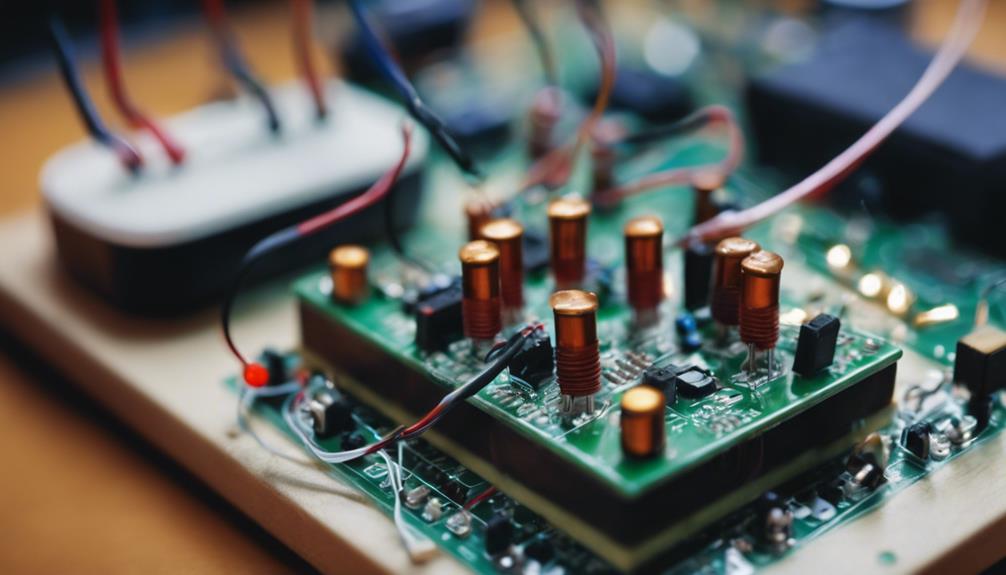
When you build a basic LC oscillator circuit, you’ll use an inductor and a capacitor to create a resonant tank circuit. This setup is the heart of the LC oscillator, where energy oscillates between the capacitor’s electric field and the inductor’s magnetic field; the capacitor stores energy in its electric field when it’s charged, and the inductor stores energy in its magnetic field when the current flows through it.
In an LC oscillator circuit, these components work together to maintain oscillations. The energy alternately shifts between the capacitor’s electric and the inductor’s magnetic fields, creating continuous oscillations.
The frequency of these oscillations is known as the resonant frequency. This frequency is determined by the values of the inductor and capacitor, following the formula ( f = rac{1}{2pisqrt{LC}} ).
The circuit requires positive feedback to keep these oscillations going. This feedback compensates for any energy lost due to resistance or other factors, ensuring continuous operation. The inductor and capacitor sustain the oscillations at the resonant frequency by storing and releasing energy, making the LC oscillator circuit an essential component in many electronic applications.
Oscillator Feedback Mechanism
In an LC oscillator, the feedback mechanism plays a vital role in sustaining oscillations by returning a portion of the output signal to the input. This feedback loop is essential for reinforcing the signal, ensuring the oscillations don’t die out. Positive feedback is crucial here; it counteracts any losses within the circuit and maintains the oscillations over time.
The feedback network typically introduces a phase shift, aligning the feedback signal correctly with the input signal. This alignment is necessary to achieve the conditions for sustained oscillations. A key point to remember is that the feedback loop’s gain must reach unity. The oscillations will eventually diminish if the voltage gain is less than one. Conversely, the system can become unstable if the gain is too high.
| Aspect | Description |
|---|---|
| Feedback Mechanism | Returns output signal to input to sustain oscillations |
| Positive Feedback | Compensates for circuit losses |
| Phase Shift | Aligns feedback signal with input for sustained oscillations |
| Unity Gain | Ensures the feedback loop’s gain is just right to maintain oscillations |
Types of LC Oscillators
LC oscillators come in several types, including Colpitts, Hartley, and Clapp oscillators, each with distinct configurations and advantages.
The Colpitts oscillator uses a capacitive voltage divider to provide feedback. This configuration guarantees stable operation and is particularly useful for high-frequency applications. It is advantageous for its simplicity and reliability.
In contrast, the Hartley oscillator utilizes a tapped inductor for feedback. This design allows for easy frequency tuning by adjusting the tap point on the inductor. It’s especially beneficial in applications where variable frequency is necessary, offering a unique edge in flexibility and tunability.
The Clapp oscillator takes frequency modulation a step further by integrating a varactor diode. This configuration stabilizes the oscillator and allows for precise frequency control. The varactor diode’s role in frequency modulation makes the Clapp oscillator ideal for applications requiring fine frequency adjustments.
Each LC oscillator has unique advantages and configurations that make it suitable for different uses.
Whether you need the stability of a Colpitts oscillator, the tunability of a Hartley oscillator, or the precise control of a Clapp oscillator, understanding these types will help you choose the right one for your needs.
Applications of LC Oscillators
Understanding the various types of LC oscillators equips you with the knowledge needed to appreciate their wide range of applications in modern electronics. LC oscillators are pivotal in generating high-frequency AC waveforms with stable oscillations, making them essential for various electronic devices.
You’ll find them in:
- RF signal generators: LC oscillators provide high-frequency stability, which is important for generating precise RF signals.
- Communication systems: Crystal-controlled LC oscillators guarantee low noise and minimal frequency drift, which is essential for reliable communications.
- Electronic devices: Radios, TVs, and mobile phones use LC oscillators to produce precise oscillations.
LC oscillators are indispensable in RF signal generators due to their exceptional frequency stability. This stability is important for applications requiring consistent signal quality.
Communication systems benefit from crystal-controlled LC oscillators, essential for maintaining low noise levels and frequency accuracy, ensuring clear transmissions. Additionally, LC oscillators are crucial for tuning and signal processing in everyday electronic devices like radios and TVs, allowing for accurate frequency control and signal reception.
Various oscillator circuits, such as Colpitts, Pierce, and Butler, offer the flexibility to design LC oscillators tailored to specific applications. This adaptability ensures that LC oscillators can be implemented in diverse electronic systems, enhancing their functionality and performance.
Advantages and Disadvantages
LC oscillators offer significant benefits, such as high-frequency stability and low energy losses, but they also have drawbacks, such as high cost and sensitivity to component changes.
One of the main advantages of LC oscillators is their capability to maintain stability at high frequencies, making them ideal for RF applications. Their high Q-factor guarantees low energy losses and minimal noise generation, critical for maintaining signal integrity.
However, LC oscillators aren’t without disadvantages. The high cost of quality components can be a significant barrier. Additionally, they aren’t suitable for generating low-frequency signals, which limits their versatility. Another notable disadvantage is their sensitivity to component variations. Changes in inductance or capacitance can cause shifts in the operating frequency, affecting overall performance.
Temperature changes can also impact LC oscillators. Temperature variations can alter the properties of the components, leading to shifts in the operating frequency and potentially disrupting the desired stability. This sensitivity to environmental factors highlights the importance of temperature management in your designs.
Conclusion
You now have a solid grasp of LC oscillators, their basic circuits, and feedback mechanisms.
You know the different types and how they’re used in various applications.
While these oscillators offer high-frequency stability and low energy losses, you should also be mindful of potential challenges like component variations and temperature sensitivity.
Understanding these nuances will help you effectively implement LC oscillators in your electronic projects and systems.
FAQs
What Is an LC Oscillator?
An LC oscillator uses a tank circuit with an inductor and capacitor to create oscillations. It relies on a feedback loop and energy exchange, ensuring frequency stability. Key elements include resonance frequency, phase shift, and oscillation types.
What Is the Difference Between an RC and an LC Oscillator?
You should know that RC oscillators use resistors and capacitors, while LC oscillators use inductors and capacitors. RC oscillators have higher power consumption and phase noise, but LC oscillators offer better frequency response, circuit stability, and tuning methods.
Why Are LC Oscillators Not Used at Low Frequencies?
It would be better not to use LC oscillators at low frequencies because the large inductor size and high capacitor values lead to impractical component selection, increased component cost, higher power consumption, circuit losses, frequency instability, phase noise, and signal distortion.
What Are LC Circuits Used For?
You’ll use LC circuits for signal processing, filter design, and frequency tuning in RF circuits. In various electronic applications, they’re great for impedance matching, magnetic resonance, voltage control, phase shifting, inductance measurement, and harmonic generation.