Unlocking the Potential of RC Coupled Amplifiers
RC coupled amplifiers are a fundamental building block in electronics, playing a crucial role in amplifying signals for various applications. This comprehensive guide will delve deep into the workings, construction, frequency response, and applications of RC coupled amplifiers. Whether you’re an electronics enthusiast or a seasoned engineer, this article will provide valuable insights into this essential electronic component.
What is an RC Coupled Amplifier?
An RC coupled amplifier, also known as a resistor-capacitor coupled amplifier, is an electronic amplifier used to amplify low-frequency AC signals. It is commonly employed in audio and radio frequency applications. The amplifier has multiple stages, each comprising resistors and capacitors connected in series.
Working Principles of RC Coupled Amplifiers
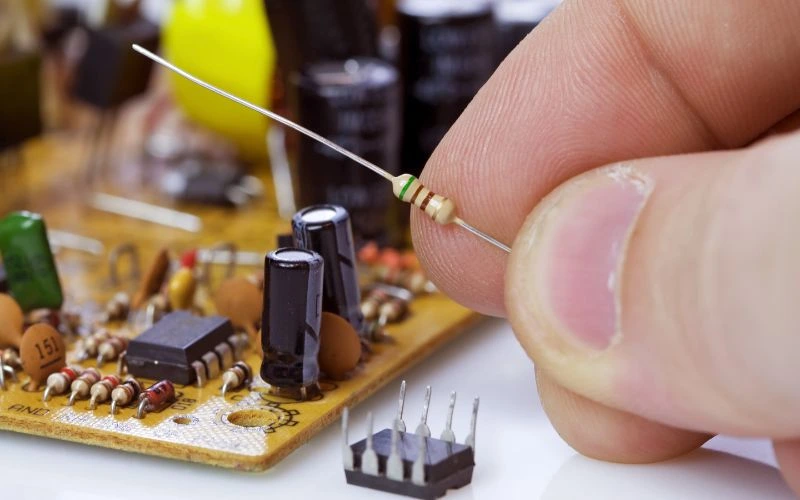
RC-coupled amplifiers operate on the principles of signal amplification through capacitive coupling and direct current (DC) blocking. Here’s how they work:
- Signal Input: The input AC signal is applied to the base of a transistor in the first stage of the amplifier.
- AC Coupling: A capacitor in series with the input signal couples the AC component of the signal into the transistor. This capacitor blocks the DC component, only amplifying the AC signal.
- Transistor Amplification: The transistor amplifies the AC signal in the first stage, and this amplified signal is then passed through subsequent stages, each providing additional amplification.
- AC Coupling Between Stages: Capacitors between stages allow the amplified AC signal to pass while blocking any DC voltage.
- Output Stage: The amplifier’s final stage delivers the amplified AC signal at the output.
Components of RC Coupled Amplifiers
RC-coupled amplifiers consist of several essential components:
- Transistors (commonly NPN or PNP)
- Resistors for biasing and signal control
- Capacitors for AC coupling and blocking DC
- Input and output terminals
- Power supply connections
Understanding Frequency Response
The frequency response of an RC-coupled amplifier is a critical aspect that determines its performance. It describes how the amplifier responds to different input frequencies. The frequency response can be divided into three main regions:
At Low Frequencies
At low frequencies, RC coupled amplifiers exhibit a nearly flat response. This means they can accurately amplify audio signals, making them suitable for applications like audio amplification in radios and audio systems.
At High Frequencies
As the frequency increases, the response of RC coupled amplifiers starts to roll off. They are less efficient in amplifying high-frequency signals, making them less suitable for applications involving very high-frequency radio signals.
At Mid-Frequencies
In the mid-frequency range, RC-coupled amplifiers perform optimally. They balance amplification and bandwidth, making them ideal for radio applications like intermediate-frequency (IF) amplification.
Types of RC Coupled Amplifiers

RC-coupled amplifiers come in various configurations, with the most common being:
- Single-Stage Common Emitter RC Coupled Amplifier: This configuration offers a simple and cost-effective amplification solution. It is often used in low-power audio amplifiers.
- Two-Stage Common Emitter RC Coupled Amplifier: This configuration provides higher gain and improved performance by employing two amplification stages. It is suitable for more demanding applications.
Advantages of RC Coupled Amplifiers
RC-coupled amplifiers offer several advantages, including:
- Cost-effectiveness
- Simplicity in design
- Good audio fidelity in the mid-frequency range
- Versatility for various audio applications
Disadvantages of RC Coupled Amplifiers
Despite their advantages, RC-coupled amplifiers also have limitations:
- Limited high-frequency response
- Susceptibility to temperature variations
- Higher power dissipation compared to other amplifier types
- Limited ability to handle very low or high-frequency signals
Applications of RC Coupled Amplifiers
RC-coupled amplifiers find applications in various fields, including:
- Audio Amplification: They are commonly used in audio amplifiers for radios, home stereo, and public address systems.
- Intermediate-Frequency Amplification: In radios, RC coupled amplifiers amplify signals at intermediates.
- Instrumentation: They are used in scientific instruments for radiosignal conditioning and amplification.
- Communication Systems: RC coupled amplifiers can be found in communication equipment such as transceivers and signal processors.
Future Trends in RC Coupled Amplifiers
As technology advances, RC coupled amplifiers are also evolving to meet the demands of modern electronics. Some emerging trends in this field include:
Integration with Digital Systems
RC-coupled amplifiers are being integrated with digital processing units, allowing for enhanced signal processing capabilities and improved efficiency.
Miniaturization
Advancements in miniaturization techniques enable the development of smaller and more compact RC-coupled amplifiers, ideal for portable and wearable devices.
Energy Efficiency
Efforts are being made to optimize RC-coupled amplifiers for energy efficiency, reducing power consumption and heat generation.
Conclusion
RC-coupled amplifiers are indispensable components in electronics, offering reliable signal amplification for a wide range of applications. Engineers and enthusiasts can harness the full potential of RC coupled amplifiers by understanding their construction, working principles, and optimization techniques. Whether you are designing audio equipment, communication systems, or signal processing circuits, these amplifiers continue to play a vital role in modern electronics. With careful optimization, their performance can be elevated to new heights. Stay updated with emerging trends to ensure your designs remain at the cutting edge of technology.
FAQs
What is the primary purpose of an RC-coupled amplifier?
The primary purpose of an RC coupled amplifier is to enhance the strength of electronic signals, particularly weak ones, by increasing their voltage amplitude. It is crucial in various electronic devices and circuits requiring signal amplification, such as radios, audio amplifiers, and communication systems. By providing voltage gain and impedance matching, RC-coupled amplifiers facilitate the efficient transfer of signals between different stages of an electronic circuit while blocking any DC voltage components that might disrupt the functioning of subsequent phases.
What is the role of coupling capacitors in RC coupled amplifiers?
Coupling capacitors play a vital role in RC coupled amplifiers by separating DC and AC components within a signal. These capacitors block DC signals, allowing only the AC signals to pass through from one amplifier stage to another. This function is essential because it ensures that any DC bias present in the input or at an earlier stage does not affect the subsequent amplification stages. By isolating the DC and AC portions of the signal, coupling capacitors help maintain the integrity of the amplified signal, contributing to the amplifier’s overall performance and efficiency.
Are RC coupled amplifiers suitable for high-frequency applications?
RC coupled amplifiers are generally not ideal for high-frequency applications due to their limited bandwidth, making them better suited for audio and low-frequency signal amplification.