Exploring Cooling Tower Types for Peak Efficiency
Regarding industrial processes, data centers, and HVAC systems, efficient cooling is crucial for maintaining equipment performance and preventing overheating. Cooling towers play a vital role in achieving this goal by dissipating heat through evaporation. In this in-depth guide, we will explore different types of cooling towers, their functions, advantages, and how to choose the best one for your specific needs.
Understanding Cooling Towers
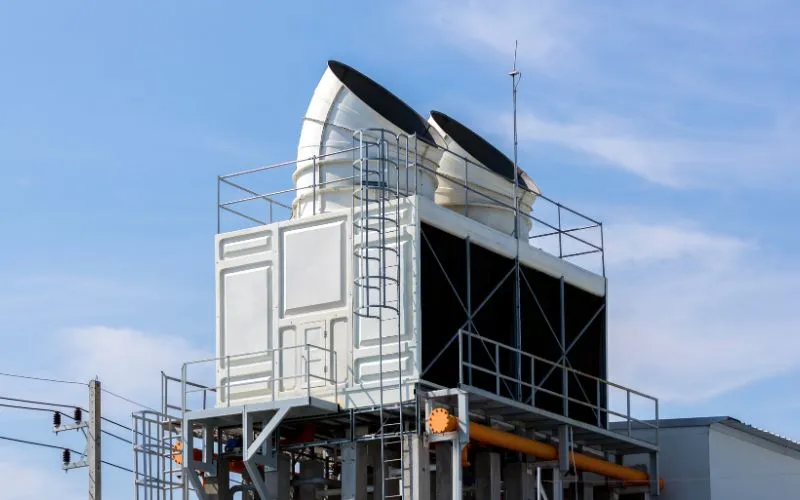
Cooling towers are heat rejection devices used in various industries to remove excess heat generated during industrial processes or to maintain optimal temperatures in HVAC systems. They operate on the principle of evaporative cooling, where water is exposed to the atmosphere, causing a portion to evaporate, thus removing heat from the remaining water.
Types of Cooling Towers
Cooling towers come in several types, each with unique characteristics and applications.
Natural Draft Cooling Towers
Natural draft cooling towers rely on the buoyancy of hot air to draw air through the tower. These towers are typically large and tall, making them suitable for power plants and heavy industries. They are highly energy-efficient but require substantial space and are costly to build.
Mechanical Draft Cooling Towers
Mechanical draft cooling towers use fans or blowers to force air through the tower. They are more compact and versatile than natural draft towers and are commonly used in commercial and industrial settings. Mechanical draft cooling towers are further divided into:
Forced Draft Cooling Towers
Fans in forced draft cooling towers are located at the tower’s base, pushing air upwards through the heat exchange media. This design ensures a consistent airflow, making them efficient and adaptable for various applications.
Induced Draft Cooling Towers
Induced draft cooling towers position fans at the top of the tower, drawing air through the heat exchange media. This configuration minimizes the risk of recirculation and allows for better airflow control. Induced draft towers are often preferred for their energy efficiency.
Cooling Tower Build Types
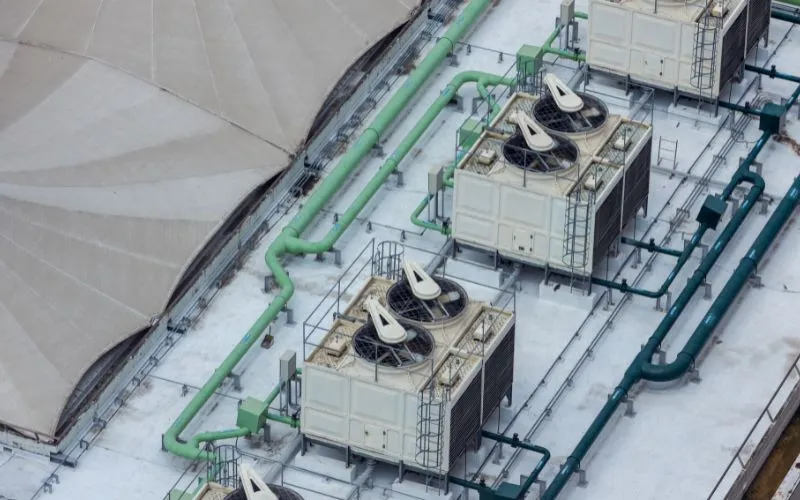
Cooling towers can also be categorized based on their build type, specifically how air and water interact within the tower.
Crossflow Cooling Towers
In crossflow cooling towers, air flows horizontally across the water flow. This design results in efficient heat transfer and is commonly found in smaller industrial applications and HVAC systems.
Counterflow Cooling Towers
Counterflow cooling towers have air and water flowing in opposite directions. This configuration maximizes heat transfer efficiency and is often used in larger industrial processes requiring high cooling capacity.
Choosing the Right Cooling Tower
Selecting the most suitable cooling tower for your needs is crucial for efficiency and cost-effectiveness. Consider the following factors when making your decision:
Factors to Consider
- Heat Load: Calculate the heat load your cooling tower needs to handle, which depends on the equipment or process it’s cooling.
- Space Constraints: Assess the available space for installation; this will impact the choice between natural draft and mechanical draft towers.
- Water Quality: The quality of the water source can affect the type of tower required and maintenance needs.
- Environmental Regulations: Ensure your cooling tower complies with local environmental regulations regarding water usage and emissions.
Efficiency and Sustainability
Efficiency is a key consideration in choosing a cooling tower. Induced draft cooling towers are often more efficient than forced draft towers due to their airflow control. Consider your choice’s environmental impact and sustainability, such as water usage and energy efficiency.
Maintenance and Cost
Factor in the maintenance requirements and associated costs when selecting a cooling tower. Mechanical draft cooling towers generally have lower maintenance needs compared to natural draft towers, which may require more frequent inspections and cleaning.
Cooling Tower Materials and Construction
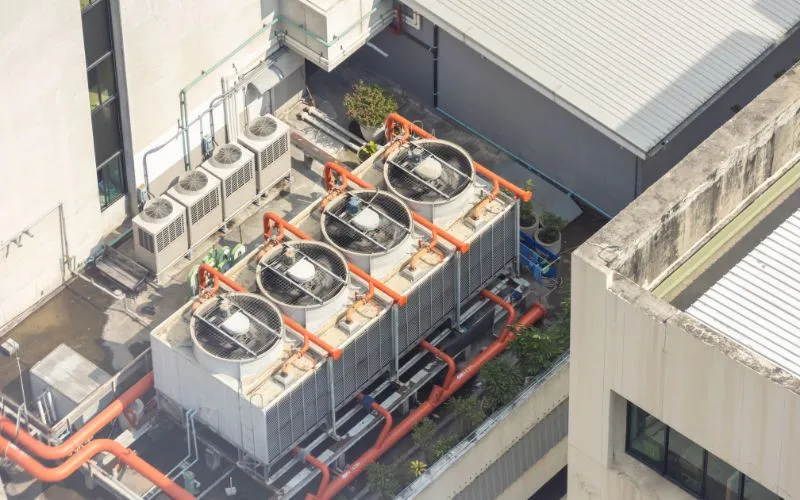
Apart from the types and build configurations, cooling towers can also vary in the materials used for their construction. The choice of materials can significantly impact the tower’s durability and resistance to corrosion. Here are some common materials used in cooling tower construction:
- Galvanized Steel: Galvanized steel is a popular choice due to its strength and resistance to rust. It’s commonly used for the structural components of cooling towers.
- Stainless Steel: Stainless steel is another corrosion-resistant option, often preferred in environments where rust or contamination could be a concern.
- Fiberglass-Reinforced Plastic (FRP): FRP cooling towers are lightweight, durable, and highly corrosion-resistant. They are commonly used in applications where water quality is a concern.
- Concrete: Concrete cooling towers are known for their durability and longevity. They are suitable for large-scale industrial applications and power plants.
Conclusion
Cooling towers are indispensable components in various industries and applications, crucial in maintaining equipment efficiency and preventing overheating. Understanding the various types, build configurations, and materials used in cooling tower construction is essential for making informed decisions about the right cooling solution for your needs.
Whether you require a natural draft cooling tower for a large-scale power plant or a compact induced draft cooling tower for your HVAC system, careful consideration of factors such as heat load, space constraints, water quality, and environmental regulations is key. Additionally, ongoing maintenance and proper water treatment are essential to ensure your cooling tower’s long-term efficiency and sustainability.
FAQs
What Are the Key Components of a Cooling Tower?
Cooling towers consist of several key components, including:
- Fan or blower
- Fill material (heat exchange media)
- Water distribution system
- Drift eliminators
- Collection basin
Which Type of Cooling Tower is More Efficient?
Induced draft cooling towers are generally more efficient than forced draft towers. Their design minimizes the risk of recirculation and allows for better airflow control, resulting in improved heat exchange performance.
How Can I Improve the Efficiency of My Cooling Tower?
To enhance the efficiency of your cooling tower, consider the following:
- Regular maintenance and cleaning to prevent fouling and scale buildup.
- Use of efficient fans or blowers with variable speed control.
- Monitoring and optimizing water treatment to maintain water quality.
- Implementing advanced controls and automation systems for better operation.
How Often Should I Clean and Inspect My Cooling Tower?
Cleaning should occur quarterly or more frequently in challenging environments, with an annual comprehensive inspection and regular water quality monitoring to ensure efficient operation.
Related Article