Electric Potential: Definition, Formula, and Key Concepts Explained
Electrical potential is the ability of charged particles to try to do Work. The unit of electrical potential is volts.
FAQs
What is electric potential?
Electric potential refers to the amount of electric potential energy per unit charge at a specific point in an electric field. A scalar quantity indicates how much work would be needed to move a charge from one point to another within the field. Electric potential is often expressed in volts (V), where 1 volt equals 1 joule per coulomb.
The higher the electric potential at a point, the more potential energy a charged particle would have at that location.
Definition:
- Electric Potential: The potential energy per unit charge at a point in an electric field.
- Measured in Volts (V): 1 volt = 1 joule per coulomb.
What is the formula for electric potential?
The electric potential VV at a point in an electric field is calculated using the formula:
V=k⋅QrV = frac{k cdot Q}{r}
Where:
- VV is the electric potential,
- kk iCoulomb’s’s constant (8.99×10⁹ Nm2/C28.99 times 10^9 , text{Nm}^2/text{C}^2),
- QQ is the charge creating the electric field
- or is the distance from the charge to the point where the potential is being measured.
This formula assumes the electric field is due to a single-point charge.
Formula:
- V = k⋅Qrfrac{k cdot Q}{r}: Electric potential at a distance or from a charge QQ.
- Coulomb’s Constant: k=8.99×10⁹ Nm2/C2k = 8.99 times 10^9 , text{Nm}^2/text{C}^2.
How is electric potential different from electric potential energy?
Electric potential measures the potential energy per unit charge at a given point in an electric field, while electric potential energy refers to the total energy a charged particle possesses due to its position in the electric field.
- Electric Potential (V): A location-specific value measured in volts that applies to all charges.
- Electric Potential Energy (U): Depends on the particle’s charge QQ and its position in the field, and it is calculated as U=Q×VU = Q times V.
Key Difference:
- Electric Potential (V): Energy per unit charge at a point.
- Electric Potential Energy (U): Total energy for a specific charge at a point.
How does electric potential relate to electric fields?
Electric potential is closely related to electric fields. The electric field represents the force a charge would experience in space, while the electric potential tells us how much potential energy a charge would have at any point within the field.
The equation defines the relationship between electric potential and the electric field:
E=−dVdrE = – frac{dV}{dr}
Where:
- EE is the electric field strength,
- DVD is the change in electric potential,
- drdr is the distance over which the potential changes.
This shows that the electric field is the rate at which the potential changes with distance.
Relationship:
- Electric Field: Represents force on a charge.
- Electric Potential: Represents energy available at a point.
- Formula: E=−dVdrE = – frac{dV}{dr}.
What are some applications of electric potential?
Electric potential plays a crucial role in many real-world applications, including:
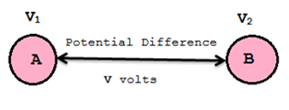
- Electric Circuits: Electric potential difference (voltage) drives current through circuits.
- Capacitors: Devices that store electrical energy by accumulating charges at different potentials.
- Electrostatics: Electric potential calculates forces and energy in electrostatic systems.
- Batteries: Batteries create a potential difference that powers electrical devices.
Applications:
- Circuits: Voltage drives the flow of electric current.
- Capacitors: Stores energy via potential difference.
- Electrostatics: Used to calculate forces in static charge systems.
- Batteries: Provides energy through potential difference.